A Study in Limitation of Lon L. Fuller’s Natural Law Philosophy through Scientific Endeavors on Humans Depicted in Poor Things
Keywords:
Poor Things, Scientific Experiments on Humans, Scientific Endeavors on Humans, Two Moralities, The Principle of Consent, The Principle of CollaborationAbstract
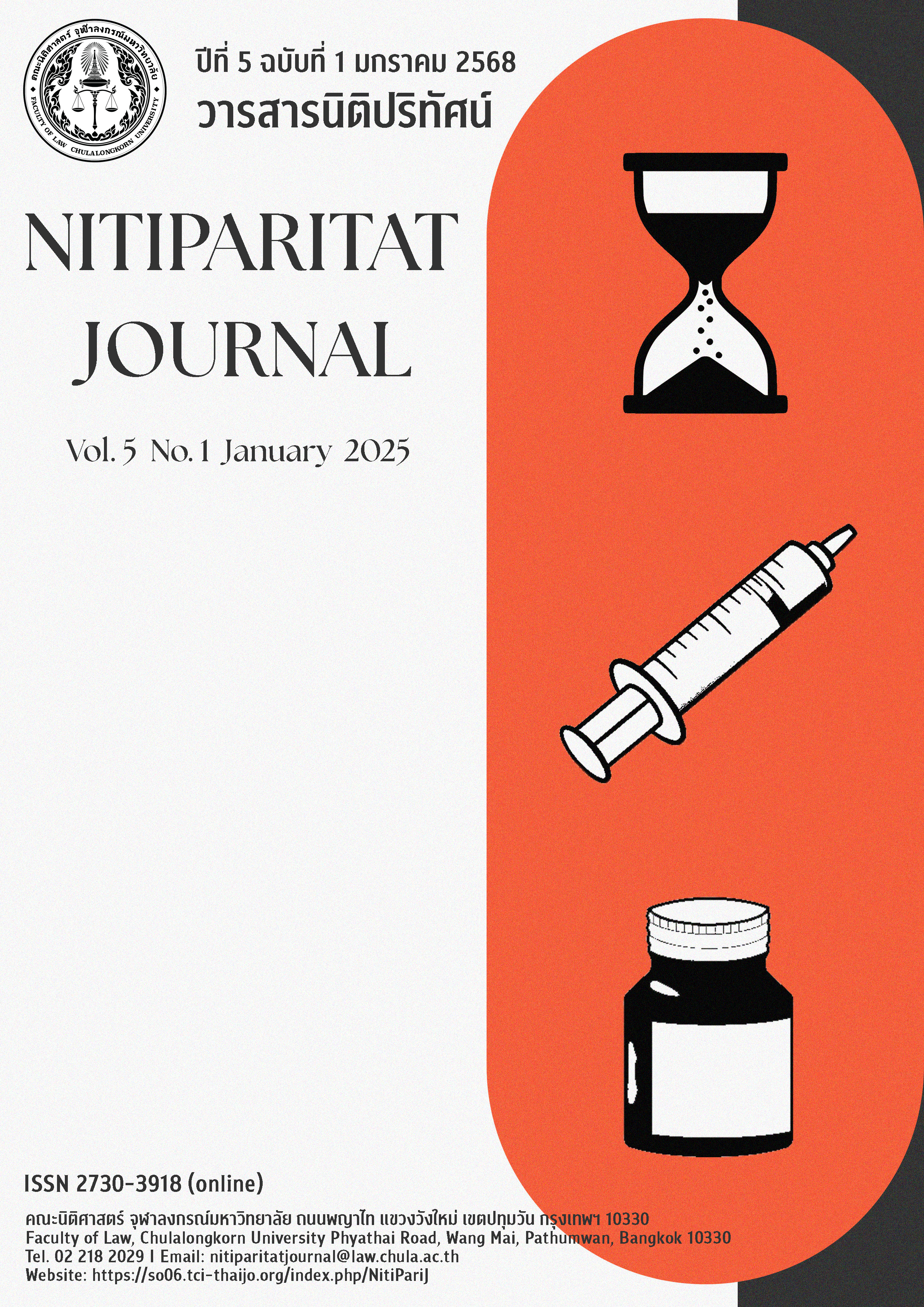
“Poor Things” is a movie that portrays a reincarnation-like revival of a deceased woman who was subjected to scientific experiment by transplanting the brain of her unborn fetus into her own skull, leading to the profound incompatibility between her body and consciousness. Additionally, the film features other experiments in which the father conducted scientific endeavors on his child, as well as one character using it as a mean of vengeance.
Hence to analyze the scientific acts conducted in this film, this study employs Lon L. Fuller’s philosophy, a contemporary natural law theory, to answer the justification, legality through Two Moralities, Internal Morality, and The Principle of Consent as well as The Principle of Collaboration, and whether it is plausible to conduct such experiments in reality. This study aims to demonstrate that Lon L. Fuller’s ideology is inadequate to address the correlation of his doctrine when used to apply the scientific endeavors depicted in “Poor Things.”
References
จรัญ โฆษณานันท์, นิติปรัชญา (กรุงเทพมหานคร: อ่านกฎหมาย, 2564).
สมยศ เชื้อไทย, นิติปรัชญาเบื้องต้น (กรุงเทพมหานคร: วิญญูชน, 2567).
Diksha Madhock, ‘Elon Musk says his Neuralink startup has implanted a chip in its first human brian’ (CNN, 30 January 2024) <https://edition.cnn.com/2024/01/30/business/elon-musk-brain-implant-neuralink-intl-hnk/index.html#:~:text=Elon%20Musk%20says%20his%20Neuralink,in%20its%20first%20human%20brain&text=The%20first> accessed 13 July 2024.
Douglas Sturm, ‘Lon Fuller’s Multidimensional Natural Law Theory’ (1966) 18 Stan L. Rev. 612.
Dulce Gonzalez, Arian Bethencourt Mirabal, and Janelle D. McCall, ‘Child Abuse and Neglect’ (National Library of Medicine, 4 July 2023) <https://www.ncbi.nlm.nih.gov/books/NBK459146/> accessed 23 May 2024.
Edwin W. Tucker, ‘The Morality of Law, by Lon L. Fuller’ (1965) 40(2) Ind. L. J. 276.
Han Kelsen, Introduction to Problems of Legal Theory (New York: Clarendon Press 1992).
Kayla Tricaso, ‘Understanding Grooming in Adult Relationships’ (Modern Intimacy, 28 January 2021) <https://www.modernintimacy.com/understanding-grooming-in-adult-relationships/> accessed 24 May 2024.
Lon L. Fuller, The Morality of Law (Connecticut: Yale University Press, rev edn).
Michelle Chesson, ‘Power dynamics in the Family: Are They Natural?’ (Medium, 13 June 2023) <https://medium.com/@michelledaceynewman/power-dynamics-in-the-family-are-they-natural-e3899c2a41fb> accessed 23 May 2024.
Robin West, ‘ON RAPE, COERCION AND CONSENT’ (Jurisprudence JOTWELL, 15 March 2016) <https://juris.jotwell.com/on-rape-coercion-and-consent/> accessed 24 May 2024.
World Health Organization, ‘Sexual Exploitation and Abuse: Prevent and Protect; What you need to know and do’ (World Health Organization Ethics) <https://www.who.int/docs/default-source/documents/ethics/sexual-exploitation-and-abuse-pamphlet-en.pdf> accessed 23 May 2024.
Downloads
Published
How to Cite
Issue
Section
License
Copyright (c) 2025 ชนิกานต์ เศรษฐวัส, ณิชาภัทร สมอุดร, พิรัชย์ สามิตสมบัติ, วรินทิรา ธเนศานนท์, วัฒน์วดี เสถียรพานิช

This work is licensed under a Creative Commons Attribution-NonCommercial-NoDerivatives 4.0 International License.
The manuscript is original, does not contain plagiarism, and does not infringe any copyright.

