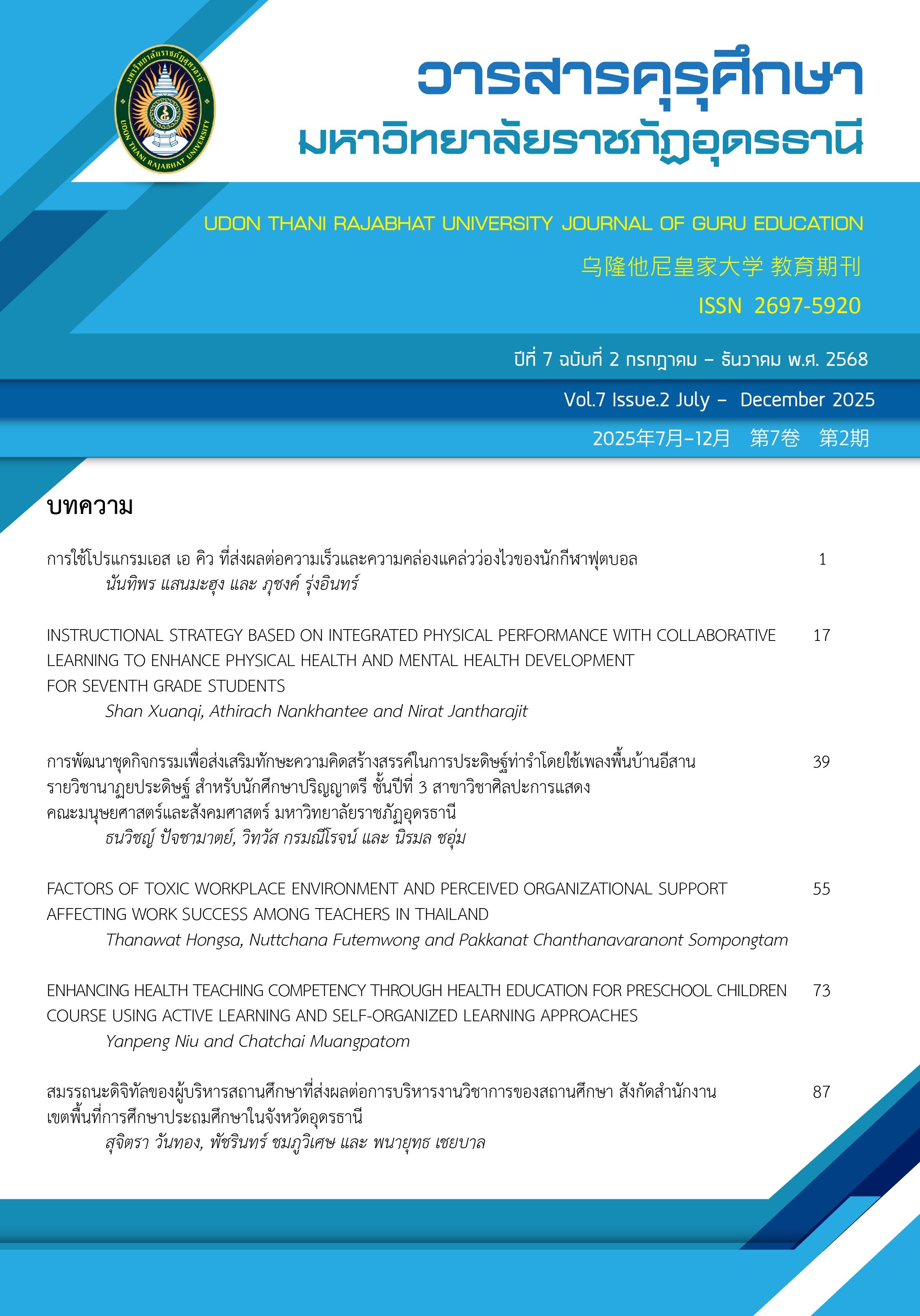
การใช้โปรแกรมเอส เอ คิว ที่ส่งผลต่อความเร็วและความคล่องแคล่วว่องไว ของนักกีฬาฟุตบอล
Article Sidebar
Main Article Content
บทคัดย่อ
การวิจัยกึ่งทดลองครั้งนี้มีวัตถุประสงค์เพื่อศึกษาผลของโปรแกรมการฝึกแบบเอส เอ คิว (S.A.Q. Training Program) ที่มีต่อความเร็วและความคล่องแคล่วว่องไวของนักกีฬาฟุตบอลระดับชั้นมัธยมศึกษาตอนต้น โรงเรียนบ้านหนองลาด (ราษฎร์อุทิศวิทยาคม) กลุ่มตัวอย่างในการวิจัยครั้งนี้คือ นักกีฬาฟุตบอลชาย จำนวน 28 คน ที่ได้มาจากการสุ่มอย่างง่ายจากประชากรทั้งหมด 30 คน แบ่งเป็นกลุ่มทดลองและกลุ่มควบคุม กลุ่มละ 14 คน โดยใช้วิธี การจับคู่ตามผลการทดสอบก่อนการฝึก กลุ่มทดลองได้รับการฝึกตามโปรแกรมเอส เอ คิว ซึ่งออกแบบตามแนวคิดของเฮล เป็นระยะเวลา 8 สัปดาห์ สัปดาห์ละ 3 วัน วันละ 90 นาที ส่วนกลุ่มควบคุมได้รับการฝึกตามโปรแกรมฟุตบอลปกติ เครื่องมือที่ใช้ในการเก็บข้อมูล ได้แก่ แบบทดสอบความเร็วระยะทาง 40 เมตร และแบบทดสอบความคล่องแคล่วว่องไวของอิลลินอยส์ วิเคราะห์ข้อมูลด้วยค่าเฉลี่ย ส่วนเบี่ยงเบนมาตรฐาน และการทดสอบค่าที (t-test) ผลการวิจัยพบว่า หลังการฝึก 4 สัปดาห์ และ 8 สัปดาห์ กลุ่มทดลองมีความเร็วและความคล่องแคล่วว่องไวสูงกว่ากลุ่มควบคุมอย่างมีนัยสำคัญทางสถิติที่ระดับ .05 และเมื่อเปรียบเทียบภายในกลุ่มทดลองก่อนและหลังการฝึก พบว่า หลังการฝึกมีความเร็วและความคล่องแคล่วว่องไวสูงกว่าก่อนการฝึกอย่างมีนัยสำคัญที่ระดับ .05 เช่นกัน สรุปได้ว่า โปรแกรมการฝึกแบบเอส เอ คิว มีประสิทธิภาพในการพัฒนาความเร็วและความคล่องแคล่วว่องไวของนักกีฬาฟุตบอลระดับมัธยมศึกษา อย่างมีนัยสำคัญ จึงมีความเหมาะสมที่จะนำไปประยุกต์ใช้ในการพัฒนาสมรรถภาพทางกายของนักกีฬาประเภทอื่น ๆ ในสถานศึกษาได้อย่างมีประสิทธิภาพ
Article Details
ข้อความที่ปรากฏในบทความแต่ละเรื่องในวารสารวิชาการเล่มนี้ ไม่ใช่ความคิดเห็นและความรับผิดชอบของคณะผู้จัดทำ บรรณาธิการ กองบรรณาธิการ และมหาวิทยาลัยราชภัฏอุดรธานี ซึ่งความรับผิดชอบด้านเนื้อหาและการตรวจร่างบทความแต่ละเรื่องเป็นของผู้เขียนแต่ละท่าน
เอกสารอ้างอิง
เจริญ กระบวนรัตน์. (2561). วิทยาศาสตร์การฝึกสอนกีฬา. ครั้งที่ 2. กรุงเทพฯ: บริษัท สินธนาก๊อปปี้เซ็นเตอร์ จำกัด.
Bloomfield, J., et al. (2007). Effective speed and agility conditioning methodology forrandom intermittent dynamic type sports. Journal of Strength and Conditioning Research, 21(4), 1093-1100.
Chaouachi, A., et al. (2014). Effects of speed, agility, and plyometric training on physical performance of young soccer players. Journal of Strength and Conditioning Research, 28(11), 330–337.
Hale, D. (2004). SAQ training for sports performance. London: SAQ International.
Hammami, M., et al. (2016). Effects of combined strength and agility training on physical performance in youth soccer players. Journal of Strength and Conditioning Research, 30(8), 2300–2311.
Jeffreys, I. (2013). Developing speed National strength and conditioning association. Champaign IL: Human kinetics.
Krejcie, R. V. & Morgan, D. W. (1970). Determining Sample Size for Research Activities. Educational and Psychological Measurement, 30, 607-610.
Lloyd, R. S., et al. (2015). Neuromuscular training and athletic performance in youth. Strength and Conditioning Journal, 37(3), 1–14.
Miller, M. G., et al. (2006). The effects of a 6-week plyometric training program on agility. Journal of Sports Science & Medicine, 5(3), 459–465.
Oliver, J. L., et al. (2018). Developing speed throughout childhood and adolescence. Strength and Conditioning Journal, 35(3), 42–48.
Rajković, M., et al. (2014). Effective of speed, agility and quickness training on performance in young soccer players. International Journal of Physical Education Fitness and Sports, 3(4), 5-10.
Robert, R. J. (2010). Physical fitness testing and evaluation. Human Kinetics.
Sheppard, J. M., & Young, W. B. (2006). Agility literature review: Classifications, training and testing. Journal of Sports Sciences, 24(9), 919–932.
Young, W. B., McDowell, M. H., & Scarlett, B. J. (2002). Specificity of sprint and agility training methods. Strength and Conditioning Journal, 24(1), 24–29.
