
E-INCLUSION FOR SPECIAL NEED STUDENTS
Article Sidebar
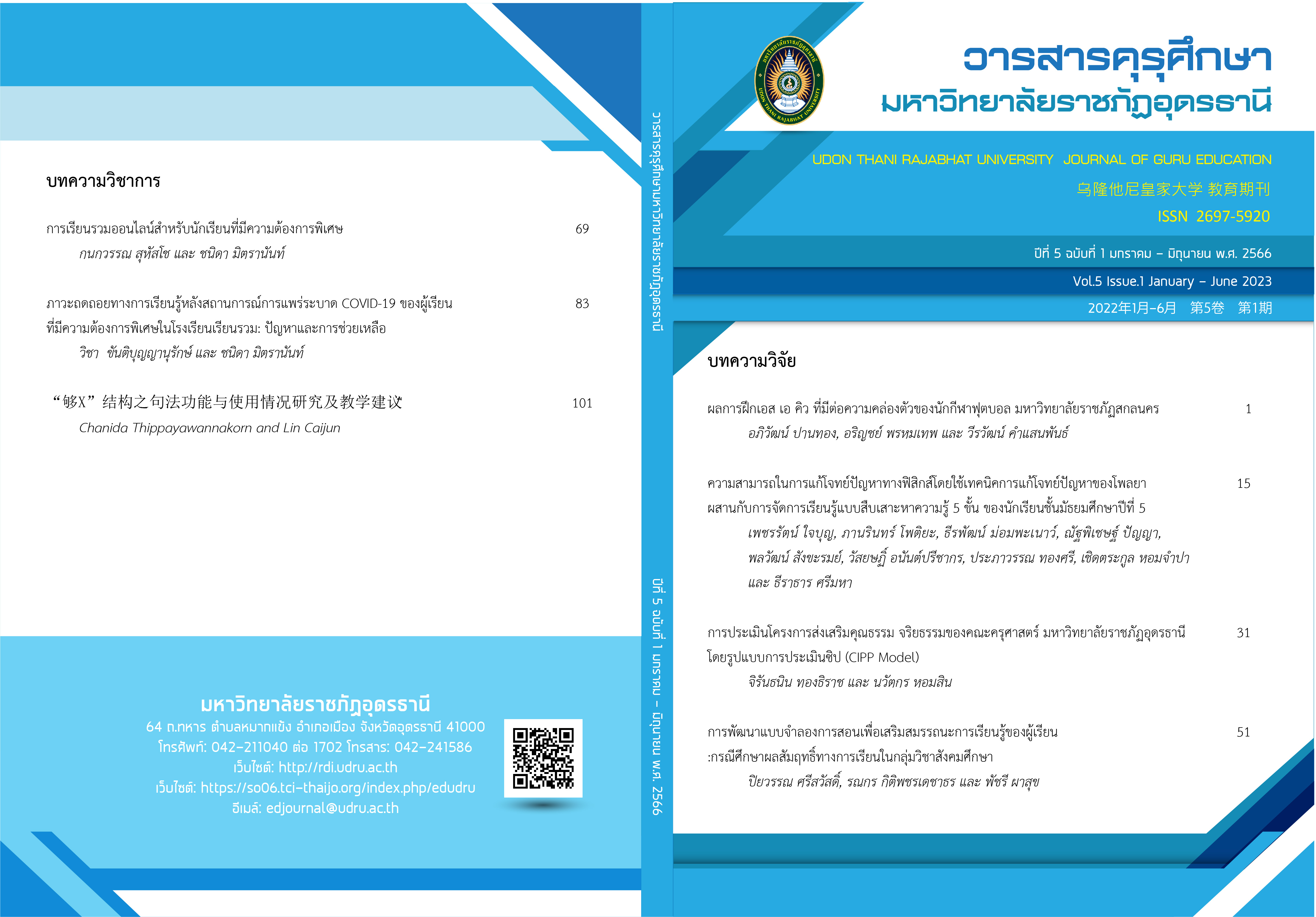
Main Article Content
Abstract
After the global outbreak of COVID-19, schools have necessitated to adjust their teaching and learning style from the traditional classroom-based teaching and learning to online education. Studies conducted in various countries have highlighted the essential factors that educators need to consider when designing online learning formats. These factors include information technology, teaching techniques, teacher involvement, and family relationships, in descending order of importance. Additionally, in the context of online education, instructors must also prioritize equal opportunities, diversity, acceptance of differences, mutual respect, and the learning environment to ensure that children with special needs had equitable access to education similar to their general children.
Article Details
ข้อความที่ปรากฏในบทความแต่ละเรื่องในวารสารวิชาการเล่มนี้ ไม่ใช่ความคิดเห็นและความรับผิดชอบของคณะผู้จัดทำ บรรณาธิการ กองบรรณาธิการ และมหาวิทยาลัยราชภัฏอุดรธานี ซึ่งความรับผิดชอบด้านเนื้อหาและการตรวจร่างบทความแต่ละเรื่องเป็นของผู้เขียนแต่ละท่าน
References
กองบรรณาธิการ, T. W. (2565). ‘โรคใหม่’ สร้าง ‘โลกแห่งการเรียนรู้ใหม่’ : อนาคตการศึกษาไทยยุคหลัง COVID-19 สืบค้นเมื่อ 3 ธันวาคม 2565, จาก https://www.eef.or.th/future-of-thai-education-after-covid19/
กิ่งเพชร ส่งเสริม, และ ผดุง อารยะวิญญู (2010). การพัฒนารูปแบบการจัดการเรียนรวม แบบคละชั้นที่มีเด็กที่มีความต้องการพิเศษในโรงเรียนประถมศึกษา
(A DEVELOPMENT OF MULTILEVEL INCLUSIVE EDUCATION FOR STUDENTS WITH SPECIAL NEEDS IN PRIMARY SCHOOLS). Journal of Srinakharinwirot Research and Development (Journal of Humanities and Social Sciences), 2(4), 34-46.
ณัฐฐา นพเก้า, สุทธิพงศ์ บุญ, และ ผดุง อารยะวิญญู (2022). การบริหารจัดการศึกษา สำหรับเด็กที่มีความต้องการพิเศษในโรงเรียนเรียนรวม. รายงานการประชุม Graduate School Conference,
วาทินี อมรไพศาลเลิศ. (2563). เทคนิคการสอนออนไลน์ช่วงโควิด-19 สําหรับนักเรียนที่มีความต้องการพิเศษ. สืบค้นเมื่อ 3 ธันวาคม 2565, จากhttps://www.chula.ac.th/news/31541/
ผดุง อารยะวิญญู. (2532). การเรียนร่วมระหว่างเด็กปกติกับเด็กที่มีความต้องการพิเศษ. กรุงเทพฯ: รำไพเพรสการพิมพ์.
Anne Meyer, D. H. R., and David Gordon. (2014). Universal design for learning: Theory and practice. MA:CAST Professional Publishing.
Asbury, K., Fox, L., Deniz, E., Code, A., & Toseeb, U. (2021). How is COVID-19 Affecting the Mental Health of Children with Special Educational Needs and Disabilities and Their Families?. Journal of Autism and Developmental Disorders, 51(5), 1772-1780, from https://doi.org/ 10.1007/s10803-020-04577-2
Azoulay, U. (2020, November 11). Global Education Coalition. UNESCO., from https://en.unesco.org/covid19/educationre sponse/globalcoalition
Hardy, I., & Woodcock, S. (2015). Inclusive education policies: discourses of difference, diversity and deficit. International Journal of Inclusive Education, 19(2), 141-164, from https://doi.org/10.1080/ 13603116.2014.908965
Kaewponthong, S., & Yeamsoontron, P. (2021). กระบวนการการจัดการเรียน การสอนออนไลน์ในช่วงวิกฤติ Covid-19 ของสถาบันการศึกษาระดับ อุดมศึกษาในจังหวัดจันทบุรี. Journal of Graduate MCU KhonKaen Campus, 8(3), 163-176.
Mseleku, Z. (2020). A literature review of E-learning and E-teaching in the era of Covid-19 pandemic. International Journal of Innovative Science and Research Technology, 5(10), 588-597.
Parmigiani, D., Benigno, V., Giusto, M., Silvaggio, C., & Sperandio, S. (2021). E-inclusion: online special education in Italy during the Covid-19 pandemic. Technology, pedagogy and education, 30(1), 111-124.
Saithong, C. (2017). แนวโน้มการจัดการเรียนรู้ห้องเรียนกลับด้านในศตวรรษที่ 21 Learning Management Trends Of Flipped Classroom In 21st Century. วารสารวิทยาลัยสงฆ์นครลำปาง, 4(1).
Smith, S., Burdette, P., Cheatham, G., & Harvey, S. (2016). Parental role and support for online learning for students with disabilities: A paradigm shift. Journal of Special Education Leadership, 92(2), 101-112. 29, 101-112.
Wilkie, K., & Jones, A. (2010). School ties: Keeping students with chronic illness connected to their school learning communities.In New Developments in ICT and Education, Amiens:France.
