
THE EVALUATION OF THE ETHICS PROMOTION PROJECT OF THE FACULTY OF EDUCATION, UDON THANI RAJABHAT UNIVERSITY, USING CIPP MODEL.
Article Sidebar
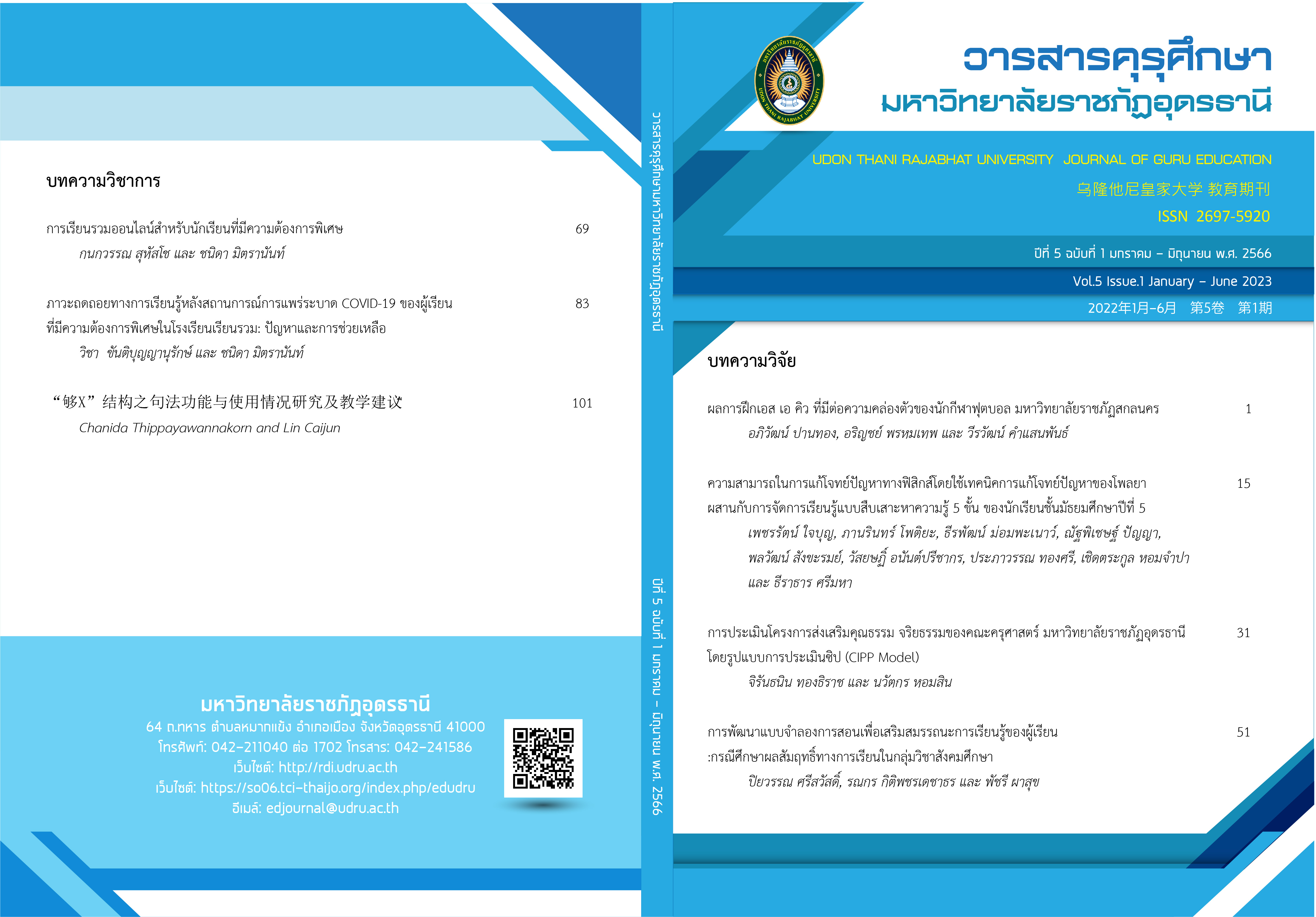
Main Article Content
Abstract
This research aimed to evaluate the Ethics Promotion Project of the Faculty of Education, Udon Thani Rajabhat University, utilizing the CIPP Model. The sample group consisted of 70 first-year students, including 24 students from the Early Childhood Education Program (Classroom 1), 24 students from the Early Childhood Education Program (Classroom 2), and 22 students from the Music Education Program. The sample group was selected using a simple-random sampling method. The research instrument was a 5-Likert-scale questionnaire was employed, demonstrating a reliability score of 0.89. The data was analyzed by using descriptive statistics including frequency, percentage, mean, and standard deviation.
The evaluation findings, based on the opinions of the 70 first-year students, revealed various aspects of the Ethics Promotion Project at the Faculty of Education, Udon Thani Rajabhat University, using the CIPP Model. In terms of the project's context, there was the highest level of the alignment between principles and reasons of the project and the policies of the affiliated organizations, the activities helping students develop ethical and moral values, and the appropriateness and necessity for problem-solving. Regarding the input factors, there was the highest level of personnel possessing the necessary knowledge and understanding for project implementation, suitable facilities, and venues for project activities. For the process, there was the highest level of effectiveness of communication, supervision, monitoring and control, the systematicity of evaluation process, and a variety of methods for providing knowledge (i.e., meetings, briefings, communication, and publicity). For the moral and ethical values of the university students, there was the highest level of moral consciousness, patriotism, religious beliefs, loyalty to the monarchy, sustainable living, peaceful co-existence, compassion, altruism, self-sacrifice, and social responsibility.
Article Details
ข้อความที่ปรากฏในบทความแต่ละเรื่องในวารสารวิชาการเล่มนี้ ไม่ใช่ความคิดเห็นและความรับผิดชอบของคณะผู้จัดทำ บรรณาธิการ กองบรรณาธิการ และมหาวิทยาลัยราชภัฏอุดรธานี ซึ่งความรับผิดชอบด้านเนื้อหาและการตรวจร่างบทความแต่ละเรื่องเป็นของผู้เขียนแต่ละท่าน
References
ดวงเดือน พันธุมนาวิน. (2543). ทฤษฎีต้นไม้จริยธรรมการวิจัยและการพัฒนาบุคคล. พิมพ์ครั้งที่3. กรุงเทพฯ: สำนักพิมพ์แห่งจุฬาลงกรณ์มหาวิทยาลัย.
นิภา กู้พงษ์ศักดิ์. (2565). การเสริมสร้างคุณลักษณะบัณฑิตที่พึงประสงค์ผ่านโครงการจิตอาสา. วารสารสถาบันวัฒนธรรมและศิลปะ มหาวิทยาลัยศรีนครินทรวิโรฒ, 14(1), 41-47.
บุญชม ศรีสะอาด. (2553). วิธีการทางสถิติสำหรับการวิจัย. พิมพ์ครั้งที่ 4. กรุงเทพฯ: สุวีริยาสาส์น.
เพ็ญแข ประจนปัจจนึก. (2551). การยกระดับคุณธรรม จริยธรรมของสังคมไทยเพื่อการปฏิรูปสังคม : แนวทางและการปฏิบัติ. กรุงเทพฯ: สำนักงานสภาที่ปรึกษาเศรษฐกิจและสังคมแห่งชาติ.
รมิตา สีมาพล. (2564). รายงานการประเมินโครงการ โรงเรียนคุณธรรม โดยใช้รูปแบบ CIPPIEST Model และ บทคัดย่อรูปแบบการพัฒนาคุณภาพผู้เรียนด้านผลสัมฤทธิ์ทางการเรียนระดับชาติ 4T Model. สืบค้นเมี่อ 5 เมษายน 2566 จาก https://www.korat2.go.th/?p=2051
รัตนะ บัวสนธ์. (2556). รูปแบบการประเมิน CIPP และ CIPIEST มโนทัศน์ที่คลาดเคลื่อนและถูกต้อง. วารสารศิลปากรศึกษาศาสตร์วิจัย, 5(2), 7-24.
สำนักงานคณะกรรมการการศึกษาแห่งชาติ. (2545). พระราชบัญญัติการศึกษาแห่งชาติ พ.ศ. 2542 และที่แก้ไขเพิ่มเติม (ฉบับที่ 2) พ.ศ. 2545. กรุงเทพฯ: พริกหวานกราฟฟิค.
สำนักงานคณะกรรมการพัฒนาเศรษฐกิจและสังคมแห่งชาติ. (2550). แผนพัฒนาเศรษฐกิจและสังคมแห่งชาติฉบับที่ 10 (พ.ศ. 2550-2554). กรุงเทพฯ: คุรุสภาลาดพร้าว.
สำนักงานเลขาธิการสภาการศึกษา. (2550). การประชุมทางวิชาการ การวิจัยทางการศึกษาระดับชาติ ครั้งที่ 12. นนทบุรี: โรงพิมพ์และทำปกเจริญผล.
สำนักส่งเสริมวิชาการและงานทะเบียน มหาวิทยาลัยราชภัฏอุดรธานี. (2565). ข้อกำหนดด้านพฤติกรรม คุณธรรม จริยธรรมของนักศึกษา. ใน คู่มือนักศึกษา มหาวิทยาลัยราชภัฏอุดรธานี ระดับปริญญาตรี ปีการศึกษา 2565. อุดรธานี: มหาวิทยาลัยราชภัฏอุดรธานี.
สุทัศน์พงษ์ กุลบุตร. (2550). การปลูกฝังคุณธรรม จริยธรรมให้แก่นักศึกษา. ศูนย์ศิลปวัฒนธรรม มหาวิทยาลัยศรีปทุม.
อัจฉรา ไชยูปถัมภ์. (2561). การพัฒนาตัวบ่งชี้คุณธรรมจริยธรรมและแนวทางปฏิบัติเพื่อเสริมสร้างความเป็นบัณฑิต ที่พึงประสงค์ของสถาบันอุดมศึกษาในเครือข่ายสถาบันอุดมศึกษาเขตภาคกลาง. วารสารครุศาสตร์จุฬาลงกรณ์มหาวิทยาลัย, 46(3), 268-286.
Kohlberg, L. (2000). The psychology of moral development, Volume II. San Francisco: Harper & Row.
Krejcie, Robert V., & Morgan, Daryle W. (1970). Determining sample size for research activities. Education and Psychological Management, 30(3), 608.
Piaget, J. (1969). The psychology of the child. New York: Basic Book.
Stufflebeam, D. L., & Shinkfield, A. J. (2007). Evaluation theory, models and applications. San Francisco, CA: Jossey-Bass.
