
The Development of Indicators on Learning Leadership of School Administrators under the Secondary Educational Service Area Office in the North of Thailand
Article Sidebar
Main Article Content
Abstract
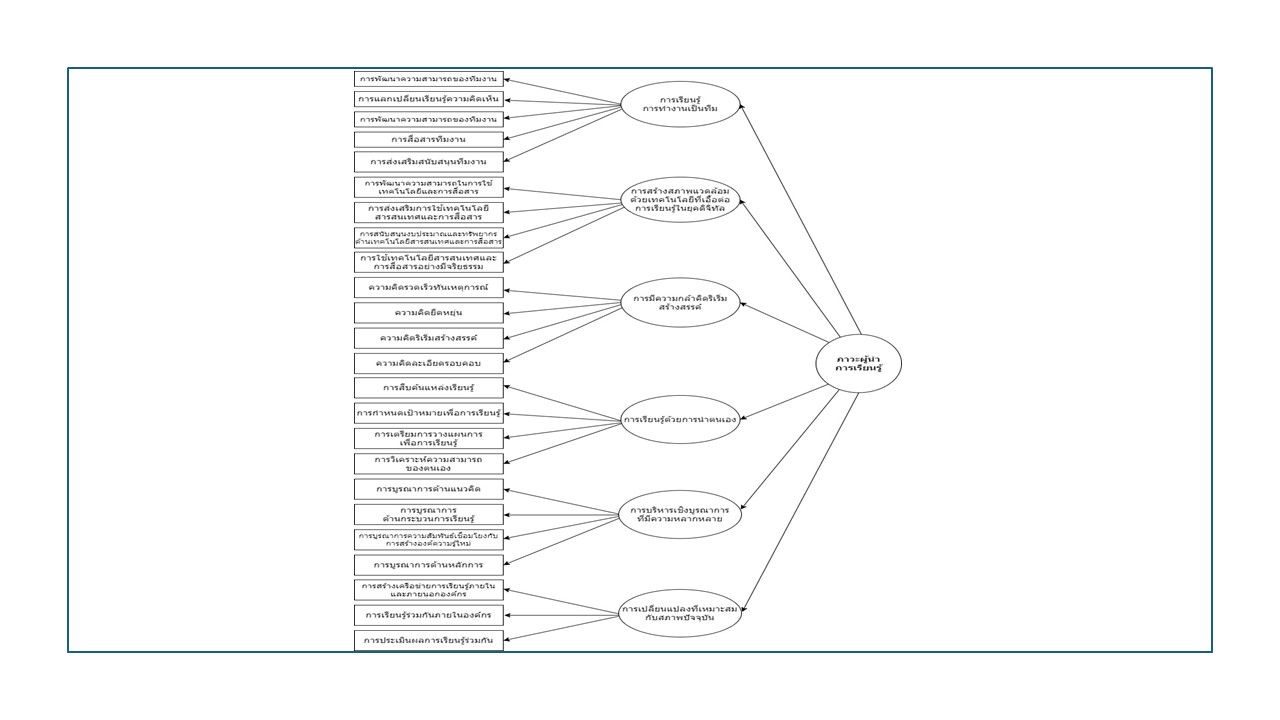
This research aimed to construct and develop indicators of learning leadership characteristics for school administrators under the Secondary Educational Service Area Offices in the North of Thailand, and to test the congruence of the structural model of learning leadership characteristics with empirical data. The sample comprised 210 school administrators under the Secondary Educational Service Area Offices in the North, selected through multi-stage sampling. The research instrument was a five-point rating scale questionnaire. Data were analyzed using statistical software for descriptive statistics, confirmatory factor analysis (CFA), and second-order confirmatory factor analysis to test the congruence of the structural model with empirical data. This descriptive research employed a learning leadership characteristics questionnaire for data collection. Basic statistics and second-order confirmatory factor analysis were used for data analysis. The results revealed six components of learning leadership characteristics: 1) creative initiative, 2) self-directed learning, 3) team learning, 4) diverse integrative management, 5) creating a technology-enhanced learning environment for the digital era, and 6) appropriate change for current conditions. Team learning exhibited the highest level of learning leadership characteristics, followed by creating a technology-enhanced learning environment for the digital era, and creative initiative, respectively. The confirmatory factor analysis showed that the model was congruent with empirical data, with a Goodness of Fit Index (GFI) of 0.97 and an Adjusted Goodness of Fit Index (AGFI) of 0.95. The factor loadings, ranked from highest to lowest, were team learning, creating a technology-enhanced learning environment for the digital era, and creative initiative, respectively.
Article Details

This work is licensed under a Creative Commons Attribution-NonCommercial-NoDerivatives 4.0 International License.
เนื้อหาและข้อมูลในบทความที่ลงตีพิมพ์ในวารสารศูนย์ดัชนีการอ้างอิงวารสารไทย ถือเป็นข้อคิดเห็นและความรับผิดชอบของผู้เขียนบทความโดยตรงซึ่งกองบรรณาธิการวารสาร ไม่จำเป็นต้องเห็นด้วย หรือร่วมรับผิดชอบใด ๆ
บทความ ข้อมูล เนื้อหา รูปภาพ ฯลฯ ที่ได้รับการตีพิมพ์ในวารสารศูนย์ดัชนีการอ้างอิงวารสารไทย ถือเป็นลิขสิทธิ์ของวารสารศูนย์ดัชนีการอ้างอิงวารสารไทย หากบุคคลหรือหน่วยงานใดต้องการนำทั้งหมดหรือส่วนหนึ่งส่วนใดไปเผยแพร่ต่อหรือเพื่อกระทำการใด จะต้องได้รับอนุญาตเป็นลายลักอักษรจากวารสารศูนย์ดัชนีการอ้างอิงวารสารไทยก่อนเท่านั้น
References
กนกอร สมปราชญ์. (2557). ภาวะผู้นำโรงเรียนและการพัฒนาตนเองสำหรับผู้บริหารสถานศึกษา. ขอนแก่น: คลังนานาวิทยา.
ฐิตินันท์ นันทะศรี. (2563), การพัฒนาตัวบ่งชี้ภาวะผู้นำเชิงนวัตกรรมของผู้บริหารสถานศึกษาในภาค
ตะวันออกเฉียงเหนือ. ปริญญาปรัชญาดุษฎีบัณฑิต, มหาวิทยาลัยราชภัฏสกลนคร.
บุญชม ศรีสะอาด. (2554). การวิจัยเบื้องต้น. (พิมพ์ครั้งที่ 9) กรุงเทพฯ: สุวีริยาสาส์น จำกัด
รัตติกรณ์ จงวิศาล. (2545). ภาวะผู้นำการเปลี่ยนแปลงสภาพในยุคแห่งการเปลี่ยนแปลง. วารสารการบริหารคน, 23(1), 98-102.
นงลักษณ์ วิรัชชัย. (2555). การวิเคราะห์องค์ประกอบเชิงยืนยัน. วารสารวิจัยและพัฒนาหลักสูตร, 2(1), 68-74.
วิโรจน์ สารรัตนะ, (2557). ภาวะผู้นำ: ทฤษฎีและนานาทัศนะร่วมสมัยปัจจุบัน. กรุงเทพมหานคร: ทิพยวิสุทธิ์.
สุเทพ พงศ์ศรีวัฒน์. (2554). ภาวะผู้นำ: ทฤษฎีและการปฏิบัติ. เชียงราย: สถาบันราชภัฏเชียงราย.
สุดสวาสดิ์ ประไพเพชร. (2551). การพัฒนาตัวบ่งชี้การบริหารเชิงบูรณาการของผู้บริหารสถานศึกษาขั้นพื้นฐาน สังกัด
กระทรวงศึกษาธิการ. ปริญญาศึกษาศาสตรดุษฎีบัณฑิต, มหาวิทยาลัยขอนแก่น
สัมฤทธิ์ กางเพ็ง. (2557). ภาวะผู้นำเชิงพุทธ. (พิมพ์ครั้งที่ 2). มหาสารคาม: อภิชาติการพิมพ์.
สมชาย เทพแสง. (2557). การบริหารจัดการ สมัยใหม: กุญแจสูความเปนเลิศ. นนทบุรี: เกรท เอ็ดดูเคชั่น.
อภิญญารัศมิ์ ประราศี. (2561). การพัฒนาโปรแกรมเสริมสร้างภาวะผู้นำการเรียนรู้ของผู้บริหารโรงเรียน สังกัดสำนักงาน
เขตพื้นที่การศึกษามัธยมศึกษา. ปริญญาปรัชญาดุษฎีบัณฑิต, มหาวิทยาลัยมหาสารคาม.
Antonacopoulou, E.P. & Bento, R.F. (2003). Methods of Learning Leadership: Taught and Experiential.
file:///C:/Users/Administrator/Downloads/Chapter5- FINAL.pdf
Bass, B. M., & Avolio, B. J. (1994). Improving organizational effectiveness through transformational leadership. Thousand Oaks, CA: Sage Publications.
Cronbach, L. J. (1990). Essentials of psychological testing (5th ed.). New York: Harper Collins Publishers.
Curtis, T. A. (2012). Leading and learning: Leadership, change, and challenge in a professional development initiative (Order No. 3504009). Available from ProQuest Dissertations & Theses Global. (1010625210). Retrieved from http://search.proquest.com/docview/1010625210?accountid=44809
Knight, J. (2009). Coaching: The key to translating research into practice lies in continuous, job-embedded learning with ongoing support. National Staff Development Council, 30(1), 18-22.
Malunga (CADECO) (2006). Learning Leadership Development from African Cultures: A Personal Perspective Chiku. International NGO Training and Research Centre.
Marquardt,M.J. (1996). Building the learning organization: A systems approach to Quantum improvement and global success. New York: McGraw-Hill.
Pietersen, W. (2010). Strategic Learning: How to be smarter than your competition and turn to insights into competitive advantage. Hobogen, NJ: John Wiley & Sons.
