
Needs Assessment for Digital Leadership Development of School Administrators, The Office of Samut Sakhon Primary Education Service Area Office
Article Sidebar
Main Article Content
Abstract
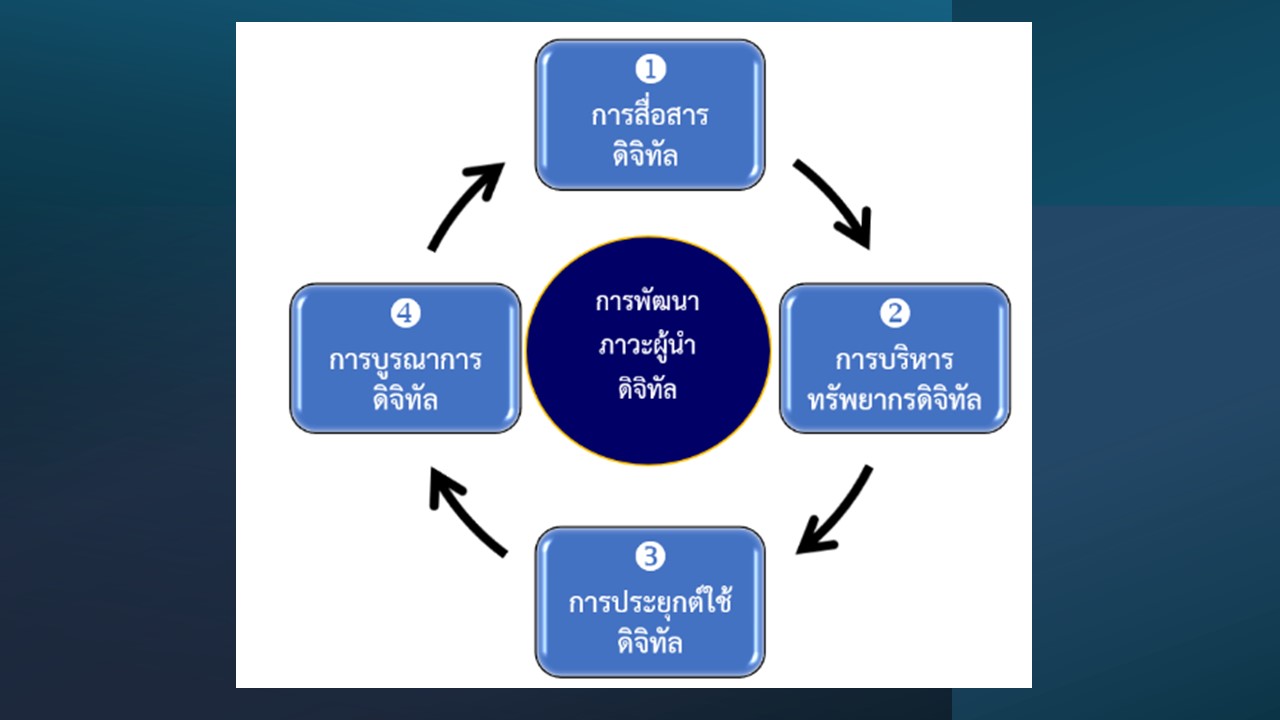
The purpose of this research was: 1) to study and compare the current state and desired state of digital leadership among school administrators in the Secondary Education Service Area Office of Samut Sakhon, and 2) to study the need for developing digital leadership among these school administrators. The sample included 328 participants, comprising school administrators and teachers from secondary schools for the academic year 2023 within the Secondary Education Service Area Office of Samut Sakhon. Data were collected using a questionnaire, and analysis was performed using basic statistics, the t-test for dependent samples, and the Priority Need Index (PNImodified). The research findings indicate that: 1. The current state of digital leadership among school administrators in the Secondary Education Service Area Office of Samut Sakhon is rated at a moderate level, while the desired state is rated at a high level. 2. The urgent requirements for developing digital leadership among school administrators in this region are classified as urgent overall (PNImodified = 0.34). These needs are ranked as follows: digital communication (PNImodified = 0.41), digital resource management (PNImodified = 0.35), digital application (PNImodified = 0.30), and digital integration (PNImodified = 0.29).
Article Details

This work is licensed under a Creative Commons Attribution-NonCommercial-NoDerivatives 4.0 International License.
เนื้อหาและข้อมูลในบทความที่ลงตีพิมพ์ในวารสารศูนย์ดัชนีการอ้างอิงวารสารไทย ถือเป็นข้อคิดเห็นและความรับผิดชอบของผู้เขียนบทความโดยตรงซึ่งกองบรรณาธิการวารสาร ไม่จำเป็นต้องเห็นด้วย หรือร่วมรับผิดชอบใด ๆ
บทความ ข้อมูล เนื้อหา รูปภาพ ฯลฯ ที่ได้รับการตีพิมพ์ในวารสารศูนย์ดัชนีการอ้างอิงวารสารไทย ถือเป็นลิขสิทธิ์ของวารสารศูนย์ดัชนีการอ้างอิงวารสารไทย หากบุคคลหรือหน่วยงานใดต้องการนำทั้งหมดหรือส่วนหนึ่งส่วนใดไปเผยแพร่ต่อหรือเพื่อกระทำการใด จะต้องได้รับอนุญาตเป็นลายลักอักษรจากวารสารศูนย์ดัชนีการอ้างอิงวารสารไทยก่อนเท่านั้น
References
กระทรวงดิจิทัลเพื่อเศรษฐกิจและสังคม. (2567). แผนปฏิบัติการ สำนักงานส่งเสริมเศรษฐกิจดิจิทัล ประจำปีงบประมาณ พ.ศ. 2564. chrome-extension://efaidnbmnnnibpcajpcglclefindmkaj/https://www.depa.or.th/storage/app/media/file/annual-operation-plan-2564.pdf
กะรัต ทองใสพร, กิติมา ศรีขำ, เขมรัตน์ บุญสุข, และมัทนา วังถนอมศักด. (2566). ภาวะผู้นำของผู้บริหารสถานศึกษาในยุคดิจิทัล. วารสารวิชาการสถาบันพัฒนาพระวิทยากร. 6(2), 162-270.
บุญชม ศรีสะอาด. (2545). การวิจัยเบื้องต้น. (พิมพ์ครั้งที่ 7). กรุงเทพฯ: สุวีริยาสาส์น.
พัชราภรณ์ ดวงชื่น. (2567). ผู้นำองค์กรในโลก VUCA. วารสารมหาวิทยาลัยคริสเตียน, 24(3), 450-458.
เยาวลักษณ์ จิตต์วโรดม. (2560). บทบาทและทักษะหลักของภาวะผู้นาในสังคมยุคดิจิทัล Role and Key Skills of Digital Society Leadership. วารสารธุรกิจปริทัศน์, 9(2), 81-91.
วัชราภรณ์ แสงทิตย์. (2565). การพัฒนาโปรแกรมเสริมสร้างภาวะผู้นำดิจิทัลของครูสังกัดสำนักงานเขตพื้นที่การศึกษามัธยมศึกษา นครราชสีมา. วิทยานิพนธ์ศึกษาศาสตรมหาบัณฑิต (การบริหารและพัฒนาการศึกษา). มหาสารคาม: บัณฑิตวิทยาลัย มหาวิทยาลัยมหาสารคาม.
สานักงานส่งเสริมเศรษฐกิจดิจิทัล. (2560). แผนการส่งเสริมเศรษฐกิจดิจิทัล พ.ศ. 2561-2564. กรุงเทพฯ: สำนักงานส่งเสริมเศรษฐกิจดิจิทัล กระทรวงดิจิทัลเพื่อเศรษฐกิจและสังคม.
สำนักงานเขตพื้นที่การศึกษามัธยมศึกษาสมุทรสาคร สมุทรสงคราม. (2566). คู่มือการปฏิบัติงานสำนักงานเขตพื้นที่การศึกษา กลุ่มนโยบายและแผน. http://www.sesaskss.go.th/
สำนักงานคณะกรรมการการศึกษาขั้นพื้นฐาน. (2562). นโยบายและจุดเน้นของสำนักงานคณะกรรมการการศึกษาขั้นพื้นฐาน ประจำปีงบประมาณ พ.ศ. 2566. https://www.obec.go.th/archives/814223
สำนักงานเลขาธิการสภาการศึกษา. (2562). พระราชบัญญัติการศึกษาแห่งชาติ พ.ศ. 2542 แก้ไขเพิ่มเติม (ฉบับที่ 4). กรุงเทพฯ: สานักงานคณะกรรมการการศึกษาขั้นพื้นฐาน.
สุกัญญา แช่มช้อย. (2558). ภาวะผู้นำทางเทคโนโลยี: การนาเทคโนโลยีสู่ห้องเรียนและโรงเรียนในศตวรรษที่ 21. วารสารศึกษาศาสตร์ มหาวิทยาลัยนเรศวร, 16(4), 216-224.
สุวิมล ว่องวาณิช. (2562). การวิจัยประเมินความต้องการจำเป็น. (พิมพ์ครั้งที่ 4). กรุงเทพฯ: สำนักพิมพ์จุฬาลงกรณ์มหาวิทยาลัย.
Berry, B. (2019). Teacher Leadership: Prospects and Promises. SAGE Journals. https://www.jstor.org/stable/26677373?seq=6
DigCompEdu. (2017). Digital Competence of Educators (DigCompEdu): Developmentand Evaluation of a Self-assessment Instrument for Teachers’ Digital Competence. DOI: 10.5220/0007679005410548In Proceedings of the 11th International Conference on Computer Supported Education.
Inan, F., & Lowther, D. (2010). Factors affecting technology integration in K-12 classrooms: A path model. Educational Technology Research and Development, 58(2), 137-154.
INTEF’s for Teacher Digital Competence. (2020). Improving Future Teachers’ Digital Competence Using Active Methodologies. JOURNAL OF NEW APPROACHES IN EDUCATIONAL RESEARCH 2020, 9(2), 275-293.
Kaganer, E., Sieber, S. & Zamora, J. (2014). The 5 keys to a Digital Mindset. https://www.forbes.com/sites/iese/2014/03/11/the-5-keys-to-a-digital-mindset/
Redecker, C., Punie, Y. (2017). Competence areas and competencies of the European Framework of Digital Competence for Teachers DigCompEdu. file:///C:/Users/THIS%20PC/Downloads/PDF_digcomedu_A4_FINAL.pdf
UNESCO. (2011). UNESCO ICT Competency Framework for Teachers. http://unesdoc.unesco.org/images/0021/002134/213475e.pdf
