
The Use of Power by Administrators Affects the Motivation to Work of Teachers in School under the Lampang Primary Educational Service Office Area 2
Article Sidebar
Main Article Content
Abstract
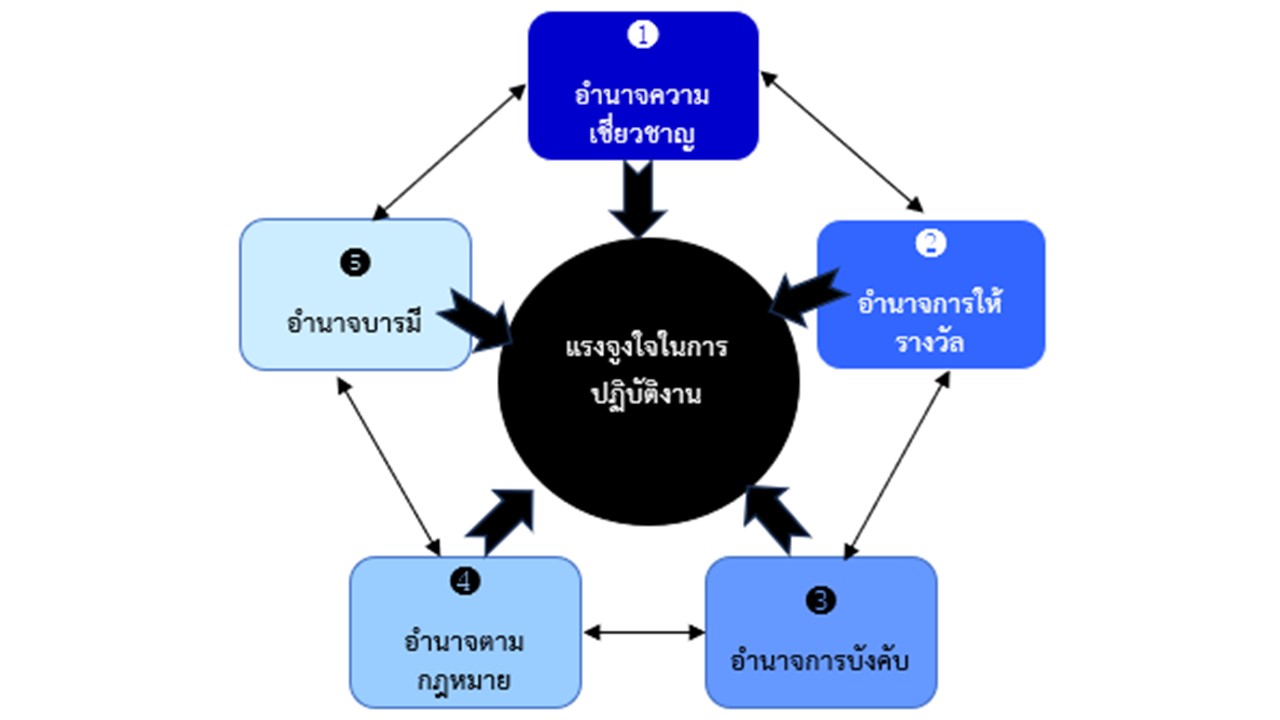
This research aimed to 1) study the use of power of administrators and teachers’ motivation, 2) study the relationship between the use of power of school administrators and teachers’ motivation in schools, and 3) study the effect of the use of power of school administrators on teachers’ motivation in schools under the Office of Lampang Primary Educational Service Area 2. The sample consisted of 297 administrators. The research instrument was a 5-level rating scale questionnaire. Part 1 focused on the use of power by school administrators, with a reliability value of 0.96. Part 2 was about teachers’ motivation, with a reliability value of 0.97. The statistics used for analysis were frequency, percentage, mean, standard deviation, and stepwise multiple regression analysis. The results of the research are as follows: 1. The use of power by school administrators and the motivation of teachers in the Lampang Educational Service Area Office 2 are overall at a high level. 2. The use of power by school administrators and the motivation of teachers in schools have a high level of positive relationship (r = 0.955) with statistical significance at the .01 level. 3. The use of the power of the school administrators to affect the motivation of teachers in schools under the Office of Elementary Education Service Area 2, District 2, has 6 aspects, namely Reward power(X4), Expert Power (X2), Coercive Power (X1), Information power (X6), Legitimate power (X3) and Referent power (X5) can predict the teacher's performance motivation in the school it belongs to—office of Elementary Education Areas beyond District 2, overall, 95%.
Article Details

This work is licensed under a Creative Commons Attribution-NonCommercial-NoDerivatives 4.0 International License.
เนื้อหาและข้อมูลในบทความที่ลงตีพิมพ์ในวารสารศูนย์ดัชนีการอ้างอิงวารสารไทย ถือเป็นข้อคิดเห็นและความรับผิดชอบของผู้เขียนบทความโดยตรงซึ่งกองบรรณาธิการวารสาร ไม่จำเป็นต้องเห็นด้วย หรือร่วมรับผิดชอบใด ๆ
บทความ ข้อมูล เนื้อหา รูปภาพ ฯลฯ ที่ได้รับการตีพิมพ์ในวารสารศูนย์ดัชนีการอ้างอิงวารสารไทย ถือเป็นลิขสิทธิ์ของวารสารศูนย์ดัชนีการอ้างอิงวารสารไทย หากบุคคลหรือหน่วยงานใดต้องการนำทั้งหมดหรือส่วนหนึ่งส่วนใดไปเผยแพร่ต่อหรือเพื่อกระทำการใด จะต้องได้รับอนุญาตเป็นลายลักอักษรจากวารสารศูนย์ดัชนีการอ้างอิงวารสารไทยก่อนเท่านั้น
References
กุลธิดา สะลิมิง และชวริศ เกิดทิพย์. (2563). การใช้อำนาจของผู้บริหารสตรีที่ส่งผลต่อการบริหารงานวิชาการตามทัศนะของครูสังกัดสำนักงานเขตพื้นที่การศึกษาประถมศึกษาจังหวัดยะลา. วารสารศึกษาศาสตร์ มหาวิทยาลัยสงขลานครินทร์ วิทยาเขตปัตตานี. 30, 3(กันยายน-ธันวาคม 2562).
ชลิดา ทวีโชคนิมิต, ชวน ภารังกูล. (2563). การใช้อำนาจของผู้บริหารสถานศึกษาในอำเภอกำแพงแสน สังกัดสำนักงานเขตพื้นที่การศึกษาประถมศึกษานครปฐมเขต 1. วารสารนวัตกรรมและการจัดการ. 5, (ฉบับเพิ่มเติม 2564). วิทยาลัยนวัตกรรมและการจัดการ, มหาวิทยาลัยราชภัฏสวนสุนันทา
ธร สุนทรายุทธ. (2556 ). ทฤษฎีองค์กรและพฤติกรรม: หลักการทฤษฎี การวิจัย และการปฏิบัติการ ทางการศึกษา. กรุงเทพฯ : เนติกุลการพิมพ์.
บุญชม ศรีสะอาด. (2556 ). การวิจัยเบื้องต้น (พิมพ์ครั้งที่ 9). กรุงเทพฯ: สุวีริยาสาส์น.
สัมฤทธิ์ กางเพ็ง และสรายุทธ กันหลง. (2559). โมเดลภาวะผู้นำทางหลักสูตรในศตวรรษที่ 21. เอกสารประกอบการสอนรายวิชา 210 208 การบริหารหลักสูตรและการสอน มหาวิทยาลัยมหาจุฬาลงกรณราชวิทยาลัย.
อิทธิพัทธ์ สุวทันพรกูล. (2562). การวิจัยทางการศึกษา แนวคิดและการประยุกต์ใช้. กรุงเทพฯ. สำนักพิมพ์จุฬาลงกรณ์มหาวิทยาลัย.
Alderfer, C. P. (1972). Existence relatedness and growth: Human needs in organizational setting. New York: Free Press.
Bierstedt, R. (1974). Power and progress : essays on sociological theory. New York : McGraw-Hill
French, J. and Raven, B. (1968). The bases of social power in group dynamics. New York: Harper & Row.
Harvard Business School. (2006). The Essentials of Power, Influence, and Persuasion. Business Literacy for HR Professionals. (Editor). Boston: Harvard Business School Press.
Kanter, R. M. (1979). Power failure management circuits. Harvard business review, 3 (4, 67 -68).
Luthan, F. (1989). December). Organization behavior. Singapore: McGraw-Hill Book.
McClelland, D.C. and Burnham, D.H. (2003). “Power is the Great Motivator.” Harvard Business Review. January 2003, 117-126.
Robbins, S. P. (1994). Organization behavior controversies and application (4th ed.). Englewood Cliffs, NJ.: Prentice-Hall.
