Participatory Management Model Based on the Four Sangahavatthu Dhammas of School Administrators
Article Sidebar
Main Article Content
Abstract
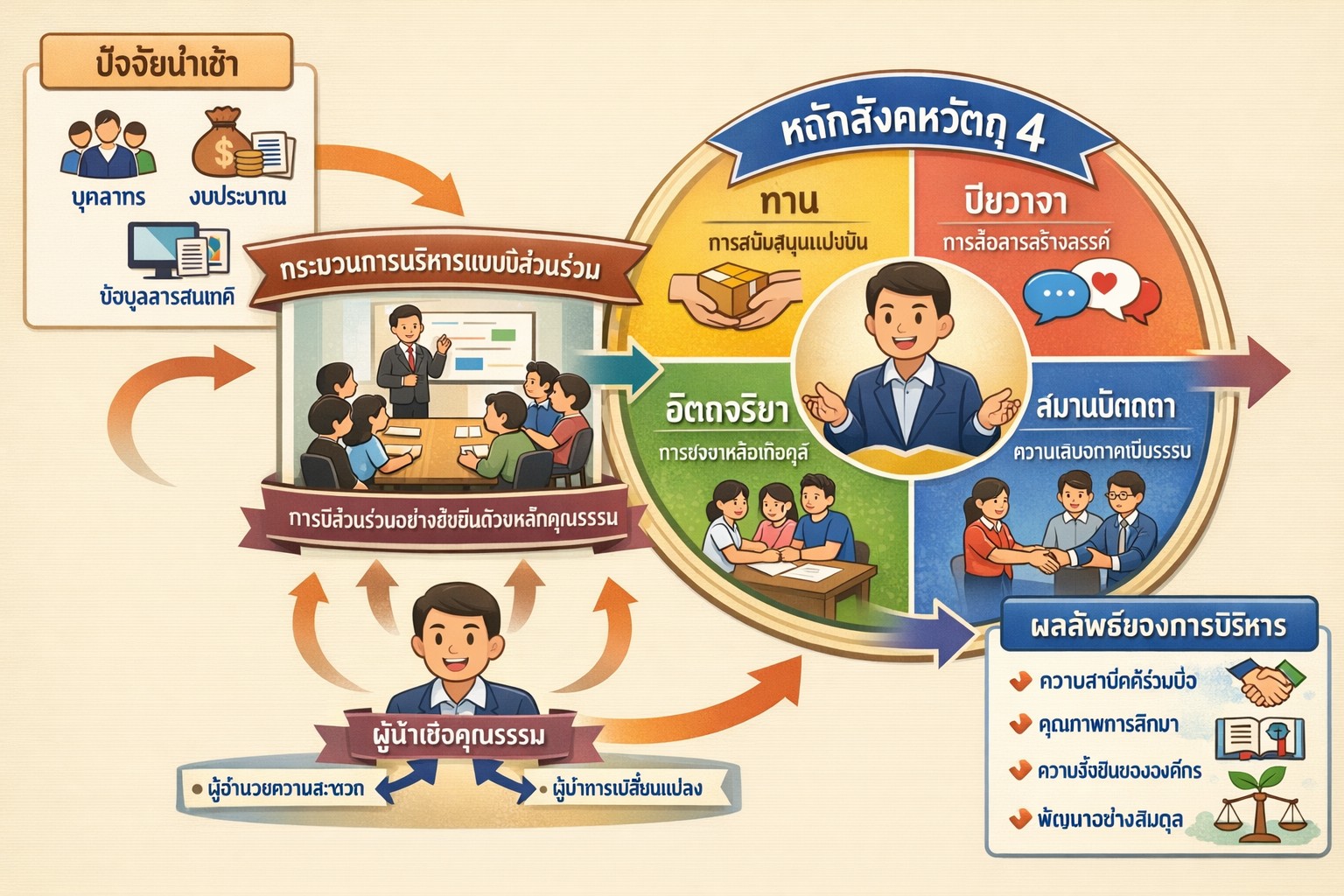
This academic article, entitled Participatory Management Model Based on the Four Saṅgahavatthu Dhammas of School Administrators aims to analyze and synthesize the concept of participatory management in educational institutions by integrating it with the Four Saṅgahavatthu Dhammas, namely Dāna (giving), Piyavācā (kind speech), Atthacariyā (beneficial conduct), and Samānattatā (impartiality), in order to develop a management model appropriate to educational administration in contemporary society. The study employed documentary research, analyzing relevant documents, concepts, theories, and academic literature on educational management, participation, and Buddhist principles, and synthesizing them into an integrated conceptual framework. The findings indicate that the participatory management model of educational institutions based on the Four Saṅgahavatthu Dhammas consists of four key components: (1) Dāna, referring to the support and sharing of resources, opportunities, and goodwill within the organization; (2) Piyavācā, referring to constructive, polite, and sincere communication that enhances mutual understanding and motivation for collaborative work; (3) Atthacariyā, referring to actions undertaken for the common good through joint planning, implementation, and shared responsibility for institutional tasks; and (4) Samānattatā, referring to administration based on equity, fairness, and respect for the dignity of all stakeholders. This model contributes to the development of an organizational culture characterized by cooperation, unity, and trust. The article highlights that applying the Four Saṅgahavatthu Dhammas as a foundation for participatory management can enhance the effectiveness of educational administration, improve the quality of educational management, and strengthen positive relationships among educational institutions, communities, and society, leading to the sustainable development of educational institutions.
Keywords: Participatory Management, Four Saṅgahavatthu Dhammas, Educational Administration
Article Details

This work is licensed under a Creative Commons Attribution-NonCommercial-NoDerivatives 4.0 International License.
เนื้อหาและข้อมูลในบทความที่ลงตีพิมพ์ในวารสารศูนย์ดัชนีการอ้างอิงวารสารไทย ถือเป็นข้อคิดเห็นและความรับผิดชอบของผู้เขียนบทความโดยตรงซึ่งกองบรรณาธิการวารสาร ไม่จำเป็นต้องเห็นด้วย หรือร่วมรับผิดชอบใด ๆ
บทความ ข้อมูล เนื้อหา รูปภาพ ฯลฯ ที่ได้รับการตีพิมพ์ในวารสารศูนย์ดัชนีการอ้างอิงวารสารไทย ถือเป็นลิขสิทธิ์ของวารสารศูนย์ดัชนีการอ้างอิงวารสารไทย หากบุคคลหรือหน่วยงานใดต้องการนำทั้งหมดหรือส่วนหนึ่งส่วนใดไปเผยแพร่ต่อหรือเพื่อกระทำการใด จะต้องได้รับอนุญาตเป็นลายลักอักษรจากวารสารศูนย์ดัชนีการอ้างอิงวารสารไทยก่อนเท่านั้น
