The Analysis of the Development of Artificial Intelligence Based on Hegel’s Concept of the Absolute
Article Sidebar
Main Article Content
Abstract
The purposes of this research were: 1) study the development of artificial intelligence, 2) examine Hegel’s concept of the Absolute, and 3) analyze the development of artificial intelligence from the perspective of Hegel’s Absolute. The data was collected from primary and secondary sources and analyzed using descriptive methods based on inductive reasoning.
The results revealed that:
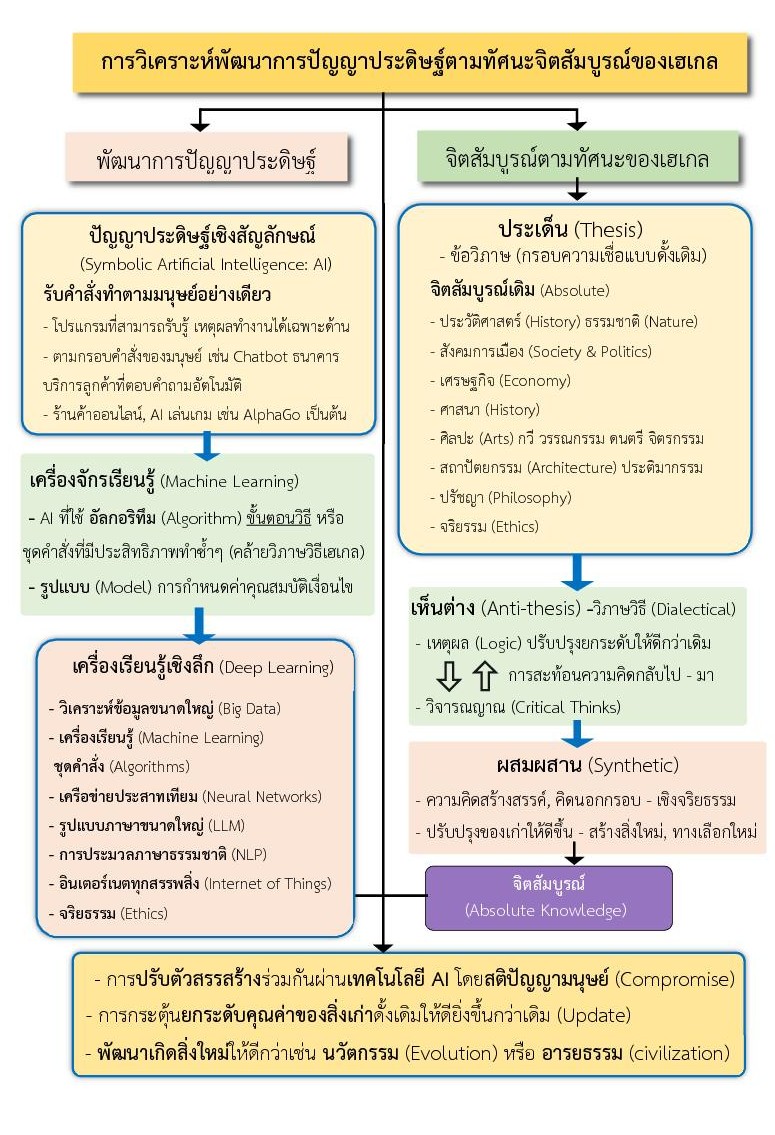
1. From counting with fingers to algebra, computer logic language to symbolic artificial intelligence (Symbolic AI) under the framework of human commands, moving towards machine learning that does not have to wait for commands to decide by itself, to deep learning for advanced and complex processing in the current era that creates ideas in leaps and bounds.
2. Hegel proposed the concept of the absolute mind through dialectics, by proposing (Thesis), arguing (Antithesis), and synthesizing (Synthesis). This concept does not focus on finding immediate results but uses intellectual skills to seek the truth in a complex and deep way in creative intelligence with judgment, reviewing ideas and synthesizing repeatedly in the same process to the absolute.
3. The development of artificial intelligence according to Hegel's view of absolute consciousness AI in the present era is a rejection of the original limitations in order to improve and elevate it to be better than before by new creative ideas that connect and integrate various knowledge, develop beyond the potential of abstract intelligence, manifest into concrete technology, become innovation or absolute things responsibly. It can be said that the two different ideas stand on the same dialectical principle.
Article Details

This work is licensed under a Creative Commons Attribution-NonCommercial-NoDerivatives 4.0 International License.
เพื่อให้เป็นไปตามกฎหมายลิขสิทธิ์ ผู้นิพนธ์ทุกท่านต้องลงลายมือชื่อในแบบฟอร์มใบมอบลิขสิทธิ์บทความ ให้แก่วารสารฯ พร้อมกับบทความต้นฉบับที่ได้แก้ไขครั้งสุดท้าย นอกจากนี้ ผู้นิพนธ์ทุกท่านต้องยืนยันว่าบทความ ต้นฉบับที่ส่งมาตีพิมพ์นั้น ได้ส่งมาตีพิมพ์เฉพาะในวารสาร วิชาการธรรม ทรรศน์ เพียงแห่งเดียวเท่านั้น หากมีการใช้ ภาพหรือตารางของผู้นิพนธ์อื่นที่ปรากฏในสิ่งตีพิมพ์อื่นมาแล้ว ผู้นิพนธ์ต้องขออนุญาตเจ้าของลิขสิทธิ์ก่อน พร้อมทั้ง แสดงหนังสือที่ได้รับการยินยอมต่อบรรณาธิการ ก่อนที่บทความจะได้รับการตีพิมพ์References
ชูพันธุ์ รัตนโภคา. (2559). ความรู้เบื้องต้นทางปัญญาประดิษฐ์. เอกสารคำสอน, ภาควิชาเทคโนโลยีวิศวกรรมอิเล็กทรอนิกส์, วิทยาลัยเทคโนโลยีอุตสาหกรรม, มหาวิทยาลัยเทคโนโลยีพระจอมเกล้าพระนครเหนือ.
Delaney, B. M., & Wallenstein, S. -O. (2012). Translating Hegel: The phenomenology of spirit and modern philosophy. Stockholm: Södertörn University.
Galante, V. (2018). Design & dialectic. OCAD University.
Hegel, G. W. F. (1977). Phenomenology of spirit (A. V. Miller, Trans.). New York: Oxford University Press.
Russell, S., & Norvig, P. (2020). Artificial intelligence: A modern approach. (4th ed.). California: Pearson.
Singer, P. (2001). Hegel: A very short introduction. New York: Oxford University Press.
