Song Creation to Promote Identity and Culture of Khok Hin Hae Subdistrict, Renu Nakhon District, Nakhon Phanom Province
Article Sidebar
Main Article Content
Abstract
This research aimed to: 1) study the identity and cultural capital of Khok Hin Hae Subdistrict, 2) create songs to promote identity and culture, and 3) develop a music communication process to promote identity and culture. This qualitative research collected data from documents and fieldwork using in-depth interviews and observation. Key informants included 30 monks, community leaders, local scholars, academics, and members of the cultural council from 10 villages in Khok Hin Hae Subdistrict. The data obtained were analyzed and used to compose 20 songs reflecting the identity and culture of the subdistrict.
The results revealed that:
1. The identity and cultural capital of Khok Hin Hae Subdistrict comprise three main aspects: 1) Art, music, and handicrafts, such as Phu Thai dance, traditional weaving, and basketry; 2) Religion, beliefs, and traditions, which are expressed through rituals and merit-making festivals based on the twelve-month traditions (Heet Sib Song); and 3) Lifestyles, language, clothing, and food, which are well-preserved and reflect local uniqueness.
2. The song creation process consists of two stages: (1) Pre-production studying information from documents and collecting field data from the local community, revealing unique aspects of language, beliefs, traditions, music, attire, food, and lifestyle; (2) Production using the gathered data to compose a total of 20 songs, strictly adhering to traditional song composition structures, consisting of four stanzas with external, internal, and inter-stanza rhymes. The content of the songs reflects the community context and is applicable in real community activities. Music arrangements and recordings were performed by both professional and local singers.
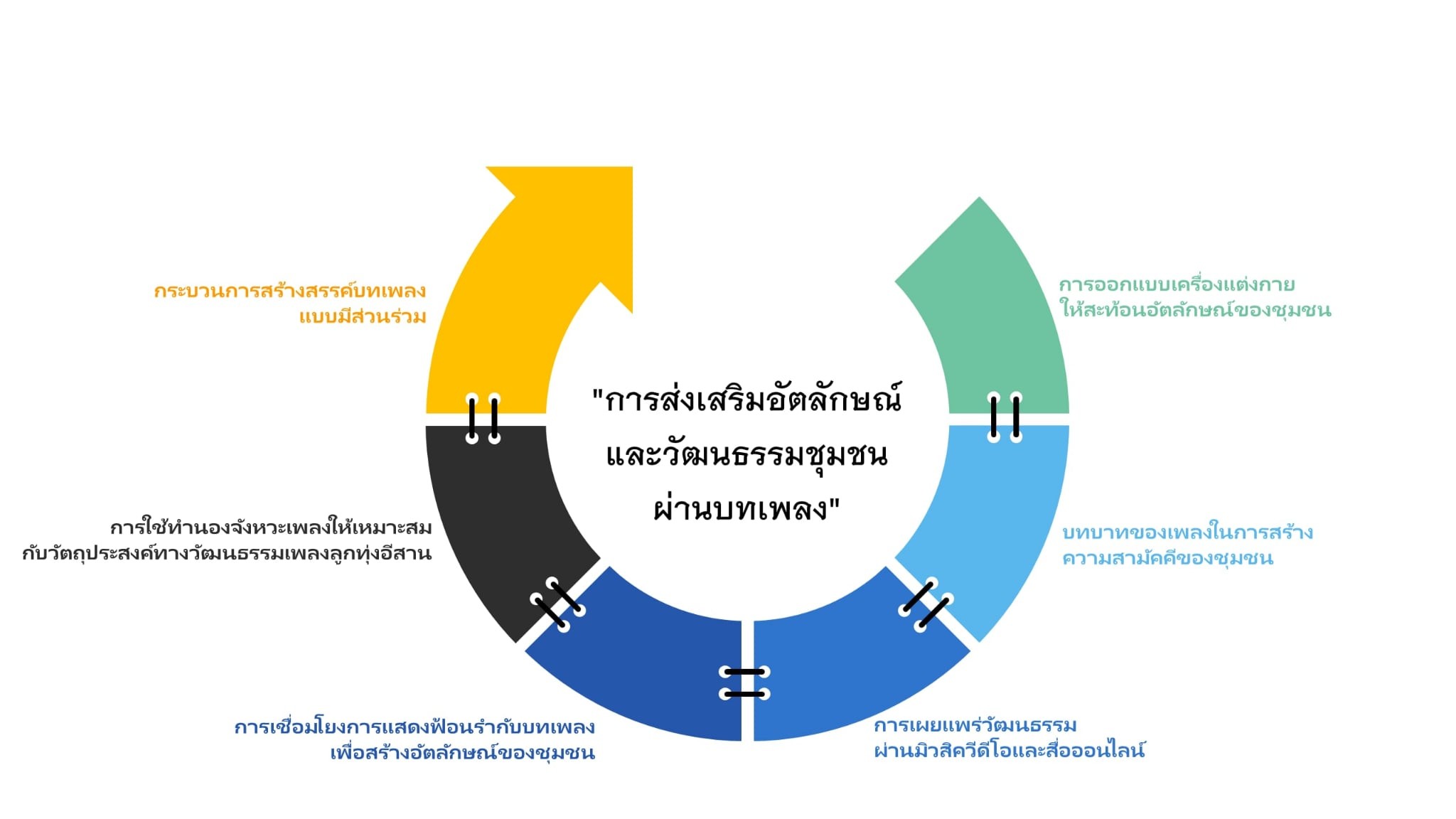
3. In developing the music communication process, the songs were utilized in the community by designing accompanying dance movements that correspond to the songs. These were then applied in community activities such as religious events, festivals, and tourism. Costumes for the performances were selected to reflect the community’s identity, such as tie-dye fabric and the community’s representative colors blue and red. Additionally, music videos were produced and disseminated via Facebook and YouTube to promote local culture to a wider audience.
Article Details

This work is licensed under a Creative Commons Attribution-NonCommercial-NoDerivatives 4.0 International License.
เพื่อให้เป็นไปตามกฎหมายลิขสิทธิ์ ผู้นิพนธ์ทุกท่านต้องลงลายมือชื่อในแบบฟอร์มใบมอบลิขสิทธิ์บทความ ให้แก่วารสารฯ พร้อมกับบทความต้นฉบับที่ได้แก้ไขครั้งสุดท้าย นอกจากนี้ ผู้นิพนธ์ทุกท่านต้องยืนยันว่าบทความ ต้นฉบับที่ส่งมาตีพิมพ์นั้น ได้ส่งมาตีพิมพ์เฉพาะในวารสาร วิชาการธรรม ทรรศน์ เพียงแห่งเดียวเท่านั้น หากมีการใช้ ภาพหรือตารางของผู้นิพนธ์อื่นที่ปรากฏในสิ่งตีพิมพ์อื่นมาแล้ว ผู้นิพนธ์ต้องขออนุญาตเจ้าของลิขสิทธิ์ก่อน พร้อมทั้ง แสดงหนังสือที่ได้รับการยินยอมต่อบรรณาธิการ ก่อนที่บทความจะได้รับการตีพิมพ์References
กชพรรณ สกุลพุทธพร. (2564). กระบวนการสร้างสรรค์สื่อเพลงเพื่อประชาสัมพันธ์การท่องเที่ยวเชิงวัฒนธรรม กรณีศึกษา เพลง 111 ปี เล่าขานตำนานเมืองเบตง. วารสารมหาจุฬานาครทรรศน์, 8(2), 212-224. https://so03.tci-thaijo.org/index.php/JMND/article/view/250499/168331
กองคลัง อบต.โคกหินแฮ่. (2566). สถิติข้อมูลประชากรตำบลโคกหินแฮ่ ประจำเดือนกันยายน 2566. นครพนม: องค์การบริหารส่วนตำบลโคกหินแฮ่.
ขวัญใจ บุญคุ้ม. (2559). วัจนลีลาและบทบาทหน้าที่ของเพลงลูกทุ่ง. (วิทยานิพนธ์ศิลปศาสตรมหาบัณฑิต). กรุงเทพฯ: มหาวิทยาลัยราชภัฏเชียงใหม่.
ฐิตินัน บุญภาพ คอมมอน. (2555). เพลงและอัตลักษณ์วัฒนธรรมชุมชน: จรัล มโนเพ็ชร กับบทบาทของนักรบทางวัฒนธรรมดนตรีล้านนา. วารสารนิเทศศาสตร์ธุรกิจบัณฑิตย์, 6(2), 146-179. https://ww2.dpu.ac.th/commarts/journal/upload/issue/NaVo1clWVo.pdf
นงเยาว์ อำรุงพงษ์วัฒนา. (2541). ศิลปะการฟ้อนผู้ไทย จังหวัดนครพนม. (รายงานการวิจัย). กรุงเทพฯ: คณะมนุษยศาสตร์และสังคมศาสตร์ สถาบันราชภัฏสวนสุนันทา.
เปรมวิทย์ วิวัฒนเศรษฐ์. (2561). อัตลักษณ์ทางวัฒนธรรมของชาติพันธุ์ในพิธีกรรมแห่งชีวิตชาวไทลื้อจังหวัดพะเยา. วารสารมหาวิทยาลัยพายัพ, 28(2), 173-189.
พจน์มาลย์ สมรรคบุตร. (2541). การฟ้อนผู้ไทยในเรณูนคร. (วิทยานิพนธ์ศิลปศาสตรมหาบัณฑิต). กรุงเทพฯ: จุฬาลงกรณ์มหาวิทยาลัย.
ภาวิณี แสนชนม์. (2557). การจัดการองค์ความรู้ภูมิปัญญาท้องถิ่นสู่ประชาคมอาเซียน กรณีศึกษาขนมจีนเรณูนคร บ้านเนินน้ำคำ ตำบลโคกหินแฮ่ อำเภอเรณูนคร จังหวัดนครพนม. วารสารวิจัยสมาคมห้องสมุดแห่งประเทศไทยฯ, 7(2), 52-63. https://so06.tci-thaijo.org/index.php/tla_research/issue/view/9117/527
ภิญโญ ภู่เทศ. (2558). การมีส่วนร่วมของประชาชนในการอนุรักษ์และพัฒนาเพลงพื้นบ้าน เพื่อการท่องเที่ยวเชิงวัฒนธรรมจังหวัดนครสวรรค์. Life Sciences and Environment Journal, 16(2), 211-219. https://ph01.tci-thaijo.org/index.php/psru/article/view/56660
ยุพิน สมคำพี่. (2554). โครงการวิจัยภูมิปัญญาการผลิตข้าวปุ้นน้ำนัวของชาวภูไทเรณูนคร. วารสารมหาวิทยาลัยราชภัฏสกลนคร, 3(5), 120-130. https://ph01.tci-thaijo.org/index.php/snru_journal/article/view/10009/9043
วิภาณ์ เทศน์ธรรม. (2561). วรรณศิลป์ วาทศาสตร์ของชาวภูไท. วารสารบัณฑิตศึกษามหาจุฬาขอนแก่น, 9(4), 68-83.
วิภาดา เถาธรรมพิทักษ์. (2559). เพลง: วรรณกรรมเพื่อส่งเสริมการท่องเที่ยว. วารสารวิชาการนวัตกรรมสื่อสารสังคม, 4(1), 62-72. https://so06.tci-thaijo.org/index.php/jcosci/article/view/93116/72942
วุฒิชัย สว่างแสง. (2564). ว่าด้วยสถานะของแถนในวัฒนธรรมอีสาน. วารสารปรัชญาและศาสนา, 6 (1), 82-110. https://so06.tci-thaijo.org/index.php/jprkku/article/view/249977/170286
สุเนตร ศรีหาคลัง, จิรโชค วีระสย, รังสรรค์ สิงหเลิศ และบุญสม ยอดมาลี. (2562). การเปลี่ยนแปลงทางวัฒนธรรม: ภาษาและการแต่งกายของชาวภูไทเรณูนครในภาคตะวันออกเฉียงเหนือของประเทศไทย. วารสารดุษฎีบัณฑิตทางสังคมศาสตร์, 9(3), 705-715. https://so05.tci-thaijo.org/index.php/phdssj/article/view/121223/159839
สุเนตร ศรีหาคลัง. (2560). การเปลี่ยนแปลงทางวัฒนธรรม: ภาษาและการแต่งกายของชาวภูไทเรณูนครในภาคตะวันออกเฉียงเหนือของประเทศไทย. กรุงเทพฯ: มหาวิทยาลัยรามคำแหง.
สุภัทรชรี บุญประชุม, ณัฐพงศ์ เขียวศรี, คงฤทธิ์ รีวงษ์, สาวิณี โกพลรัตน์. (2564). การสื่อสารกับการสืบทอดอัตลักษณ์การฟ้อนผู้ไทยเรณูนคร อำเภอเรณูนคร จังหวัดนครพนม. วารสารศิลปวัฒนธรรมอีสาน, 2(1), 13-29.
Bernabé Villodre, M. del M. (2014). Cultural identity and using music in the intercultural educational process. Procedia-Social and Behavioral Sciences, 132, 302-308. https://doi.org/10.1016/j.sbspro.2014.04.304
Castañeda Gonzales, K. L. (2022). Comunicación en el fortalecimiento de la identidad cultural: configuración de relaciones y significados. Ciencia Latina, 6(4), 2302-2321. https://doi.org/10.37811/cl_rcm.v6i4.2757
Howell, G., Higgins, L., & Bartleet, B. -L. (2017). Community music practice: Intervention through facilitation. In R. Mantie & G. Dylan Smith (Eds.), The Oxford Handbook of Music Making and Leisure (pp. 601-618). New York: Oxford University Press.
Merriam, A. P. (1964). The Anthropology of Music. Evanston, IL: Northwestern University Press.
