Leadership, Organizational Management Policy, Management Innovation, Competitive Potential, and the Success of Clean Energy Business in Thailand
Article Sidebar
Main Article Content
Abstract
This research aimed to: (1) examine the current conditions of leadership, organizational management policies, management innovation, competitive capability, and business success of clean energy enterprises in Thailand; (2) investigate the influence of leadership, organizational management policies, management innovation, and competitive capability on the success of clean energy businesses in Thailand; and (3) develop a model for enhancing the success of clean energy entrepreneurs in Thailand. The study employed a mixed-methods research design. In the quantitative phase, the population consisted of 3,784 clean energy entrepreneurs in Thailand, from which a sample of 300 respondents was selected. In the qualitative phase, 20 key informants were purposively selected, comprising clean energy entrepreneurs and experts in the clean energy business sector in Thailand. Research instruments included a questionnaire for quantitative data collection and a semi-structured interview guide for in-depth qualitative interviews. Quantitative data were analyzed using Structural Equation Modeling (SEM), while qualitative data were analyzed through content analysis.
The findings revealed that:
1. The overall conditions of leadership, organizational management policies, management innovation, competitive capability, and business success of clean energy enterprises in Thailand were at a high level, particularly in terms of leadership, organizational management policies, management innovation, and competitive capability.
2. The modified and validated structural equation model indicated that leadership, organizational management policies, and management innovation exerted statistically significant direct effects on the competitive capability of clean energy businesses at the .05 level.
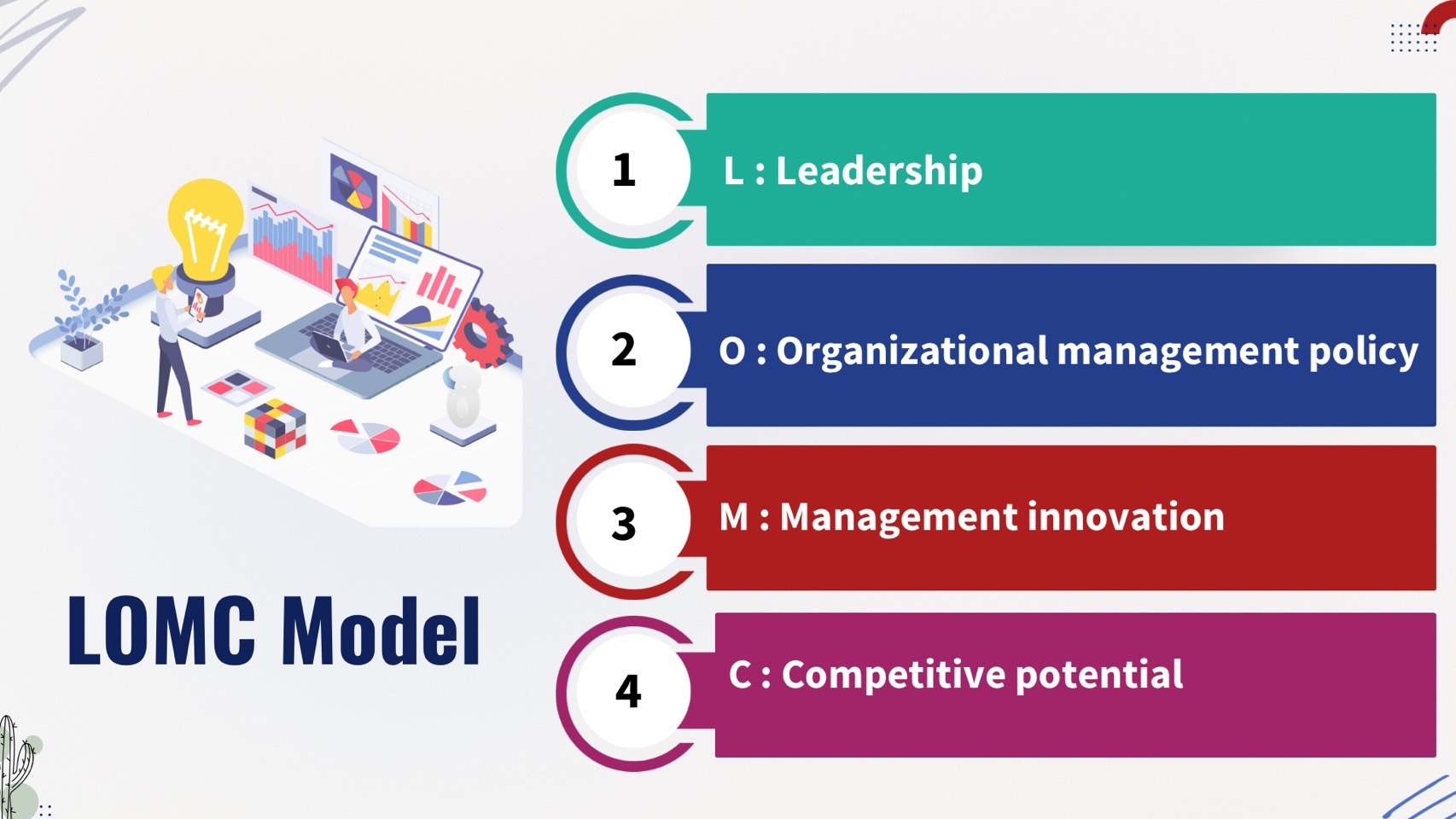
3. The developed model for enhancing the success of clean energy entrepreneurs in Thailand, referred to as the LOMC Model, comprises four key components: (1) Leadership, (2) Organizational Management Policy, (3) Management Innovation, and (4) Competitive Capability. This model can serve as a practical guideline for enhancing the success and sustainability of clean energy entrepreneurs in Thailand.
Article Details

This work is licensed under a Creative Commons Attribution-NonCommercial-NoDerivatives 4.0 International License.
เพื่อให้เป็นไปตามกฎหมายลิขสิทธิ์ ผู้นิพนธ์ทุกท่านต้องลงลายมือชื่อในแบบฟอร์มใบมอบลิขสิทธิ์บทความ ให้แก่วารสารฯ พร้อมกับบทความต้นฉบับที่ได้แก้ไขครั้งสุดท้าย นอกจากนี้ ผู้นิพนธ์ทุกท่านต้องยืนยันว่าบทความ ต้นฉบับที่ส่งมาตีพิมพ์นั้น ได้ส่งมาตีพิมพ์เฉพาะในวารสาร วิชาการธรรม ทรรศน์ เพียงแห่งเดียวเท่านั้น หากมีการใช้ ภาพหรือตารางของผู้นิพนธ์อื่นที่ปรากฏในสิ่งตีพิมพ์อื่นมาแล้ว ผู้นิพนธ์ต้องขออนุญาตเจ้าของลิขสิทธิ์ก่อน พร้อมทั้ง แสดงหนังสือที่ได้รับการยินยอมต่อบรรณาธิการ ก่อนที่บทความจะได้รับการตีพิมพ์References
กรมพัฒนาธุรกิจการค้า. (2567). ข้อมูลผู้ประกอบการธุรกิจพลังงานสะอาด. เข้าถึงได้จากhttps://datawarehouse.dbd.go.th/stats/35101?type=business
กระทรวงพลังงาน. (2563). รายงานประจาปี 2562. กรุงเทพฯ: สำนักงานนโยบายและแผนพลังงาน กระทรวงพลังงาน.
Barsei, A. N., Pamungkasih, E., Sabtohadi, J., Asmoro, B. T., Anindyasari, Y., & Saputra, A. (2024). Community-based centralized solar mini-grid management for rural electrification: Evidence from remote villages. E3S Web of Conferences, 506, 1-8.
Batool, K., Zhao, Z. Y., Irfan, M., Ullah, S., & Işik, C. (2023). Assessing the competitiveness of Indian solar power industry using the extended Five Forces Model: A green innovation perspective. Environmental Science and Pollution Research International, 30(34), 82045-82067.
Diamantopoulos, A., & Siguaw, J. A. (2000). Introducing LISREL: A guide for the uninitiated. Thousand Oaks, CA: Sage Publications.
Farhan, B. Y. (2024). Visionary leadership and innovative mindset for sustainable business development: Case studies and practical applications. Research in Globalization, 8, 1-11.
Gilmanshin, I. (2024). Modeling the operating modes of solar power plants for powering reclamation plants for water treatment and wastewater reuse. E3S Web of Conferences, 542, 01001. https://doi.org/10.1051/e3sconf/202454201001
Hair, J. F., Ringle, C. M., & Sarstedt, M. (2011). PLS SEM: Indeed a silver bullet. Journal of Marketing Theory and Practice, 19(2), 139-151. https://doi.org/10.2753/MTP1069 6679190202
Hooper, D., Coughlan, J., & Mullen, M. R. (2008). Structural equation modelling: Guidelines for determining model fit. Electronic Journal of Business Research Methods, 6(1), 53-60. https://doi.org/10.21427/D7CF7R
Hussain, N., & Li, B. (2022). Entrepreneurial leadership and entrepreneurial success: The role of knowledge management processes and knowledge entrepreneurship. Frontiers in Psychology, 13, 829959. https://doi.org/10.3389/fpsyg.2022.829959
Johansson, B., Despeisse, M., Bokrantz, J., Braun, G., Cao, H., Chari, A., Fang, Q., González Chávez, C. A., Skoogh, A., Söderlund, H., Wang, H., Wärmefjord, K., Nyborg, L., Sun, J., Örtengren, R., Schumacher, K. A., Espinal, L., Morris, K. C., Nunley, J. Jr., Kishita, Y., Umeda, Y., Acerbi, F., Pinzone, M., Persson, H., Charpentier, S., Edström, K., Brandell, D., Gopalakrishnan, M., Rahnama, H., Abrahamsson, L., Öhrwall Rönnbäck, A., & Stahre, J. (2024). Challenges and opportunities to advance manufacturing research for sustainable battery life cycles. Frontiers in Manufacturing Technology, 4, 1360076. https://doi.org/10.3389/fmtec.2024.1360076
Juniarti, A. T., Setia, B. I., Alghifari, E. S., & Sya’roni, D. A. W. (2024). Green leadership and competitive advantage: The role of mediation from knowledge management and talent management. Journal of Eastern European and Central Asian Research (JEECAR), 11(3). https://doi.org/10.15549/jeecar.v11i3.1648
MacCallum, R. C., Browne, M. W., & Sugawara, H. M. (1996). Power analysis and determination of sample size for covariance structure modeling. Psychological Methods, 1(2), 130-149. https://doi.org/10.1037/1082 989X.1.2.130
Manit, J., Kanjanaboos, P., Naweephattana, P., Naikaew, A., Srathongsian, L., Seriwattanachai, C., Supruangnet, R., Nakajima, H., Eiamprasert, U., & Kiatisevi, S. (2024). Towards device stability of perovskite solar cells through low-costalkyl-terminated SFX-based hole transporting materials and carbon electrodes. Scientific Reports, 14(1), 1-13.
Marzouk, O. A. (2024). Portrait of the decarbonization and renewables penetration in Oman's energy mix, motivated by Oman's national green hydrogen plan. Energies, 17(19), 4769.
Nunnally, J. C., & Bernstein, I. H. (1967). Psychometric Theory. New York: McGraw Hill.
Rastegar, H., Eweje, G., & Sajjad, A. (2024). The impact of environmental policy on renewable energy innovation: A systematic literature review and research directions. Wiley Sustainable Development, 32(4), 3859-3876.
Sarker, M. T., Haram, M. H. S. M., Ramasamy, G., Al Farid, F., & Mansor, S. (2023). Solar photovoltaic home systems in Malaysia: A comprehensive review and analysis. Energies, 16(23), 7718.
Wenten, I. G., Khoiruddin, K., & Siagian, U. W. (2024). Green energy technologies: A key driver in carbon emission reduction. Journal of Engineering & Technological Sciences, 56(2), 143-192.
