Patterns of Clean and Alternative Energy Utilization in Khlong Sam Subdistrict, Khlong Luang District, Pathum Thani Province
Article Sidebar
Main Article Content
Abstract
This study aimed to: (1) examine clean and alternative energy sources suitable for reducing environmental pollution and lowering the operational costs of Khlong Sam Subdistrict Administrative Organization; (2) analyze the investment feasibility of implementing such energy sources; and (3) develop an appropriate clean and alternative energy utilization plan for Khlong Sam Subdistrict Administrative Organization. A mixed-methods research design was employed. Quantitative data were collected from 399 residents in Khlong Sam Subdistrict using a questionnaire and analyzed using frequency, percentage, mean, and standard deviation. Qualitative data were obtained from 30 key informants, comprising executives of Khlong Sam Subdistrict Administrative Organization, personnel involved in energy management, and community leaders or representatives. In-depth interviews and focus group discussions were used as research instruments, and qualitative data were analyzed through inductive interpretation.
The findings revealed that:
1. Solar energy was identified as the most suitable alternative energy source, followed by hydropower, wind energy, biomass energy, and geothermal energy, respectively. Respondents demonstrated a high level of awareness regarding energy conservation and environmental protection (x̄ = 4.11, S.D. = 1.03), and perceived the Subdistrict Administrative Organization’s capacity for energy management to be at a high level (x̄ = 4.32, S.D. = 0.776).
2. Investment feasibility was also rated at a high level (x̄ = 4.33, S.D. = 0.823). Key approaches included the installation of solar photovoltaic systems, the promotion of collaboration among communities and relevant agencies, and implementation in accordance with government regulations.
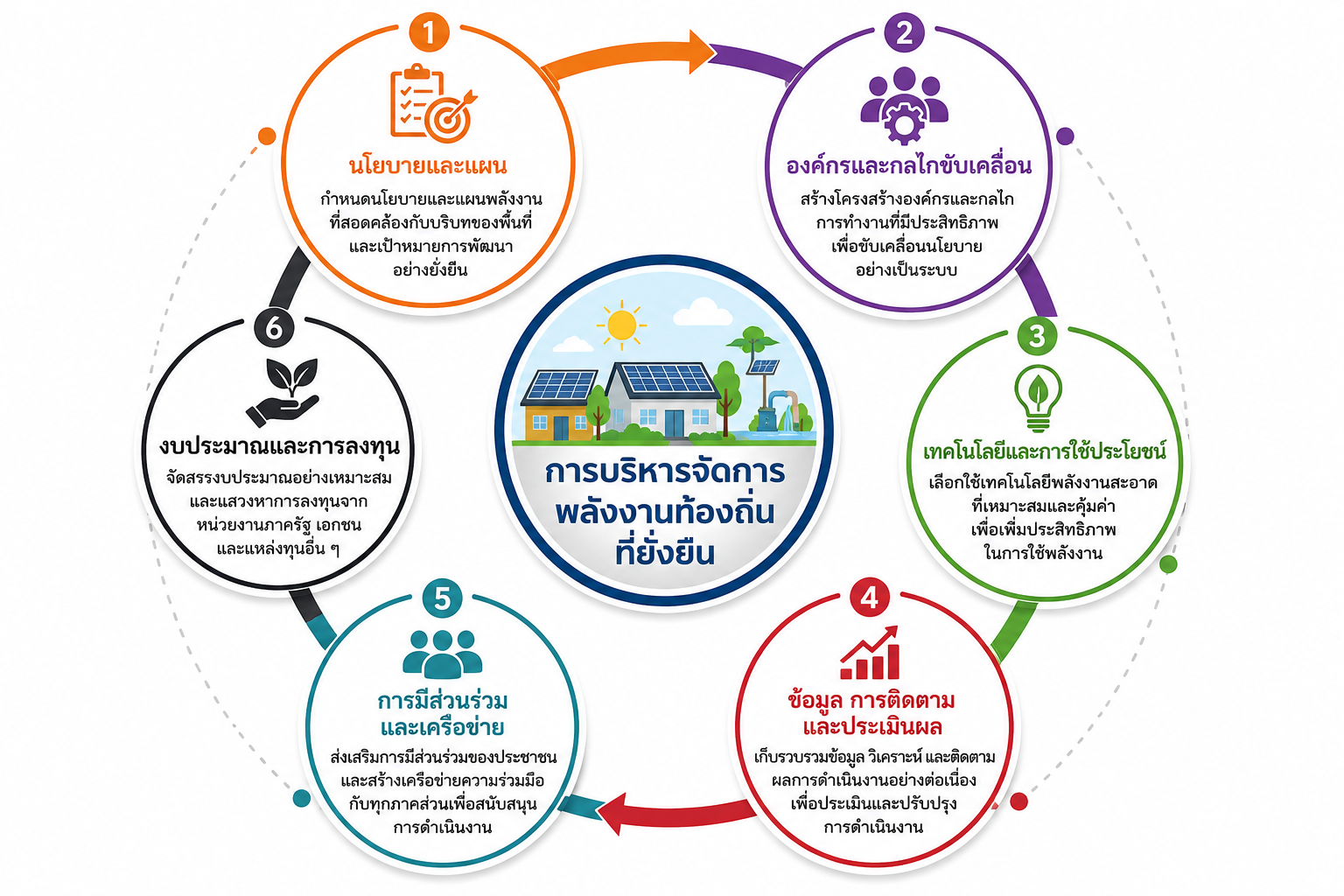
3. The proposed clean and alternative energy utilization plan emphasized solar energy as the primary source. The plan consists of assessing local energy potential, developing supporting infrastructure, determining investment models, implementing pilot projects, and establishing a clean energy learning center. These measures are expected to enhance public participation, reduce energy expenditures, and support sustainable local development.
Article Details

This work is licensed under a Creative Commons Attribution-NonCommercial-NoDerivatives 4.0 International License.
เพื่อให้เป็นไปตามกฎหมายลิขสิทธิ์ ผู้นิพนธ์ทุกท่านต้องลงลายมือชื่อในแบบฟอร์มใบมอบลิขสิทธิ์บทความ ให้แก่วารสารฯ พร้อมกับบทความต้นฉบับที่ได้แก้ไขครั้งสุดท้าย นอกจากนี้ ผู้นิพนธ์ทุกท่านต้องยืนยันว่าบทความ ต้นฉบับที่ส่งมาตีพิมพ์นั้น ได้ส่งมาตีพิมพ์เฉพาะในวารสาร วิชาการธรรม ทรรศน์ เพียงแห่งเดียวเท่านั้น หากมีการใช้ ภาพหรือตารางของผู้นิพนธ์อื่นที่ปรากฏในสิ่งตีพิมพ์อื่นมาแล้ว ผู้นิพนธ์ต้องขออนุญาตเจ้าของลิขสิทธิ์ก่อน พร้อมทั้ง แสดงหนังสือที่ได้รับการยินยอมต่อบรรณาธิการ ก่อนที่บทความจะได้รับการตีพิมพ์References
ณิชยารัตน์ พาณิชย์และวิสาขา ภู่จินดา. (2556). แนวทางการบริหารจัดการพลังงานทดแทนในระดับชุมชนของประเทศไทย. วารสารการจัดการสิ่งแวดล้อมและความยั่งยืน, 10(1), 55-76. https://so02.tci-thaijo.org/index.php/JEM/article/view/25854/21936
ดวงกมล อิศรางพร. (2560). แนวทางการผลิตพลังงานหมุนเวียนเพื่อความยั่งยืนของชุมชนในจังหวัดสุรินทร์. (วิทยานิพนธ์วิทยาศาสตรมหาบัณฑิต). กรุงเทพฯ: คณะบริหารการพัฒนาสิ่งแวดล้อม สถาบันบัณฑิตพัฒนบริหารศาสตร์.
วิสาขา ภู่จินดา และสิริสุดา หนูทิมทอง. (2556). การบริหารจัดการพลังงานหมุนเวียนเพื่อผลิตพลังงาน ใช้ในระดับชุมชนและระดับครัวเรือน: กรณีศึกษา ชุมชนเกาะพะลวย. วารสารการจัดการสิ่งแวดล้อมและความยั่งยืน, 9(2), 45-64. https://so02.tci-thaijo.org/index.php/JEM/article/view/26129/22163
ศราวุธ จตุรบูรณ์ และณฐา คุปตัษเฐียร. (2557). การศึกษาความเป็นไปได้ในการใช้พลังงานทดแทน: กรณีศึกษาชุมสายหลักโทรศัพท์พื้นฐานในประเทศไทย. วารสารวิศวกรรมศาสตร์ ราชมงคลธัญบุรี, 12(1), 55-62. https://ph01.tci-thaijo.org/index.php/jermutt/article/view/242076/164590
ศิวพร แน่นหนา, ธาริณี มีเจริญ, ศุภวิช นิยมพันธุ์, พงศ์ไกร วรรณตรง, นิศานาถ แก้ววินัด และชลิตา แก้วบุตรดี. (2567). การศึกษาการเพิ่มประสิทธิภาพการใช้พลังงานทดแทนจากแสงอาทิตย์ โดยการมีส่วนร่วมของชุมชนบ้านลำพุก จังหวัดสุรินทร์. วารสารวิชาการเทคโนโลยีอุตสาหกรรมและวิศวกรรม มหาวิทยาลัยราชภัฏพิบูลสงคราม, 6(1), 40-55. https://ph02.tci-thaijo.org/index.php/psru-jite/article/view/251220/170288
สายสุนีย์ สิทธิมงคล. (2564). การศึกษาปัจจัยในการเลือกใช้พลังงานทดแทนหรือพลังงานหมุนเวียนจากแสงอาทิตย์ด้วยเซลล์แสงอาทิตย์ (Solar cells) ในบ้านพักอาศัยในเขตกรุงเทพมหานครและปริมณฑล. (สารนิพนธ์การจัดการมหาบัณฑิต). กรุงเทพฯ: วิทยาลัยการจัดการ มหาวิทยาลัยมหิดล.
Han, J., & Chang, H. (2022). Development and opportunities of clean energy in China. Applied Sciences, 12(9), 4783.
Romero-Rubio, C., & de Andrés Díaz, J. R. (2015). Sustainable energy communities: A study contrasting Spain and Germany. Energy Policy, 85, 397-409.
Smith, J. (2021). Renewable energy policies and future trends. Journal of Clean Energy Research, 25(3), 45-60.
Yang, S. (2022). Clean energy, economic development and healthy energy intensity: an empirical analysis based on China’s inter-provincial panel data. Environmental Science and Pollution Research, 29(53), 80366-80382.
