An Analysis of Abraham Lincoln's Political Philosophy
Article Sidebar
Main Article Content
Abstract
This research aimed to: 1) examine political concepts and theories; 2) investigate the political views of Abraham Lincoln; and 3) analyze Abraham Lincoln’s political philosophy. This study employed documentary research by collecting data from primary sources, including Abraham Lincoln’s speeches and writings, and secondary sources, including books, academic articles, and related research studies. The data were analyzed using descriptive analysis based on the inductive approach.
The findings revealed that:
1. The political concepts and theories underlying Abraham Lincoln’s political philosophy include democracy, liberalism, human rights, and popular sovereignty. These principles emphasize freedom, equality, and human dignity as fundamental values of political and social life.
2. Abraham Lincoln’s political views were centered on government by the people, grounded in the principle of human equality, and committed to promoting the rights, liberties, and political participation of citizens. These views are reflected in his well-known conception of government of the people, by the people, and for the people.
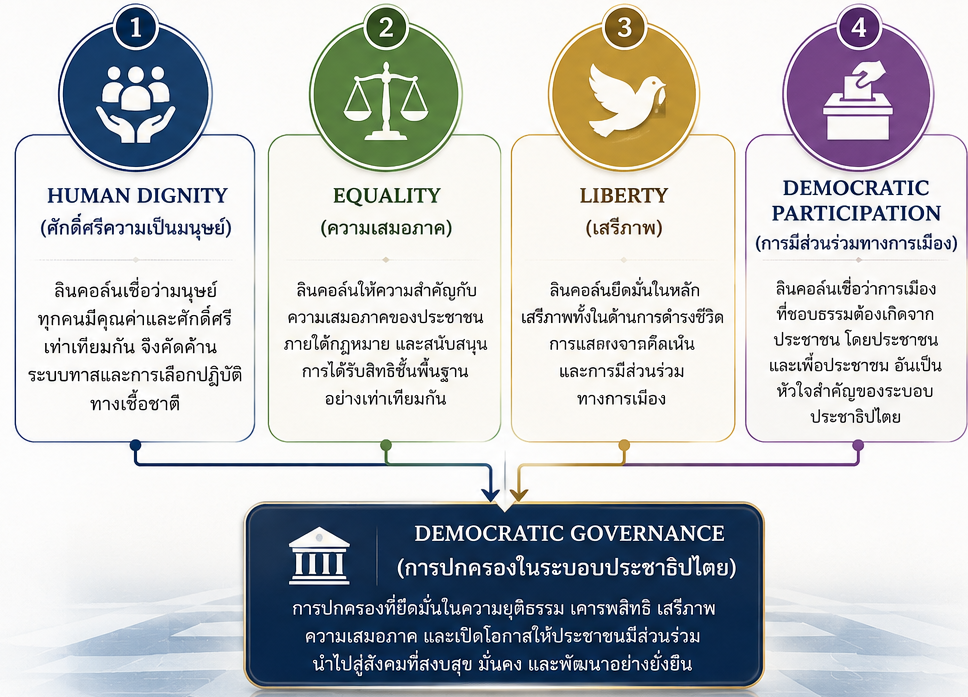
3. Abraham Lincoln’s political philosophy consists of four major dimensions: (1) a political ideology that upholds human dignity and equality; (2) democratic principles based on popular sovereignty; (3) the protection of individual rights and freedoms in both personal life and political expression; and (4) the promotion of equal political participation through democratic processes. The knowledge gained from this study is the synthesis of Abraham Lincoln’s political philosophy as a significant foundation of modern democracy. This philosophy is grounded in the principles of human dignity, equality, liberty, and citizens’ participation, which serve as essential guidelines for the development of democratic governance in contemporary societies.
Article Details

This work is licensed under a Creative Commons Attribution-NonCommercial-NoDerivatives 4.0 International License.
เพื่อให้เป็นไปตามกฎหมายลิขสิทธิ์ ผู้นิพนธ์ทุกท่านต้องลงลายมือชื่อในแบบฟอร์มใบมอบลิขสิทธิ์บทความ ให้แก่วารสารฯ พร้อมกับบทความต้นฉบับที่ได้แก้ไขครั้งสุดท้าย นอกจากนี้ ผู้นิพนธ์ทุกท่านต้องยืนยันว่าบทความ ต้นฉบับที่ส่งมาตีพิมพ์นั้น ได้ส่งมาตีพิมพ์เฉพาะในวารสาร วิชาการธรรม ทรรศน์ เพียงแห่งเดียวเท่านั้น หากมีการใช้ ภาพหรือตารางของผู้นิพนธ์อื่นที่ปรากฏในสิ่งตีพิมพ์อื่นมาแล้ว ผู้นิพนธ์ต้องขออนุญาตเจ้าของลิขสิทธิ์ก่อน พร้อมทั้ง แสดงหนังสือที่ได้รับการยินยอมต่อบรรณาธิการ ก่อนที่บทความจะได้รับการตีพิมพ์References
กิตติพัฒน์ สุวรรณสิริเมธี. (2568). ปรัชญาการเมือง. ขอนแก่น: มหาวิทยาลัยมหามกุฏราชวิทยาลัย วิทยาเขตอีสาน.
ประยงค์ สุวรรณบุบผา. (2537). ปรัชญาตะวันตกสมัยโบราณ. กรุงเทพฯ: โอเดียนสโตร์.
Aristotle. (1992). Politics (E. Barker, Trans.). Oxford: Oxford University Press. (Original work published ca. 350 B.C.E.).
Foner, E. (2010). The Fiery Trial: Abraham Lincoln and American Slavery. New York: W.W. Norton & Company.
Lincoln, A. (1861). First Inaugural Address. In R. P. Basler (Ed.), The Collected Works of Abraham Lincoln. (Vol. 4). New Brunswick, NJ: Rutgers University Press.
Lincoln, A. (1863). Gettysburg Address. In R. P. Basler (Ed.), The Collected Works of Abraham Lincoln. (Vol. 7). New Brunswick, NJ: Rutgers University Press.
Lincoln, A. (1865). Second Inaugural Address. In R. P. Basler (Ed.), The Collected Works of Abraham Lincoln. (Vol. 8). New Brunswick, NJ: Rutgers University Press.
Locke, J. (1988). Two Treatises of Government. Cambridge: Cambridge University Press.
Rousseau, J. -J. (1997). The Social Contract and Other Later Political Writings. Cambridge: Cambridge University Press.
White, R. C. (2009). A. Lincoln: A Biography. New York: Random House.
