Influence of Debt Behavior and Management on the Debt Burden of Members of the Saraburi Hospital Savings Cooperative
Article Sidebar
Main Article Content
Abstract
This study aimed to examine the factors influencing the debt burden of members of the Saraburi Hospital Savings Cooperative using multiple regression analysis. The dependent variable was the debt burden of cooperative members, while the independent variables included personal factors, basic needs related to consumption, utilities, housing, healthcare, education, and social activities, along with personal values, investment behavior, and debt management approaches. The sample consisted of 342 members.
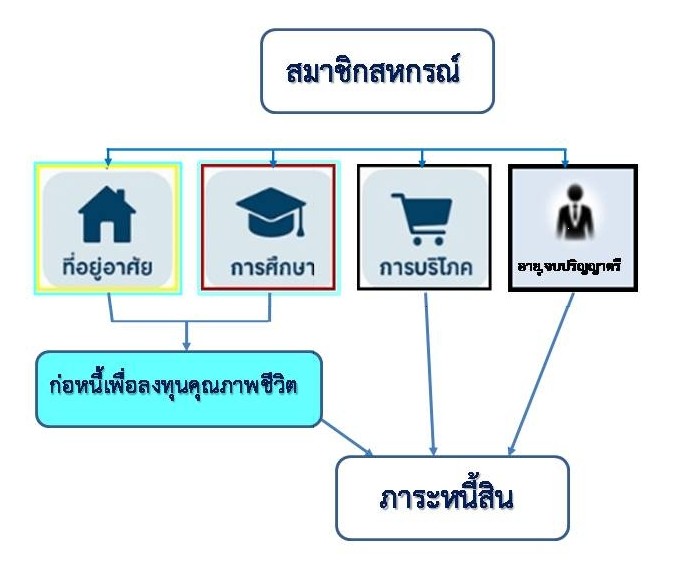
The results revealed that: The majority of cooperative members were female, aged between 41 and 50 years (38.9%). In terms of education, 82.5% had completed a bachelor’s degree. Regarding income, 13.5% earned between 50,001 and 55,000 baht per month. Most members (26.7%) had debts not exceeding 400,000 baht, while 26.3% reported having no debt. With respect to debt incurrence and management behaviors, members exhibited moderate levels of needs related to consumption, utilities, housing, and healthcare. For other needs, members consistently demonstrated spending behaviors influenced by personal values. Factors found to significantly affect the debt burden, at a statistically significant level, included being aged 21-30 years (B = -6.13, p = 0.015), holding a bachelor’s degree (B = 7.16, p = 0.005), consumption needs (B = 3.49, p = 0.015), housing needs (B = 4.19, p = 0.000), and educational needs (B = 3.35, p = 0.000). The regression model explained 47.3% of the variance in debt burden (R² = 0.473). These findings indicate that a considerable portion of debt arises from investments in quality of life rather than from extravagant consumption. This reflects a positive outlook on self-investment, aiming to generate long-term returns, which can be applied in personal financial planning and in the formulation of effective credit policies for the cooperative.
Article Details

This work is licensed under a Creative Commons Attribution-NonCommercial-NoDerivatives 4.0 International License.
เพื่อให้เป็นไปตามกฎหมายลิขสิทธิ์ ผู้นิพนธ์ทุกท่านต้องลงลายมือชื่อในแบบฟอร์มใบมอบลิขสิทธิ์บทความ ให้แก่วารสารฯ พร้อมกับบทความต้นฉบับที่ได้แก้ไขครั้งสุดท้าย นอกจากนี้ ผู้นิพนธ์ทุกท่านต้องยืนยันว่าบทความ ต้นฉบับที่ส่งมาตีพิมพ์นั้น ได้ส่งมาตีพิมพ์เฉพาะในวารสาร วิชาการธรรม ทรรศน์ เพียงแห่งเดียวเท่านั้น หากมีการใช้ ภาพหรือตารางของผู้นิพนธ์อื่นที่ปรากฏในสิ่งตีพิมพ์อื่นมาแล้ว ผู้นิพนธ์ต้องขออนุญาตเจ้าของลิขสิทธิ์ก่อน พร้อมทั้ง แสดงหนังสือที่ได้รับการยินยอมต่อบรรณาธิการ ก่อนที่บทความจะได้รับการตีพิมพ์References
ชัยธวัช คมวงษ์เทพ และวรรณรพี บานชื่นวิจิตร. (2566). การศึกษาปัญหาภาระหนี้สินของบุคลากรโรงพยาบาลทหารผ่านศึก. รายงานการประชุม Graduate School Conference, 6(1), 433.
ณัฐวุฒิ ศิริวัฒน์. (2562). พฤติกรรมการบริโภคแบบทันใจกับความเสี่ยงการเกิดหนี้สินในกลุ่มผู้มีรายได้ประจำ. วารสารการจัดการธุรกิจ, 10(1), 89-104.
ไทยพีบีเอส. (2567). วิกฤตการเงิน วัยทำงาน แก่ก่อนรวย. เข้าถึงได้จาก https://www.thaipbs.or.th/news/content/342198
ธนาคารไทยพาณิชย์. (2567). ชำระหนี้แค่ไหนเรียกว่าปลอดภัย. เข้าถึงได้จาก https://www.scb.co.th/th/personal-banking/loans/up.html
ธนาคารแห่งประเทศไทย. (2564). รายงานภาวะหนี้ครัวเรือนของประเทศไทย. เขาถึงได้จาก https://www.bot.or.th/
ธนาคารแห่งประเทศไทย. (2565). รายงานภาวะหนี้ครัวเรือนไทย. เข้าถึงได้จาก https://www.bot.or.th
นิพิฐพนธ์ สนิทเหลือ, วัชรีพร สาตร์เพ็ชร์ และญาดา นภาอารักษ์. (2562). การคำนวณขนาดตัวอย่างสำหรับงานวิจัยโดยใช้โปรแกรมสำเร็จรูป G*Power. วารสารวิชาการ สถาบันเทคโนโลยีแห่งสุวรรณภูมิ, 5(1), 496-507. https://so04.tci-thaijo.org/index.php/svittj/article/view/181958/136948
ปิยะวิชญ์ วุฒิสมบัติ และณัฏฐณิชา ฉายรัศมี. (2567). การศึกษาการบริโภคและการก่อหนี้ บัตรเครดิตของกลุ่มวัยเริ่มทำงานในพื้นที่กรุงเทพมหานครของประเทศไทย. วารสารสังคมศาสตร์ปัญญาพัฒน์, 6(4), 469-482.
พรทิพย์ แสงช่วง และศิวพงศ์ ธีรอำพน. (2564). ปัจจัยที่ส่งผลต่อการเป็นหนี้นอกระบบของประชาชนในกรุงเทพมหานคร และ ปริมณฑล. วารสารรัฐประศาสนศาสตร์มหาวิทยาลัยราชภัฏสวนสุนันทา, 4(2), 59-69.
พรพรรณษา สุขรัตน์, กลางใจ แสงวิจิตร, ธนาวุธ แสงกาศนีย์ และกุลวดี ลิ่มอุสันโน. (2566). การก่อหนี้และวิธีการจัดการหนี้สินที่ส่งผลต่ออิสรภาพทางการเงินของ สมาชิกสหกรณ์ออมทรัพย์แห่งหนึ่ง. วารสารการจัดการธุรกิจ มหาวิทยาลัยบูรพา, 13(1), 1-20. https://so01.tci-thaijo.org/index.php/BJBM/article/view/267391
วราภรณ์ อึ้งอารีย์วิทยา. (2567). ความต้องการและความสามารถในการจ่ายเพื่อที่อยู่อาศัยกลุ่มวัยเริ่มทำงานในเขตอำเภอเมืองจังหวัดขอนแก่น. Chulalongkorn University Theses and Dissertations (Chula ETD). 12655. https://digital.car.chula.ac.th/chulaetd/12655
สมชาย ใจดี. (2563). ความต้องการด้านการลงทุนและการศึกษากับภาระหนี้สินของครัวเรือนไทย. วารสารเศรษฐศาสตร์และการเงิน, 12(2), 45-60.
อนุสรณ์ ธรรมใจ. (2562). เศรษฐกิจครัวเรือนกับภาระหนี้สินในยุคใหม่. กรุงเทพฯ: จุฬาลงกรณ์มหาวิทยาลัย.
อัจฉราพร เรืองสกุล, อนุชา ภูริพันธุ์ภิญโญ และสุจิตรา รอดสมบุญ. (2566). ปัจจัยที่มีผลต่อความสามารถในการชำระหนี้เงินกู้ของสมาชิกสหกรณ์การเกษตรพยุหะคีรี จำกัด จังหวัดนครสวรรค์. วารสารสังคมศาสตร์เพื่อการพัฒนาท้องถิ่น มหาวิทยาลัยราชภัฏมหาสารคาม, 7(2), 20-29.
Atkinson, A., & Messy, F. -A. (2012). Measuring financial literacy: Results of the OECD/INFE Pilot Study (OECD Working Papers on Finance, Insurance and Private Pensions No. 15). OECD Publishing.
Becker, G. S. (1993). Human capital: A theoretical and empirical analysis, with special reference to education. (3rd ed.). Chicago: University of Chicago Press.
Best. J. W., & Kahn, J. V. (1993). Research in education. Boston: Allyn and Bacon.
Brown, S., Taylor, K., & Price, S. (2005). Debt and distress: Evaluating the psychological cost of credit. Journal of Economic Psychology, 26(5), 642-663.
Browning, M., & Lusardi, A. (1996). Household saving: Micro theories and micro facts. Journal of Economic Literature, 34(4), 1797-1855.
Katona, G. (1975). Psychological Economics. New York: Elsevier.
Maslow, A. H. (1970). Motivation and personality. (2nd ed.). New York: Harper & Row.
Squires, S., & Ho, H. W. L. (2023). Generation Z’s perceptions and attitudes toward debt: a case study of young consumers in rural Michigan, USA. Young Consumers, 24(2), 133-148.
Thompson, M. N., & Dahling, J. J. (2019). Employment and poverty: Why work matters in understanding poverty. American Psychologist, 74(6), 673-684. https://doi.org/10.1037/amp0000468
