An Evaluation of the Master’s degree in Education, Program in Educational Administration, Payap University by CIPP Model
Article Sidebar
Main Article Content
Abstract
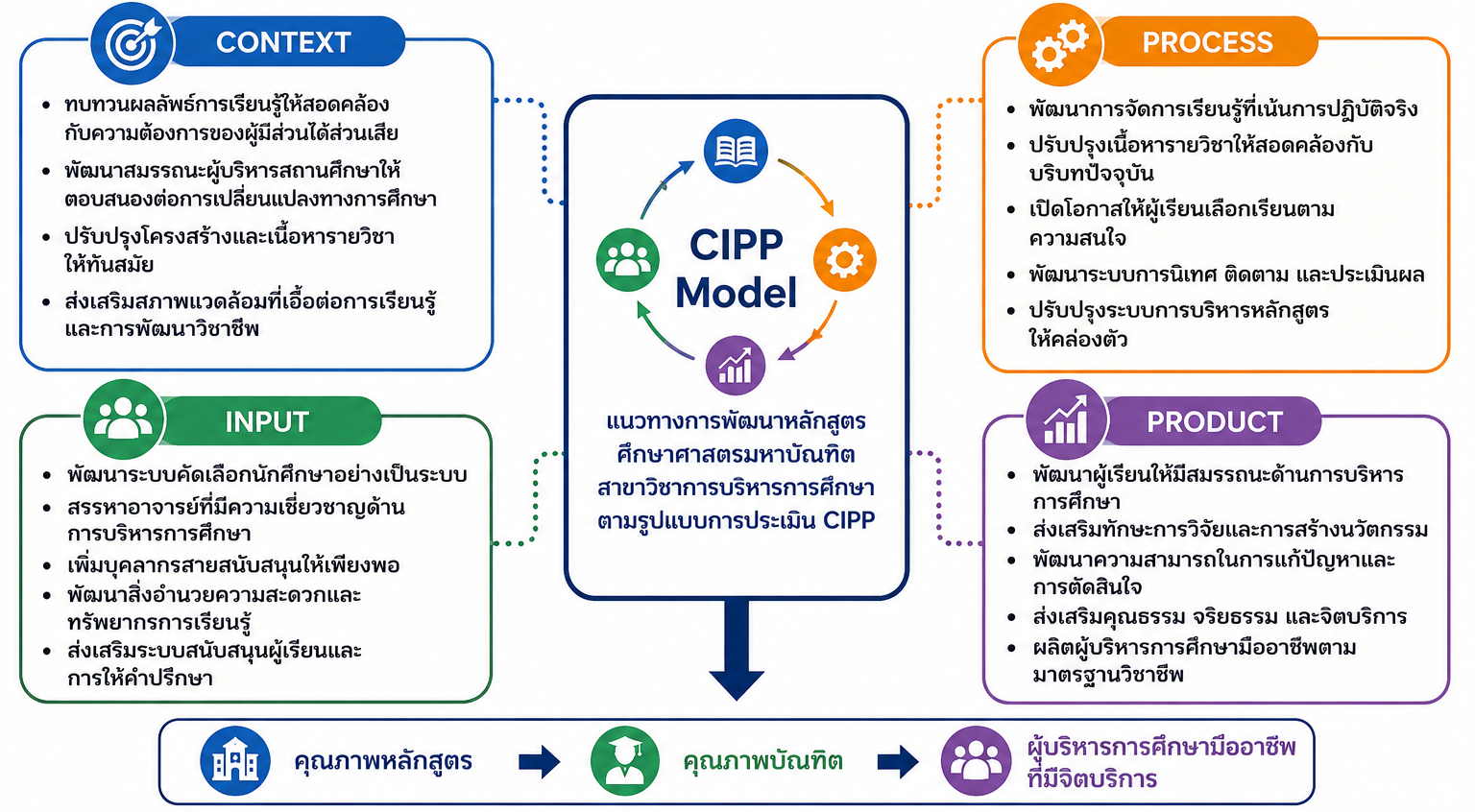
This research aimed to evaluate the Master of Education Program in Educational Administration (New Curriculum, 2021) at Payap University using the CIPP Evaluation Model, which consists of four dimensions: Context, Input, Process, and Product. The target groups included 8 program administrators and lecturers, 15 students enrolled in the 2021 academic year, 4 supervising instructors, 15 mentor administrators, 15 graduate employers and supervisors, and 15 graduates who completed the program in the 2022 academic year. The research instruments consisted of semi-structured interview forms, focus group discussion records, two curriculum evaluation questionnaires, and a graduate achievement survey. The first questionnaire assessed the context, input, and process dimensions, while the second assessed the product dimension. Both questionnaires employed a five-point rating scale with reliability coefficients of 0.94 and 0.87, respectively. Data were analyzed using frequency, percentage, mean, standard deviation, and content analysis.
The findings revealed that: (1) the overall evaluation of the Master of Education Program in Educational Administration was at a high level (M = 4.25). When considered by dimension, the context, process, and input dimensions were also rated at a high level, with mean scores of 4.28, 4.26, and 4.21, respectively. (2) The evaluation of the product dimension showed an overall rating at the highest level (M = 4.72). All aspects of program outcomes were rated at the highest level, with mean scores ranging from 4.56 to 4.85. The three highest-rated outcomes were commitment to good governance and service-mindedness (M = 4.85), lifelong learning capability (M = 4.80), and adaptability (M = 4.79), respectively.
Article Details

This work is licensed under a Creative Commons Attribution-NonCommercial-NoDerivatives 4.0 International License.
เพื่อให้เป็นไปตามกฎหมายลิขสิทธิ์ ผู้นิพนธ์ทุกท่านต้องลงลายมือชื่อในแบบฟอร์มใบมอบลิขสิทธิ์บทความ ให้แก่วารสารฯ พร้อมกับบทความต้นฉบับที่ได้แก้ไขครั้งสุดท้าย นอกจากนี้ ผู้นิพนธ์ทุกท่านต้องยืนยันว่าบทความ ต้นฉบับที่ส่งมาตีพิมพ์นั้น ได้ส่งมาตีพิมพ์เฉพาะในวารสาร วิชาการธรรม ทรรศน์ เพียงแห่งเดียวเท่านั้น หากมีการใช้ ภาพหรือตารางของผู้นิพนธ์อื่นที่ปรากฏในสิ่งตีพิมพ์อื่นมาแล้ว ผู้นิพนธ์ต้องขออนุญาตเจ้าของลิขสิทธิ์ก่อน พร้อมทั้ง แสดงหนังสือที่ได้รับการยินยอมต่อบรรณาธิการ ก่อนที่บทความจะได้รับการตีพิมพ์References
กระทรวงศึกษาธิการ. (2548). แนวทางการบริหารเกณฑ์มาตรฐานหลักสูตรระดับอุดมศึกษา พ.ศ. 2548. กรุงเทพฯ: กระทรวงศึกษาธิการ.
กาญจนา คุณารักษ์. (2549). พื้นฐานการพัฒนาหลักสูตร. (พิมพ์ครั้งที่ 2). นครปฐม: มหาวิทยาลัยศิลปากร.
เกษม วัฒนชัย. (2546). การบริหารเพื่ออการพัฒนาคุณภาพ. กรุงเทพฯ: 21 เซ็นจูรี่จํากัด.
ชัชจริยา ใบลี, นวัตกร หอมสิน และธีรพบ เพ็งจันทร์. (2564). การประเมินหลักสูตรปรัชญาดุษฎีบัณฑิต สาขาวิชาการบริหารการศึกษา บัณฑิตวิทยาลัย มหาวิทยาลัยราชภัฏอุดรธานี. วารสารมหาวิทยาลัยนราธิวาสราชนครินทร์ สาขามนุษยศาสตร์และสังคมศาสตร์, 8(2), 108-126.
นิพนธ์ วรรณเวช, จุมพจน์ วนิชกุล, วัชรี ชูชาติ, สุริยงค์ ชวนขยัน, พงษ์ศักดิ์ รวมชมรัตน์ และสาโรจน์ เผ่าวงศากุล. (2564). การประเมินหลักสูตรครุศาสตรมหาบัณฑิต สาขาวิชาการบริหารการศึกษา หลักสูตรปรับปรุง พ.ศ. 2559 คณะครุศาสตร์ มหาวิทยาลัยราชภัฏกาญจนบุรี. วารสารศิลปศาสตร์และอุตสาหกรรมบริการ, 4(2), 242-253.
บุญชม ศรีสะอาด และอรนุช ศรีสะอาด. (2551). การประเมินหลักสูตรการศึกษาดุษฎีบัณฑิต สาขาวิชาการบริหารและพัฒนาการศึกษา คณะศึกษาศาสตร์ มหาวิทยาลัยมหาสารคาม. มหาสารคาม: คณะศึกษาศาสตร์ มหาวิทยาลัยมหาสารคาม.
ปาริชาติ บัวเจริญ และประภัสสร สมสถาน. (2565). แนวทางการประกันคุณภาพการศึกษาระดับหลักสูตร. วารสารปัญญา, 29(3), 141-155. https://so06.tci-thaijo.org/index.php/panya-thjo/article/view/259223
พจนีย์ มั่งคั่ง, กัญภร เอี่ยมพญา, ศิริวัฒน์ จิระเดชประไพ, พรทิพย์ คำชาย, สมศักดิ์ เอี่ยมคงสี, ลินดา นาคโปย และอำนาจ บุญประเสริฐ. (2561). การประเมินหลักสูตรครุศาสตรมหาบัณฑิต สาขาวิชาการบริหารการศึกษา (หลักสูตรปรับปรุง ปี พ.ศ. 2559). คณะครุศาสตร์ มหาวิทยาลัยราชภัฎราชนครินทร์. วารสารวิชาการหลักสูตรและการสอน มหาวิทยาลัยราชภัฎสกลนคร, 10(28), 243-255.
รัตนะ บัวสนธ์. (2556). CIPP และ CIPPIEST มโนทัศที่คาดเคลื่อนและถูกต้องในการใช้. วารสารศิลปากรศึกษาศาสตร์วิจัย, 5(2), 7-24.
ลัดดาวัลย์ เพชรโรจน์. (2562). การประเมินหลักสูตรศึกษาศาลตรมหาบัณฑิต สาขาวิชาการบริหารการศึกษา มหาวิทยาลัยราชพฤกษ์ด้วยรูปแบบ CIPPIEST. วารสารมนุษยศาสตร์และสังคมศาสตร์ มหาวิทยาลัยราชพฤกษ์, 5(2), 19-36.
วิชัย วงษ์ใหญ่. (2554). การพัฒนาหลักสูตรระดับอุดมศึกษา. กรุงเทพฯ: ธเนศวรการพิมพ์.
สมหวัง พิธิยานุวัฒน์. (2553). วิธีวิทยาการประเมินศาสตร์แห่งคุณค่า. (พิมพ์ครั้งที่ 5). กรุงเทพฯ: จุฬาลงกรณ์มหาวิทยาลัย.
สำเริง อ่อนสัมพันธ์. (2560). การประเมินหลักสูตรศึกษาศาสตรมหาบัณฑิต สาขาวิชาการบริหารการศึกษา คณะศึกษาศาสตร์ มหาวิทยาลัยศิลปากร. วารสารศิลปากรศึกษาศาสตร์วิจัย, 19(1), 12-27.
สุชาดา นันทะไชย, มณฑป ไชยชิต, สุดารัตน์ สารสว่าง, วิสุทธ์ วิจิตรพัชราภรณ์ และพร้อมพิไล บัวสุวรรณ. (2552). การประเมินหลักสูตรศึกษาศาสตรดุษฎีบัณฑิต สาขาวิชาการบริหารการศึกษา คณะศึกษาศาสตร์ มหาวิทยาลัยเกษตรศาสตร์. วารสารสักทอง, 15(1), 91-103.
สุเทพ อ่วมเจริญ. (2555). การพัฒนาหลักสูตร ทฤษฎีและการปฏิบัติ. (พิมพ์ครั้งที่ 5). นครปฐม: มหาวิทยาลัยศิลปากร.
Madaus, G. F., Scriven, M., & Stufflebeam, D. L. (Eds.). (1988). Evaluation models: Viewpoints on educational and human services evaluation. (2nd ed.). London: Kluwer Academic Publishers.
Shinkfield, A. J., & Stufflebeam, D. L. (1995). Teacher evaluation: Guide to effective practice. Dordrecht, The Netherlands: Kluwer Academic Publishers.
Stufflebeam, D. L. (2003). The CIPP model for evaluation. In T. Kellaghan & D. L. Stufflebeam (Eds.), International handbook of educational evaluation (pp. 31-62). Dordrecht, The Netherlands: Kluwer Academic Publishers.
