A Case Study of Improving English Speaking Ability for Presentation Using Audio Lingual Method
Article Sidebar
Main Article Content
Abstract
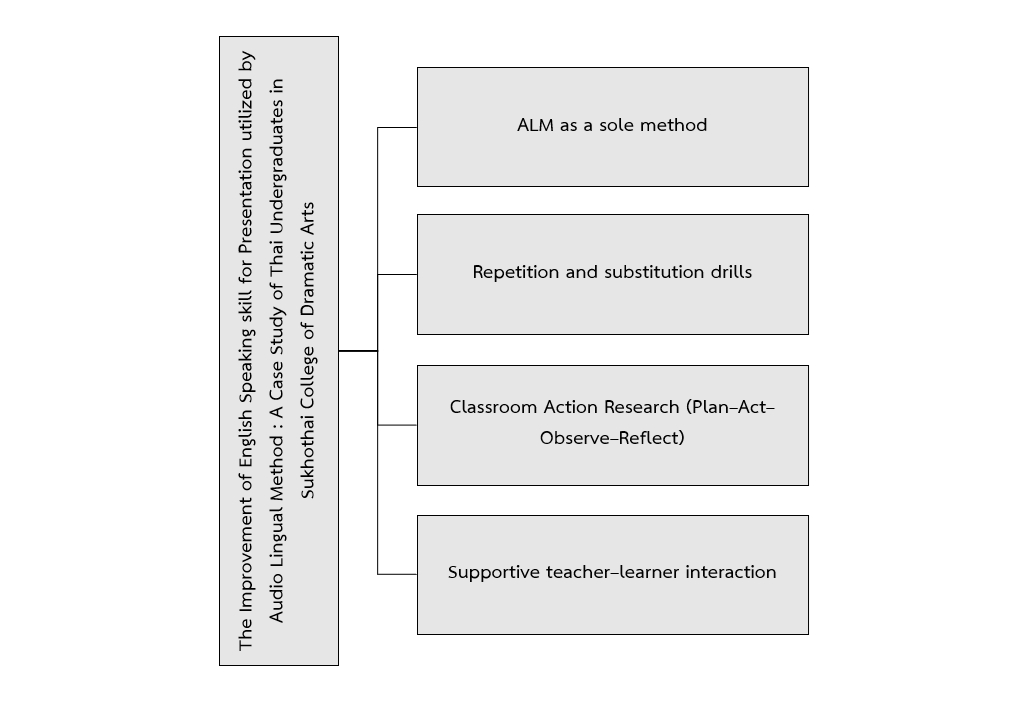
The Audio-Lingual Method (ALM) has long been accepted as an English language teaching approach for developing learners’ listening and speaking skills. It emphasizes habit formation through imitation, repetition, and corrective feedback between learner and instructor an approach that shares similarities with instructional methods in Thai dance and music. This research article presents the application of ALM to enhance learners’ English speaking ability for presentations, utilizing ALM as the sole instructional method. The study aimed to compare the English-speaking performance of undergraduate students before and after the implementation of ALM. The participants were 20 undergraduate students majoring in Thai dance and music at Sukhothai College of Dramatic Arts, all of whom were enrolled in an academic English course during the second semester of the 2024 academic year. Research instruments included: (1) ALM-based learning management plans, and (2) learning materials, activities, and assignments across lesson chapters. The study employed a classroom action research framework based on Jean McNiff (1998), following the cyclical process of planning, acting, observing, and reflecting. Data were analyzed using mean, standard deviation, percentage, and the Wilcoxon Signed-Ranks Test.
Findings revealed that: the learning outcomes aligned with the research objectives. Initially, students had difficulty with (1) accurate pronunciation of consonants and vowels, (2) correct syllable stress and appropriate intonation, and (3) grammatical correctness in speech. Improvements in these areas were observed progressively across the three action research cycles. Evaluations were based on students’ performance in presentations, activity participation, and assignment completion. Results showed that the post-test mean score (M = 50.60) was significantly higher than the pre-test score. The Wilcoxon Signed-Ranks Test confirmed that students’ speaking performance after the intervention was significantly improved at the .01 level. The findings align with previous ALM studies, which emphasize the effectiveness of repetition and substitution drills in enhancing learners’ pronunciation and grammatical competence. Furthermore, the study highlights parallels between ALM and traditional Thai performing arts instruction, suggesting pedagogical compatibility and potential for cross-disciplinary application.
Article Details

This work is licensed under a Creative Commons Attribution-NonCommercial-NoDerivatives 4.0 International License.
เพื่อให้เป็นไปตามกฎหมายลิขสิทธิ์ ผู้นิพนธ์ทุกท่านต้องลงลายมือชื่อในแบบฟอร์มใบมอบลิขสิทธิ์บทความ ให้แก่วารสารฯ พร้อมกับบทความต้นฉบับที่ได้แก้ไขครั้งสุดท้าย นอกจากนี้ ผู้นิพนธ์ทุกท่านต้องยืนยันว่าบทความ ต้นฉบับที่ส่งมาตีพิมพ์นั้น ได้ส่งมาตีพิมพ์เฉพาะในวารสาร วิชาการธรรม ทรรศน์ เพียงแห่งเดียวเท่านั้น หากมีการใช้ ภาพหรือตารางของผู้นิพนธ์อื่นที่ปรากฏในสิ่งตีพิมพ์อื่นมาแล้ว ผู้นิพนธ์ต้องขออนุญาตเจ้าของลิขสิทธิ์ก่อน พร้อมทั้ง แสดงหนังสือที่ได้รับการยินยอมต่อบรรณาธิการ ก่อนที่บทความจะได้รับการตีพิมพ์References
Boonpok, P. (2007). The development of spoken English proficiency of adult learners using the Audiolingual Method. (Master’s thesis). Bangkok: Thammasat University. (In Thai).
Boonpok, P. (2018). Research on the Audio-Lingual Method (ALM) in Foreign Language Teaching from the Past to the Present. Language and Linguistics, 29(2), 61-80. https://so04.tci-thaijo.org/index.php/joling/article/view/135661
Charoenpanit, P. (2014). The effect and affecting factors of using Audiolingual Method to develop spoken English proficiency of informal workers. (Master’s thesis). Bangkok: Thammasat University. (In Thai).
Chunsuvimol, B. (2011). ALM and the teaching of basic English speaking in Thailand. phasaalae phasaasaat (Language and Linguistics), 30(1), 42-54. (In Thai).
Chunsuvimol, B., & Charoenpanit, P. (2017). Effectiveness of the Audiolingual Method: A Further Synthesis of Research Through 2015. SSRN Electronic Journal. https://doi.org/10.2139/ssrn.2962925
Hidayati, K. H. (2016). Using Audio Lingual Method to Improve Students Pronunciation Ability of Darul Mahdiah Private School. ELLITE: Journal of English Language, Literature, and Teaching, 1(1), 25-34.
McNiff, J. (1988). Action research: Principles and practice. London: Macmillan Education.
Racelis, J. V., & Matsuda, P. K. (2013). Integrating process and genre into the second language writing classroom: Research into practice. Language Teaching, 46(3), 382393. https://doi.org/10.1017/S0261444813000116
Skinner, B. F. (1957). Verbal Behavior. New York: Appleton-Century-Crofts.
Zhang, Y., Baills, F., & Prieto, P. (2024). Embodied music training can help improve speech imitation and pronunciation skills. Language Teaching, 1-23. Advance online publication. https://doi.org/10.1017/S0261444824000363
