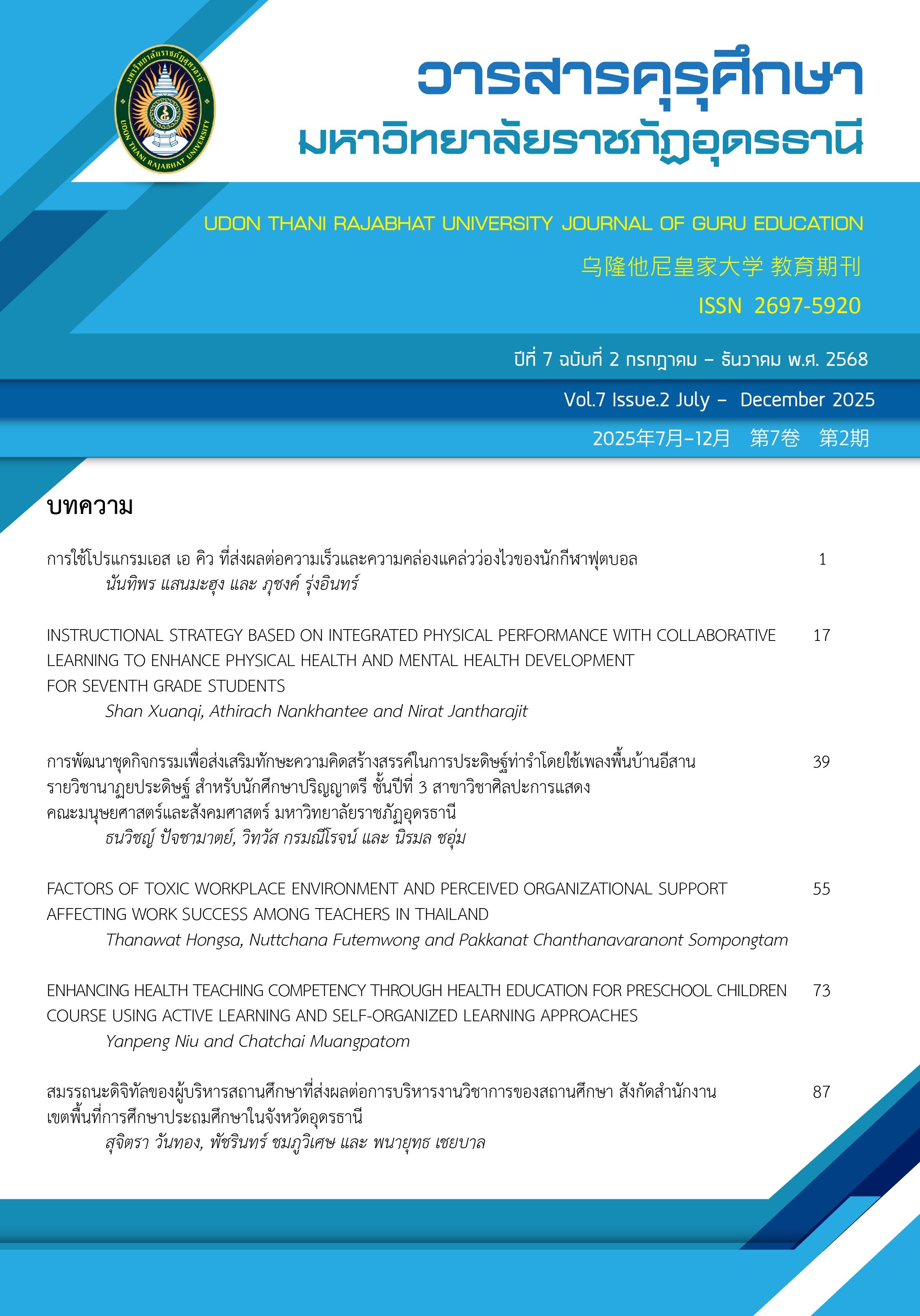
THE DEVELOPMENT ACTIVITY TO ENCOURAGE OF SKILLS IN CREATING CHOREOGRAPHY THROUGH NORTHEASTERN FOLK SONG PRACTICES: A CASE STUDY OF CHOREOGRAPHY IN BACHELOR OF FINE ARTS PROGRAM IN PERFORMING ARTS, FACULTY OF HUMANITIES AND SOCIAL SCIENCES, UDON THANI RAJABHAT UNIVERSITY.
Article Sidebar
Main Article Content
Abstract
This study aimed to develop and evaluate the effectiveness of a set of learning activities designed to enhance creative thinking skills in choreography using Northeastern Thai folk songs, based on the 80/80 efficiency criterion. The study also aimed to measure students’ creative thinking achievement before and after the intervention (pretest–posttest), focusing on four dimensions of creativity originality, fluency, flexibility, and elaboration, according to Guilford’s creative thinking framework and related theories. The research employed a quasi-experimental design with a one-group pretest–posttest approach. The participants consisted of 12 students selected through purposive sampling. The research instruments included eight learning activity sets, pre- and post-tests, and performance evaluation forms. Data were collected over 10 weeks, with two hours of instruction per week, totaling 20 hours. The data were analyzed using the mean, standard deviation, and t-test. The results indicated that the developed activities met the 80/80 efficiency criterion, and students’ posttest scores were significantly higher than their pretest scores at the .05 level. These findings demonstrate that the learning activities effectively enhanced students’ creative thinking skills, particularly in applying Northeastern Thai folk songs to choreography, leading to a clear and significant improvement in students’ creative abilities.
Article Details
ข้อความที่ปรากฏในบทความแต่ละเรื่องในวารสารวิชาการเล่มนี้ ไม่ใช่ความคิดเห็นและความรับผิดชอบของคณะผู้จัดทำ บรรณาธิการ กองบรรณาธิการ และมหาวิทยาลัยราชภัฏอุดรธานี ซึ่งความรับผิดชอบด้านเนื้อหาและการตรวจร่างบทความแต่ละเรื่องเป็นของผู้เขียนแต่ละท่าน
References
กุลรดา พุทธผล. (2563). การพัฒนาความคิดสร้างสรรค์ของนักเรียนชั้นประถมศึกษาปีที่ 6 ผ่านการจัดการเรียนการสอนรูปแบบนาฏศิลป์สร้างสรรค์ (PIIACR). วารสารพัฒนศิลป์วิชาการ, 4(1), 117-131.
ขวัญฤดี ตันตระบัณฑิตย์. (2561). การจัดการนวัตกรรมและความคิดสร้างสรรค์. ขอนแก่น: ขอนแก่นการพิมพ์.
ชัยยงค์ พรหมวงศ์. (2556). การทดสอบประสิทธิ์ภาพสื่อหรือชุดการสอน. วารสารศิลปากรศึกษาศาสตร์วิจัย, 5(1), 7-20.
ธวัชชัย ซ้ายศรี. (2565). สื่อการสอนรายวิชาหน้าพาทย์ นาฏยศัพท์ และภาษานาฏศิลป์ วิทยาลัยนาฏศิลป์พัทลุง สถาบันบัณฑิตพัฒนศิลป์ กระทรวงวัฒนธรรม. สืบค้นเมื่อวันที่ 15 ตุลาคม พ.ศ. 2567, จาก https://media.bpi.ac.th/admin/attach/w2/f20190315111723_9PyCn2UGHE.pdf.
ประพันธ์ศิริ สุเสารัจ. (2551). การพัฒนาการคิด. กรุงเทพฯ: สำนักพิมพ์ประพันธ์ศิริ.
วนิช สุธารัตน์. (2547). ความคิดและความคิดสร้างสรรค์. กรุงเทพฯ : สุวีริยาสาส์น.
วิจารณ์ พานิช. (2555). วิถีสร้างการเรียนรู้เพื่อศิษย์ในศตวรรษที่ 21. กรุงเทพฯ: มูลนิธิสดศรี-สฤษดิ์วงศ์.
วีระ สุดสังข์. (2550). การคิดวิเคราะห์ คิดอย่างมีวิจารณญาณและคิดสร้างสรรค์. กรุงเทพฯ: สุวีริยาสาส์น.
วีรภัทร จินตะไล. (2560). การสร้างกิจกรรมนาฏศิลป์ พัฒนาความคิดสร้างสรรค์ของนักเรียนชั้นประถมศึกษาปีที่ 1 โรงเรียนวัดตาลเอน (โศภนชนูปถัมภ์). วิทยานิพนธ์ปริญญาการศึกษามหาบัณฑิต สาขาวิชาศิลปศึกษา มหาวิทยาลัยศรีนครินทรวิโรฒ.
สุรพล วิรุฬห์รักษ์. (2543). นาฏยศิลป์ปริทรรศน์. กรุงเทพฯ: สำนักพิมพ์แห่งจุฬาลงกรณ์มหาวิทยาลัย.
อุดมวดี วรรณกุล. (2564). การพัฒนาชุดกิจกรรมการเรียนรู้ตามแนวคิดเกมมิฟิเคชันเพื่อส่งเสริมทักษะการทำงานเป็นทีมในรายวิชาการศึกษาค้นคว้าและสร้างองค์ความรู้. วิทยานิพนธ์ปริญญาการศึกษามหาบัณฑิต สาขาวิชาเทคโนโลยีการศึกษา มหาวิทยาลัยศรีนครินทร์วิโรฒ.
