
Structural Innovation and Local Agency in Siam The Hennebique System in Bangkok’s Ananta Samakhom Throne Hall
Article Sidebar
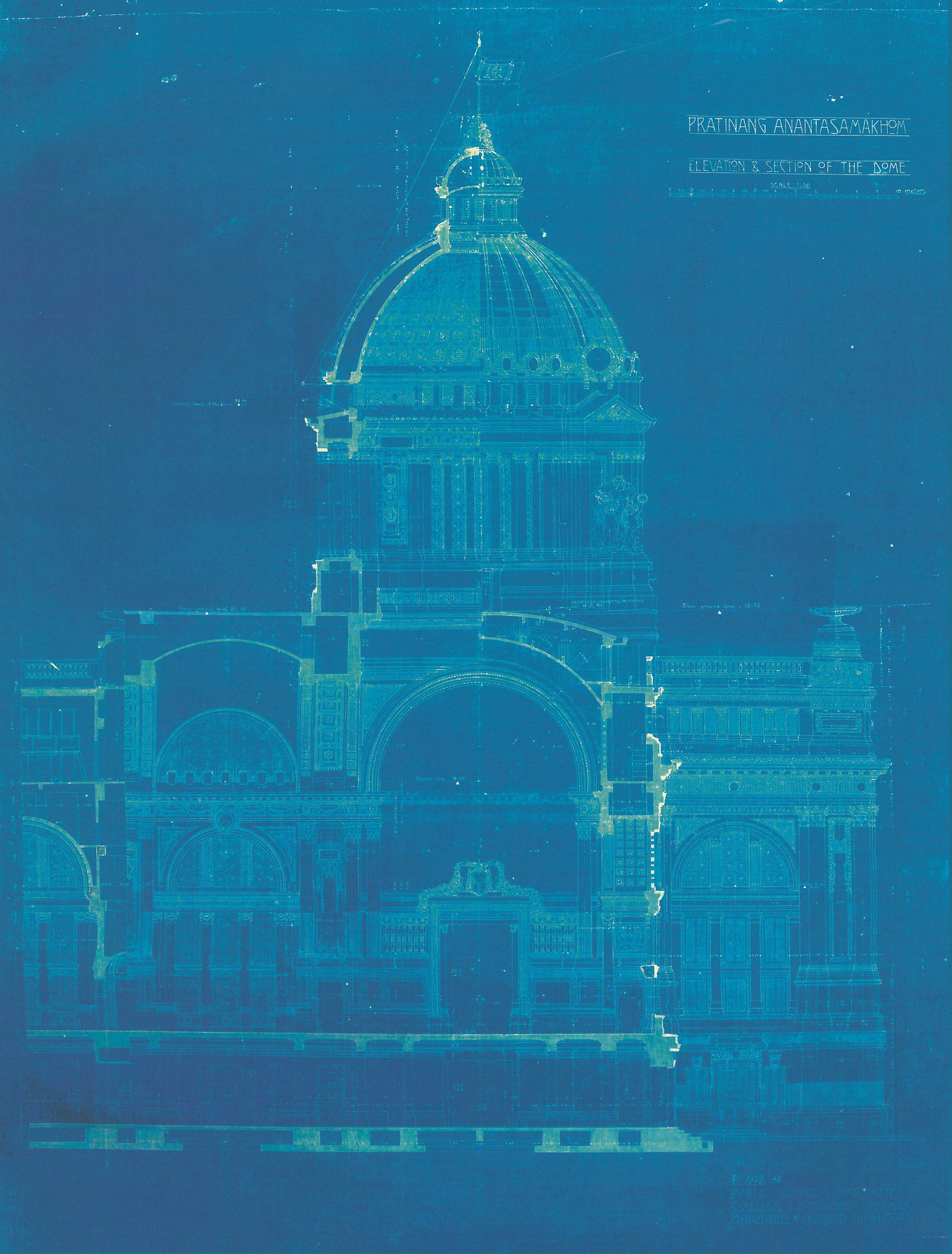
Main Article Content
Abstract
The adoption of the French Hennebique system in constructing the Ananta Samakhom Throne Hall (1907–1915) introduced advanced reinforced concrete to Siam, but also imposed proprietary constraints, limiting local control over design and contractor selection. Siam’s Public Works Department (PWD) engineers were relegated to supervisory roles under Hennebique’s patent. Meanwhile, Bangkok’s soft soil led to foundation settlement, exposing flaws in the Compressol pile system, employed by Hennebique’s concessionaire. To resolve this, E.G. Gollo, an Italian engineer, employed by the Siamese government, devised a caisson foundation, stabilizing the structure and reducing reliance on Hennebique’s specialists. This article examines how Gollo’s intervention marked a crucial shift in Siam’s modernization, strengthening local agency in architectural development and technological adaptation.
Article Details

This work is licensed under a Creative Commons Attribution-NonCommercial 4.0 International License.
References
Primary Sources
• Bangkok Times. 1908. The Throne Hall. Bangkok Times, 12 November: 5.
• Chulalongkorn, King. 2477 BE (1934 CE). จดหมายเหตุพระราชกิจรายวัน ภาค 7 [Daily Royal Letters of His Majesty King Chulalongkorn: Part 7]. Published on the occasion of the royal cremation of MC Dhamrongsiri Sritawat (ม.จ.ธำรงศิริ ศรีธวัช), 2 July 1934. Bangkok: Sophon Phiphat Thanakon Printing House.
―――. 2482 BE (1939 CE). สำเนาพระราชหัตถ์เลขาส่วนพระองค์พระบาทสมเด็จพระจุลจอมเกล้าเจ้าอยู่หัวถึงเจ้าพระยายมราช (ปั้น สุขุม) กับประวัติเจ้าพระยายมราช [Copy of the Royal Correspondence from King Chulalongkorn to Chao Phraya Yommarat (Pan Sukhum) with the Biography of Chao Phraya Yommarat]. Published on the occasion of the royal cremation of Chao Phraya Yommarat (Pan Sukhum), 10 April 1939. Bangkok: Bamrungtham Printing House.
―――. 2514 BE (1971 CE). จดหมายเหตุพระราชกิจรายวัน ภาค 5 และภาค 6 พระราชนิพนธ์ในพระบาทสมเด็จพระจุลจอมเกล้าเจ้าอยู่หัว [Daily Royal Letters of His Majesty King Chulalongkorn: Part 5 and Part 6]. Published on the occasion of the royal cremation of Police Colonel Ploen Srisakorn (พันตำรวจเอก เพลิน ศรีสาคร) and Mrs. Kanha Srisakorn (นางกัณหา ศรีสาคร), 21 December 1971. Bangkok: Fine Arts Department [2nd ed.; 1st ed. 2477].
• Damrong Ratchanuphap, Prince (กรมพระยาดำรงราชานุภาพ). 2475 BE (1932 CE). คำนำ [Foreword]. In จดหมายเหตุเรื่องก่อฤกษพระที่นั่งจักรีมหาปราสาท คัดลอกจากหนังสือค๊อต [Records of the Auspicious Ceremony of the Chakri Maha Prasat Throne Hall Transcribed from the Court Book]. Bangkok: Sophon Phiphat Thanakon Printing House.
• Foreign Office of Great Britain. 1902. Diplomatic and Consular Reports: Report for the Year 1901 on the Trade of the Consular District of Bangkok. London: His Majesty’s Stationery Office.
• NAT (กองจดหมายเหตุแห่งชาติ กรมศิลปากร). 2527 BE (1984 CE). จดหมายเหตุพระราชพิธี รัชมังคลาภิเษก ร.ศ. 126, 127 [The Royal Chronicle of the Ratchamangkhalaphisek Ceremony, 1907–1908]. Bangkok: Fine Arts Department.
• Statistical Office, H.M. Customs. 1908–1913. The Foreign Trade and Navigation of the Port of Bangkok. n.p.: Published by Order of the Director-General.
Secondary Sources
• Bandit Jurasai & Pirasri Povatong (บัณฑิต จุลาสัย และ พีรศรี โพวาทอง). 2550 BE (2007 CE). การศึกษาข้อมูลในเอกสารประวัติศาสตร์สถาปัตยกรรม พระราชวังดุสิต [The Study of Historic Documents on the Architectural History of Dusit Palace]. Unpublished Technical Report. Bangkok: Chulalongkorn University.
• Brown, Ian. 1988. The Elite and the Economy in Siam c. 1890–1920. Singapore: Oxford University Press.
• Chatri Prakitnonthakan (ชาตรี ประกิตนนทการ). 2563 BE (2020 CE). ศิลปะ – สถาปัตยกรรมคณะราษฎร สัญลักษณ์ทางการเมืองในเชิงอุดมการณ์ [The Art and Architecture of the People’s Party: Political Symbols in Ideological Aspect]. Bangkok: Matichon Press.
• Chot Kalayanamitr (โชติ กัลยาณมิตร). 2526 BE (1983 CE). อิทธิพลสถาปัตยกรรมแบบตะวันตกในสมัยกรุงรัตนโกสินทร์, 2325–2525 [Influence of Western Architecture in the Rattanakosin Period, 1782–1982 CE]. หน้าจั่ว/NAJUA, Special Issue: 57–76.
• Chua, Lawrence (ลอเรณศ์ ฉั่ว). 2013. กรุงเทพฯ/สำเพ็ง: หนึ่งเมืองสองนคร เชื้อชาติ สถาปัตยกรรม และชาตินิยมในกรุงเทพฯ ต้นศตวรรษที่ 20 [Bangkok/Sampheng: One Polity Two Cities]. อ่าน/READ 5(1): 154–165.
• Curley, Robert. 2010. Reinforced Concrete. In The Britannica Guide to Inventions that Changed the Modern World, ed. by Robert Curley, 212–214. New York: Britannica Educational Publishing.
• Cusack, Patricia. 1986. Architects and the Reinforced Concrete Specialist in Britain 1905–08. Architectural History 29: 183–196.
―――. 1987. Agents of Changes: Hennebique, Mouchel and Ferro Concrete in Britain, 1897–1908. Construction History 3: 61–74.
• Duangchit Chitrabongse, Mom Chao (ดวงจิตร จิตรพงศ์, ม.จ.). 2535 BE (1992 CE). ป้าป้อนหลาน [An Aunt Feeding her Niece]. Bangkok: Watthanchai Printing [2nd ed.; 1st ed. 2511 BE].
• Filippi, Francesca B. 2008. Da Torino a Bangkok: Architetti e ingegneri nel regno del Siam. Venezia: Marsilio.
―――. 2010. Early 20th Century Bangkok: An International Building Site. Asian Journal of Literature, Culture, and Society 4(2): 1–24.
• Filippi, Francesca B. & Fasoli, Vilma. 2014. The Penetration of Italian Professionals in the Context of the Siamese Modernization. ABE Journal 5: 1–28. https://doi.org/10.4000/abe.841.
• Forty, Adrian. 2012. Concrete and Culture. London: Reaktion Books.
• Gallotti, Paul. 1910. Le Béton armé et les ponts au Siam. Le Béton Armé 144: 67–69.
• Koompong Noobanjong. 2013. The Aesthetic of Power: Architecture, Modernity, and Identity from Siam to Thailand. Bangkok. White Lotus.
• Kullada Kesboonchoo Mead. 2004. The Rise and Decline of Thai Absolutism. London: Routledge.
• Neungreudee Lohapon (หนึ่งฤดี โลหผล). 2543 BE (2000 CE). The Contribution of E. Giovanni Gollo to the Artistic and Architectural Movements in Siam. In พันเอก ยี.อี. เยรินี และวิศวกร กอลโล: ข้าราการไทย [Col. G.E. Gerini and Ing. E.G. Gollo: Italians at the Court of Siam], 54–60. Bangkok: Silpakorn University.
• Nithi Sthapitanonda (นิธิ สถาปิตานนท์), ed. 2008. แบบสถาปัตยกรรมอาคารและสถานที่ทางประวัติศาสตร์ในประเทศไทย [Architectural Drawings of Historic Buildings & Places in Thailand]. Bangkok: Li-Zenn.
• Peleggi, Maurizio. 2002. Lords of Things: The Fashioning of the Siamese Monarchy’s Modern Image. Honolulu: University of Hawai‘i Press.
• Pinai Sirikiatikul (พินัย สิริเกียรติกุล). 2565 BE (2022 CE). กำเนิดรับเหมาก่อสร้างในสยาม [The Origin of General Contracting in Siam]. หน้าจั่ว/NAJUA 19(2): 72–111.
• Ploy & Ju (นายร้อยโทพลอย และนายร้อยโทจู). 1909. ตำราก่อสร้าง เล่ม 1 [Construction Manual, Vol. 1]. Bangkok: Samaki Printing House.
• Porphant Ouyyanont. 2015. The Foundation of the Siam Commercial Bank and the Siam Cement Company: Historical Context and Alternative Historiographies. Sojourn: Journal of Social Issues in Southeast Asia 30(2): 455-496.
• Seidenfaden, Erik. 1928. Guide to Bangkok with Note on Siam. Bangkok: Royal State Railway Department of Siam [2nd ed.; 1st ed. 1927].
• Somchart Chungsiriarak (สมชาติ จึงสิริอารักษ์). 2553 BE (2010 CE). สถาปัตยกรรมตะวันตกในสยาม สมัยรัชกาลที่ 4–พ.ศ. 2480 [Western Architecture in Siam from the Reign of King Rama IV to 1937]. Bangkok: Silpakorn University.
• Sumet Jumsai na Ayudhya (สุเมธ ชุมสาย ณ อยุธยา). 2525 BE (1982 CE). น้ำ [Water]. In ลักษณะไทย [Thai Characteristics], ed. by MR Kukrit Pramoj (ม.ร.ว. คึกฤทธ์ ปราโมช), 142–294. Bangkok: Thai Wattana Panich.
• Thongchai Winichakul. 2000. The Quest for “Siwilai”: A Geographical Discourse of Civilizational Thinking in the Late Nineteenth and Early Twentieth-Century Siam. The Journal of Asian Studies 59(3): 528–549. https://doi.org/10.1017/S0021911800014327.
• Wyatt, David K. 1969. The Politics of Reform in Thailand: Education in the Reign of King Chulalongkorn. Bangkok: Thai Wattana Panich.
