
The Careers of Islam’s Transcultural Trendsetters in Central and Southern Thailand
Article Sidebar
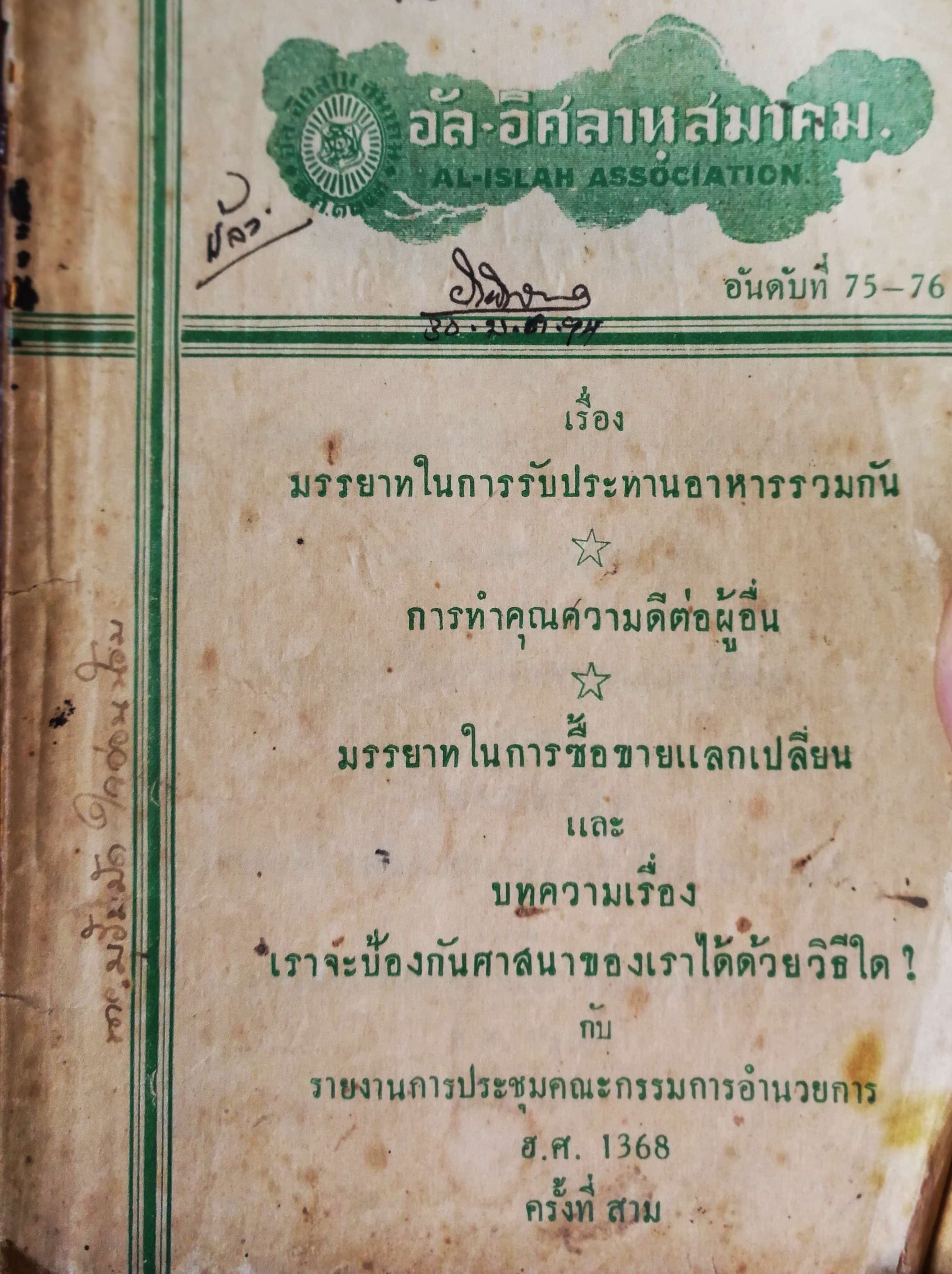
Main Article Content
Abstract
Muslims in Thailand, as with those across the Muslim World, have been influenced by modernist, reformist, and revivalist trends from the Middle East and South Asia, challenging traditional religious leadership. This article applies Nile Green’s religious economies model to Thai Islam, focusing on five key figures: (1) ‘Ahmad Wahab, (2) Direk Kulsiriswad, (3) and Sheikh Rida ‘Ahmad Samadi in Bangkok, and (4) Ustadh ‘Abdullah Chinarong and (5) Ismail Lutfi Japakiya in the far South. We document the impact of transnational Islamic movement, the connections between them, and how all these were multilingual, cosmopolitan middlemen that reshaped the local practice of Islam in Thailand’s diverse religious landscape.
Article Details

This work is licensed under a Creative Commons Attribution-NonCommercial 4.0 International License.
References
• Amporn Marddent. 2016. Gender Piety of Muslim Women in Thailand. PhD Dissertation. Frankfurt: Johann Wolfgang Goethe University.
• Braam, Ernesto H. 2006. Traveling with the Tablighi Jama‘at in South Thailand. ISIM Review 17: 42–43.
―――. 2013. Malay Muslims and the Thai-Buddhist State: Confrontation, Accommodation and Disengagement. In Encountering Islam: The Politics of Religious Identities in Southeast Asia, ed. by Hui Yew-Foong, 271–312. Singapore: Institute of Southeast Asian Studies.
• Bradley, Francis R. 2010. The Social Dynamics of Islamic Revivalism in Southeast Asia: The Rise of the Patani School, 1785–1909. PhD Dissertation. Madison: University of Wisconsin.
• Bruckmayr, Philipp. 2019. Cambodia’s Muslims and the Malay World: Malay Language, Jawi Script, and Islamic Factionalism from the 19th Century to the Present. Leiden: Brill.
• Buehler, Arthur F. 1998. Sufi Heirs of the Prophet: The Indian Naqshbandiyya and the Rise of the Mediating Sufi Shaykh. Columbia: University of South Carolina Press.
• Dalrymple, Graham H. & Joll, Christopher M. 2021. The Muslim Sultans of Singora in the 17th Century. Journal of the Siam Society 109(1): 37–62.
―――. 2022. The Demise and Rise of Singora’s Sultan Sulaiman Lineage. Journal of the Siam Society 110(2): 53–84.
• Daungyewa Utarasint. 2018. Voices and Votes Amid Violence: Power and Electoral Accountability in Thailand’s Deep South. PhD Dissertation. Canberra: Australian National University.
• Dickson, William Rory. 2022. Sufism and Shari‘a: Contextualizing Contemporary Sufi Expressions. Religions 13(5): 449. https://doi.org/10.3390/rel13050449.
• Federspiel, Howard M. 2001. Islam and Ideology in the Emerging Indonesian State: The Persatuan Islam (Persis), 1923–1957, Social, Economic, and Political Studies of the Middle East and Asia. Leiden: Brill.
• Finke, Roger & Stark, Rodney. 2005. The Churching of America, 1776–2005: Winners and Losers in our Religious Economy. New Brunswick: Rutgers University Press.
• Green, Nile. 2009. Journeymen, Middlemen: Travel, Transculture, and Technology in the Origins of Muslim Printing. International Journal of Middle East Studies 41(2): 203–224.
―――. 2011. Bombay Islam: The Religious Economy of the West Indian Ocean, 1840–1915. Cambridge, UK: Cambridge University Press.
―――. 2015. Terrains of Exchange: Religious Economies of Global Islam. London: Oxford University Press
• Hafiz Salae. 2017. The Political Accommodation of Salafi-Reformist Movements in Thailand. PhD Dissertation. The University of Leeds.
• Hasan Madmarn. 2011. Egypt’s Influence on the Education of Thai Muslims from the Nasser Era to the Present. In Islamic Studies and Islamic Education in Contemporary Southeast Asia, ed. by Kamaruzzaman Bustamam-Ahmad & Patrick Jory, 29–41. Kuala Lumpur: Yayasan Ilmuwan.
• Horstmann, Alexander. 2007. The Tablighi Jama‘at, Transnational Islam, and the Transformation of the Self Between Southern Thailand and South Asia. Comparative Studies of South Asia, Africa and the Middle East 27(1): 26–40.
• Husam Lamato et al. 2017. The Role of Haji Sulong in Fighting Special Autonomy for Patani Southern Thailand (1947–1954). Jurnal Historica 1(1): 47–64.
• Joll, Christopher M. 2011. Muslim Merit-making in Thailand’s Far-south. Dordrecht: Springer.
―――. 2014. Making Sense of Thailand’s “Merit-Making” Muslims: Adoption and Adaption of the Indic in the Creation of Islamicate Southern Thailand. Islam and Christian-Muslim Relations 25(3): 303–320.
―――. 2022. Malay Exiles in Central Thailand: Revisiting the Cultural Geography of Islam in Thailand and the Malay World’s Northern Diasporas. Indonesia and the Malay World 50(147): 73–288. https://doi.org/10.1080/13639811.2022.2049558.
• Liow, Joseph Chinyong. 2009a. Islam, Education and Reform in Southern Thailand: Tradition and Transformation. Singapore: Institute of Southeast Asian Studies.
―――. 2009b. Local Networks and Transnational Islam in Thailand (with Emphasis on the Southernmost Provinces). In Transnational Islam in South and Southeast Asia: Movements, Networks, and Conflict Dynamics, ed. by Peter Mandaville, 189–208. Seattle: The National Bureau of Asian Research.
―――. 2010. Religious Education and Reformist Islam in Thailand’s Southern Border Provinces: The Roles of Haji Sulong Abdul Kadir and Ismail Lutfi Japakiya. Journal of Islamic Studies 21(1): 29–58.
• Muhammad Ilyas Yahprung. 2014. Islamic Reform and Revivalism in Southern Thailand: A Critical Study of the Salafi Reform Movement of Shaykh Dr. Ismail Lutfi Chapakia Al-Fatani. PhD Dissertation. Kuala Lumpur: International Islamic University of Malaysia.
• Noor, Farish A. 2007. Pathans to the East! The Development of the Tablighi Jama‘at Movement in Northern Malaysia and Southern Thailand. Comparative Studies of South Asia, Africa and the Middle East 27(1): 7–25.
―――. 2012. Islam on the Move: The Tablighi Jama‘at in Southeast Asia. Amsterdam: Amsterdam University Press.
• Ockey, James. 2011. Individual Imaginings: The Religio-nationalist Pilgrimages of Haji Sulong Abdulkadir al-Fatani. Journal of Southeast Asian Studies 42(1): 89–119.
• Ricklefs, Merle Calvin. 2001. A History of Modern Indonesia Since c. 1200. Stanford: Stanford University Press [3rd Ed.].
• Scupin, Raymond. 1978. Muslims in Bangkok: Islam and Modernization in a Buddhist Society. PhD Dissertation. Santa Barbara: University of California.
―――. 1980a. Islam in Thailand Before the Bangkok Period. Journal of the Siam Society 68(1): 55–71.
―――. 1980b. Islamic Reformism in Thailand. Journal of the Siam Society 68(2): 1–10.
―――. 1980c. The Politics of Islamic Reformism in Thailand. Asian Survey 20(12): 1223–1235.
―――. 1987. Interpreting Islamic Movements in Thailand. Crossroads 3(2–3): 78–93.
―――. 1998. Muslim Accommodation in Thai Society. Journal of Islamic Studies 9(2): 229–258.
―――. 2001. Parallels Between Buddhist and Islamic Movements in Thailand. Prajna Vihara 2(1): 105–138.
• Songsiri Putthongchai. 2013. What is it Like to be Muslim in Thailand? A Case Study of Thailand Through Muslim Professionals’ Perspectives. PhD Dissertation. University of Exeter.
• Srawut Aree & Joll, Christopher M. 2020. The Religious Geography of Malay South Thailand: Revisiting the Impact of South Asian and Middle Eastern Transnational Islamic Movements. Sojourn: Journal of Social Issues in Southeast Asia 35(2): 343–363.
• Tadmor, Uri. 1991. The Malay Villagers of Nonthaburi: Cultural Notes. Sari 10: 69–84.
―――. 1992a. Linguistic Devices in a Malay Folktale from Central Thailand. Paper presented at the Third International Symposium on Language and Linguistics, Chulalongkorn University, Bangkok, 8–10 January 1992.
―――. 1992b. The Malay Dialects of Central Thailand: A Preliminary Survey. Paper presented at the Third International Symposium on Language and Linguistics, Chulalongkorn University, Bangkok, 8–10 January 1992.
―――. 2004. Dialect Endangerment; The Case of Nonthaburi Malay. Bijdragen tot de Taal-, Land- en Volkenkunde 160(4): 511–531.
• Thanin Salam. 2004. The Roles of the Lineage of Sultan Sulaiman Shah in the Thai Government During the Late Ayutthaya Regime: A Case Study of Chaiya. MA Thesis. Pattani: Prince of Songkhla.
• van Roy, Edward. 2016. Contending Identities: Islam and Ethnicity in Old Bangkok. Journal of the Siam Society 104: 169–202.
• Winyu Ardrugsa. 2012. ‘‘Stranger’’/‘‘Home-Land’’: Muslim Practice and Spatial Negotiation in Contemporary Bangkok. PhD Dissertation. Nonthaburi: Sukhothai Thammathirat Open University.
