
Preliminary Analysis of Earthenware Production from the Shwe Creek Excavation in Bagan
Article Sidebar
Main Article Content
Abstract
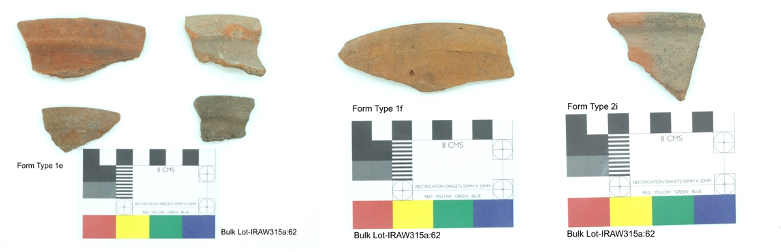
This article analyzes earthenware sherds from Shwe Creek (Operation 315a, Unit 315a–1) in Bagan, Myanmar, as part of the IRAW@Bagan project. Focusing on diagnostic rim sherds from the 2019 excavation season, the research employs typological classification and seriation to establish a preliminary chronological framework. Findings suggest a high degree of standardization in pottery production, particularly for utilitarian ceramics, and highlight both elite-controlled (attached) and market-driven (independent) production modes. Despite limited data, this preliminary archeological report provides a foundation for future ceramic research and relative dating of historical sites, emphasizing the need for continued analysis of Bagan’s earthenware traditions.
Article Details

This work is licensed under a Creative Commons Attribution-NonCommercial 4.0 International License.
References
• Aung Kyaing. 1999. Ancient Ceramic and Glazed Kilns at Bagan. Paper Presented at the Conference on Glazed Ceramics of Southeast Asia: Their History, Technology, and Traditions, National Museum of Bagan, 20–22 September.
• Aung Thaw. 1968. Report on Excavation at Beikthano. Rangoon: Ministry of Union Culture.
• Bayard, Don. 1977. Phu Wiang Pottery and the Prehistory of Northeastern Thailand. Modern Quaternary Research in Southeast Asia 3: 57–102.
• Brown, Roxanna M. 1977. Ceramics of South-East Asia: Their Dating and Identification. Kuala Lumpur: Oxford University Press.
• Cheong, Kong F. 2019. Surface Collection and Elevation Mapping Strategies at Shwe Creek and Otein Taung. In Integrated Socio-Ecological History of Residential Patterning, Agricultural Practices, and Water Management at the “Classical” Burmese (Bama) Capital of Bagan, Myanmar (11th to 14th Century CE): Report on the 2019 IRAW@Bagan Field Season, ed. by Gyles Iannone et al., 63–82. Peterborough: Trent University.
• Costin, Cathy L. 1991. Craft Specialization: Issues in Defining, Documenting, and Explaining the Organization of Production. Archaeology Method and Theory 3: 1–56.
• Department of Archaeology (ရှေးဟောင်းသုတေသနဦးစီးဌာန). 2003a. ပုဂံအနော်ရထာမင်းနန်းတော်ရာ သုတေသနပြု တူးဖော်မှုအစီရင်ခံစာ [Report on the Excavation of Anawrahta Palace Site in Bagan]. Bagan: Department of Archaeology.
• Department of Archaeology (ရှေးဟောင်းသုတေသနဦးစီးဌာန). 2003b. ပုဂံနန်းတော်ရာကုန်း တူးဖော်မှုလုပ်ငန်း တင်ပြ အစီရင်ခံစာ [Report on the Excavation of Bagan Palace Site]. Bagan: Department of Archaeology.
• Fraser-Lu, S. 1994. Burmese Crafts Past and Present. Kuala Lumpur: Oxford University Press.
• Guy, John. 1989. Ceramic Traditions of South-East Asia. Singapore: Oxford University Press.
• Hein, Don & Ramsay, W. Ross H. 2020. The Kilns of Myinkaba―for Pottery or Glass? In EurASEAA14, Volume II: Material Culture and Heritage, Papers from the Fourteenth International Conference of the European Association of Southeast Asian Archaeologists, ed. by Helen Lewis, 22‒40. Oxford: Archaeopress.
• Higham, Charles F.W. 2001. Commentary on Archaeology in Myanmar: Past, Present, and Future. Asian Perspectives 40(1): 127–138.
• Hudson, Bob. 2004. The Origins of Bagan; the Archaeological Landscape of Upper Burma to AD 1300. PhD Dissertation. University of Sydney.
• Hudson, Bob et al. 2001. The Origin of Bagan: New Dates and Old Inhabitants. Asian Perspectives 40(1): 48–74.
―――. 2002. Digging for Myths: Archaeological Excavations and Surveys among the Legendary Nineteen Founding Villages of Pagan. In Burma: Art and Archaeology, ed. by Alexandra Green & T. Richard Blurton, 9–22. London: British Museum Press.
• Iannone, Gyles et al., eds. 2019. Integrated Socio-Ecological History of Residential Patterning, Agricultural Practices, and Water Management at the “Classical” Burmese (Bama) Capital of Bagan, Myanmar (11th to 14th Century CE): Report on the 2019 IRAW@Bagan Field Season. Peterborough: Trent University.
• Luce, Gordon H. 1969. Old Burma–Early Pagan (Volume 1). New York City: J.J. Augustin.
• McIntosh, Roderick J. 1991. Early Urban Clusters in China and Africa: The Arbitration of Social Ambiguity. Journal of Field Archaeology 18(2): 199–212.
• Myo Nyunt Aung. 2018. Archaeological Conservation of Bagan Ancient Monuments in Myanmar. น้าจั่ว/NAJUA 33: 23–42.
• Orton, Clive & Hughes, Mike. 2013. Pottery in Archaeology. Cambridge, UK: Cambridge University Press [2nd Edition].
• Plog, Stephen. 1978. Social Interaction and Stylistic Similarity: A Reanalysis. Advances in Archaeological Method and Theory 1: 143–182.
―――. 1983. Analysis of Style in Artifacts. Annual Review of Anthropology 12: 125–142.
• Rice, P.M. 1991. Specialization, Standardization and Diversity: A Retrospective. In The Ceramic Legacy of Anna O. Shepard, ed. by R.L. Bishop & F.W. Lange, 257–279. Niwot: University Press of Colorado.
• Rivera, Raiza S. & Cheong, Kong F. 2019. Operation 315a, Unit 315a¬–2: Archaeological Investigation of the Occupation Site at Shwe Creek, Bagan, Myanmar. In Integrated Socio-Ecological History of Residential Patterning, Agricultural Practices, and Water Management at the “Classical” Burmese (Bama) Capital of Bagan, Myanmar (11th to 14th Century CE): Report on the 2019 IRAW@Bagan Field Season, ed. by Gyles Iannone et al., 143¬–168. Peterborough: Trent University.
• Sawang Lertrit. 2003. On Chronology-Building for Central Thailand through an Attribute-Based Ceramic Seriation. Asian Perspectives 42(1): 41–71.
• Stadtner, Donald M. 2001. The Questions and Answers of Maungdaung Sayadaw and the Confluence of the Ananda Temple, Pagan and the Mingun Pagoda. Paper Presented at the Conference Texts and Contexts in Southeast Asia, Yangon, 12–14 December.
―――. 2011. Sacred Sites of Burma: Myth and Folklore in an Evolving Spiritual Realm. Bangkok: River Books.
―――. 2013. Ancient Pagan: Buddhist Plain of Merit. Bangkok: River Books [2nd Ed.; 1st Edition 2005].
• Strologo, Sergio Della& Kyaw Nyein. 1963. Report on Pagan Trip for Analysis of Old Glazing Kiln. A Chapter of Improved Ceramic Production in Burma. USAID Project Report (Unpublished).
• Tamura, Ellie & Cheong, Kong F. 2019. Operation 315a, Unit 315a–1: Archaeological Investigation of the Occupation Site at Shwe Creek, Bagan, Myanmar. In Integrated Socio-Ecological History of Residential Patterning, Agricultural Practices, and Water Management at the “Classical” Burmese (Bama) Capital of Bagan, Myanmar (11th to 14th Century CE), ed. by Gyles Iannone et al., 93–134. Peterborough: Trent University.
• Taw Sein Ko & Forchchammer, Emmanuel. 1899. Inscriptions of Pagan, Pinya and Ava. Rangoon: Superintendent of Burma, Government Printing.
• Than Tun. 2005. Myanma Design. Yangon: Plastic Rainbow.
• Trigger, Bruce G. 1990. Monumental Architecture: A Thermodynamic Explanation of Symbolic Behaviour. World Archaeology 22(2): 119–132.
• Yian, Goh Geok. 2018. Positioning Bagan in the Buddhist Ecumene: Myanmar’s Trans-Polity Connections. In Bagan and the World: Early Myanmar and Its Global Connections, ed. by Goh Geok Yian et al., 179–197. Singapore: ISEAS–Yusof Ishak Institute.
• Yian, Goh Geok & Miksic, John N. 2019. Southeast Asian Archaeological Site Reports: Myanmar–Singapore Archaeology Training Project (MSATP). Singapore: NUS Press.
