
Memory, Power, and Gender in Siamese Cremation Volumes
Article Sidebar
Main Article Content
Abstract
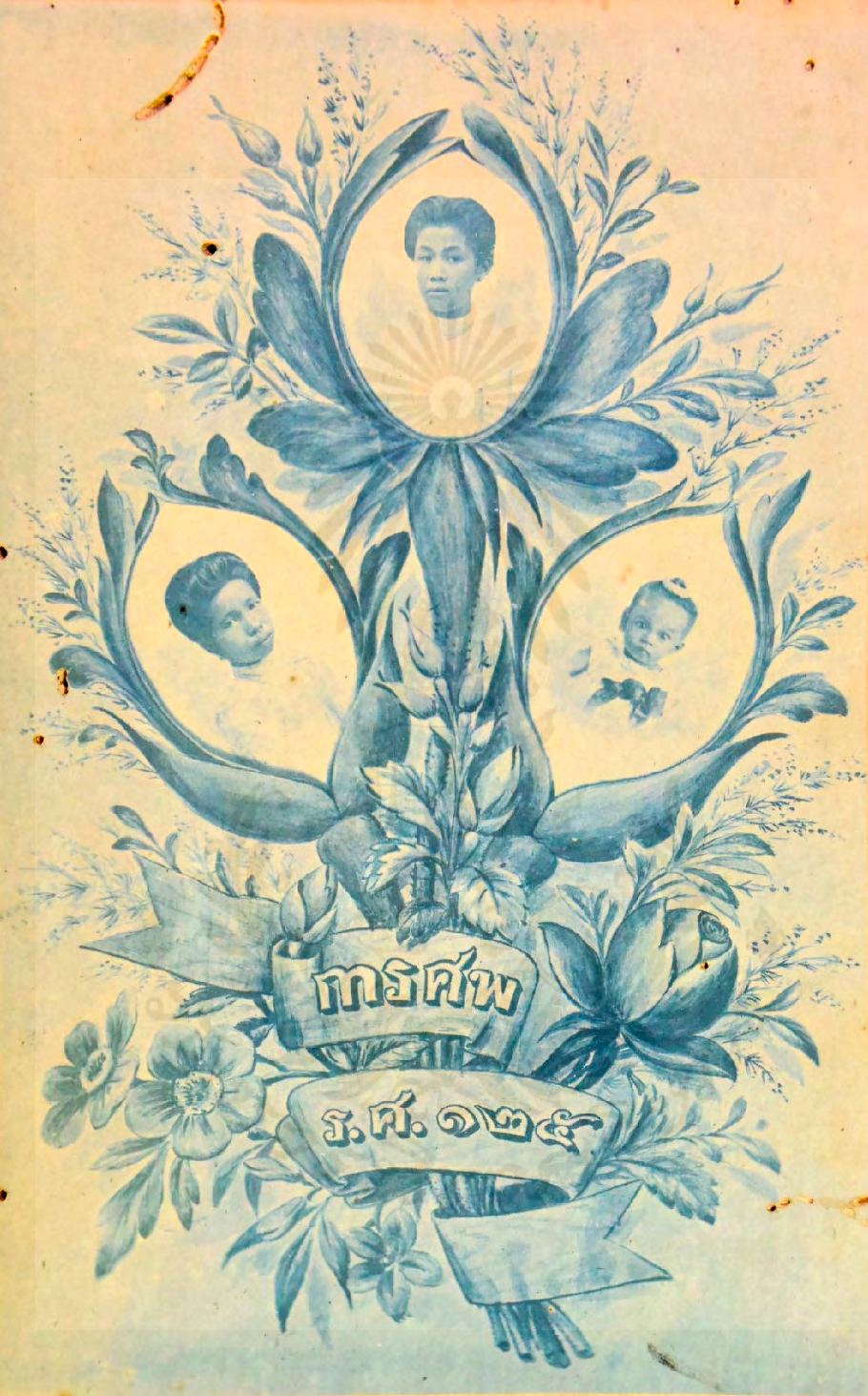
This article examines gender dynamics within the tradition of cremation volumes in early 20th-century Siam, shaped in part by the editorial direction of Prince Damrong Rajanubhab (1862–1943). It argues that these commemorative texts functioned as instruments of patriarchal control and elite self-representation. Through an analysis of sponsorship patterns and biographical narratives, the study highlights how women’s agency in shaping public memory emerged only conditionally, mediated through relationships with male kin and embedded within elite social networks. By situating cremation volumes as cultural artifacts, the article sheds light on the intersection of memory, power, and gender in elite Siamese society.
Article Details

This work is licensed under a Creative Commons Attribution-NonCommercial 4.0 International License.
References
Cremation Volumes
• Chulachomklao Chao Yu Hua, Phrabat Somdet Phra (จุลจอมเกล้าเจ้าอยู่หัว, พระบาทสมเด็จพระฯ = King Rama V). 2468 BE (1925 CE). พระราชหัตถเลขาในพระบาทสมเด็จฯ พระจุลจอมเกล้าเจ้าอยู่หัว เรื่อง เสด็จประพาสแหลมมลายู เมื่อรัตนโกสินทรศก 108, 109, 117, 120 รวม 4 คราว [Royal Letters of King Chulalongkorn on His Visits to the Malay Peninsula in Rattanakosin Era 108, 109, 117, and 120]. Bangkok: Thai Press.
• Damrong Rajanubhab, Prince (ดำรงราชานุภาพ, กรมพระยา). 2460 BE (1917 cE). ประชุมพงษาวดาร ภาคที่ 8 [Collection of Chronicles, Volume 8]. Bangkok: Thai Press.
―――. 2462 BE (1919 CE). คำสวดวิสาขบูชา [Visakha Bucha Chants]. Bangkok: Sophonphiphatthanakon Press.
―――. 2463 BE (1920 CE). ประชุมพงศาวดาร ภาคที่ 17 ตำนานเรื่องเลิกหวยแลบ่อนเบี้ยในกรุงสยาม [Collected Chronicles, Volume 17: The Legend of the Abolition of Lotteries and Gambling Houses in Siam]. Bangkok: Sophonphiphatthanakon Press.
―――. 2465 BE (1922 CE). ประชุมพงศาวดาร ภาคที่ 24 จดหมายเหตุเรื่องปราบฮ่อ [Collected Chronicles, Volume 24: The Suppression of the Haw Rebellion]. Bangkok: Sophonphiphatthanakon Press.
―――. 2468 BE (1925 CE). คำให้การชาวกรุงเก่า: แปลจากฉบับหลวงที่ได้มาจากเมืองพม่า [Testimony from Ayuthaya: Translated from the Royal Manuscript Obtained from Myanmar]. Bangkok: Sophonphiphatthanakon Press.
• Phra Ratchaphirom (Chaem) (พระราชาภิรมย์ [แจ่ม]). 2468 BE (1925 CE). ปัญญาสชาดก ประชุมนิทานในประเทศนี้แต่โบราณ 50 เรื่อง ภาคที่ 6 [The Fifty Jataka Tales: Collection of Ancient Stories from this Land, Volume 6]. Bangkok: Watchirayan Library.
• Phutthayotfa Chulalok, Phrabat Somdet Phra (พุทธยอดฟ้าจุฬาโลก, พระบาทสมเด็จพระฯ = King Rama I). 2463 BE (1920 CE). ประชุมพระราชปุจฉา ภาคที 2 เปนพระราชปุจฉาในรัชกาลที 1 (ตอนที 1) [Royal Inquiries, Volume 2: Inquiries During the Reign of King Rama I (Part 1)]. Bangkok: Sophonphiphatthanakon Press.
• Prachakichakornchak (Chaem), Phraya (ประชากิจกรจักร์ [แช่ม], พระยา). 2462 BE (1919 CE). ว่าด้วยภาษาต่างๆ ในสยามประเทศ [On the Various Languages in Siam]. Bangkok: Sophonphiphatthanakon Press.
Secondary Sources
• Celis, Karen & Childs, Sarah. 2020. Feminist Democratic Representation. Oxford: OUP.
• Charrad, Mounira M. 2010. Women’s Agency Across Cultures: Conceptualizing Strengths and Boundaries. Women’s Studies International Forum 33(6): 517–522.
• Connell, Raewyn & Messerschmidt, James. 2005. Hegemonic Masculinity: Rethinking the Concept. Gender & Society 19(6): 829–859.
• Cornwall, Andrea. 1997. Men, Masculinity and “Gender in Development”. Gender & Development 5(2): 8–13.
• Cornwall, Andrea & Lindisfarne, Nancy. 2017. Dislocating Masculinity: Gender, Power and Anthropology. In Dislocating Masculinity: Comparative Ethnographies, ed. by Andrea Cornwall & Nancy Lindisfarne, 11–47. London: Routledge.
• Costa, LeeRay. 1997. Exploring the History of Women’s Education and Activism in Thailand. Explorations: A Graduate Student Journal of Southeast Asian Studies 1(2): 1–21.
• Eberhardt, Nancy. 2006. Imagining the Course of Life: Self-Transformation in a Shan Buddhist Community. Honolulu: University of Hawai‘i Press.
• Kandiyoti, Deniz. 1988. Bargaining with Patriarchy. Gender & Society 2(3): 274–290.
• Kepner, Susan Fulop. 1996. The Lioness in Bloom: Modern Thai Fiction about Women. Berkeley: University of California Press.
• Murray, Rainbow. 2024. The Substantive Representation of Men: Intersectionality, Masculinities, and Men’s Interests. European Journal of Political Research 64(2): 493–512.
• Natanaree Posrithong. 2015. Voices and Roles of Competing Groups of Elite Women in Siam’s Political and Social Transitions, 1868-1942. PhD Dissertation. Canberra: The Australian National University.
• Olson, Grant A. 1992. Thai Cremation Volumes: A Brief History of a Unique Genre of Literature. Asian Folklore Studies 51(2): 279–294.
• Palmer, Craig T. & Steadman, Lyle B. 1997. Human Kinship as a Descendant Leaving Strategy: A Solution to an Evolutionary Puzzle. Journal of Social and Evolutionary Systems 20(1): 39–51.
• Peters, Pauline E. 1995. Uses and Abuses of the Concept of “Female-Headed Households” in Research on Agrarian Transformation and Policy. In Women Wielding the Hoe: Lessons from Rural Africa for Feminist Theory and Development Practice, ed. by Deborah Fahy Bryceson, 93–108. Oxford: Berg Publishers.
• Severs, Eline et al. 2016. Power, Privilege and Disadvantage: Intersectionality Theory and Political Representation. Politics 36(4): 346–354.
• Singh, Karandeep. 2025. Performing Prestige: The Role of Cremation Volumes in Reinforcing Elite Status in Early Twentieth-Century Thailand. MA Thesis. Hamburg: Universität Hamburg.
• Smooth, Wendy. 2011. Standing for Women? Which Women? The Substantive Representation of Women’s Interests and the Research Imperative of Intersectionality. Politics & Gender 7(3): 436–441.
