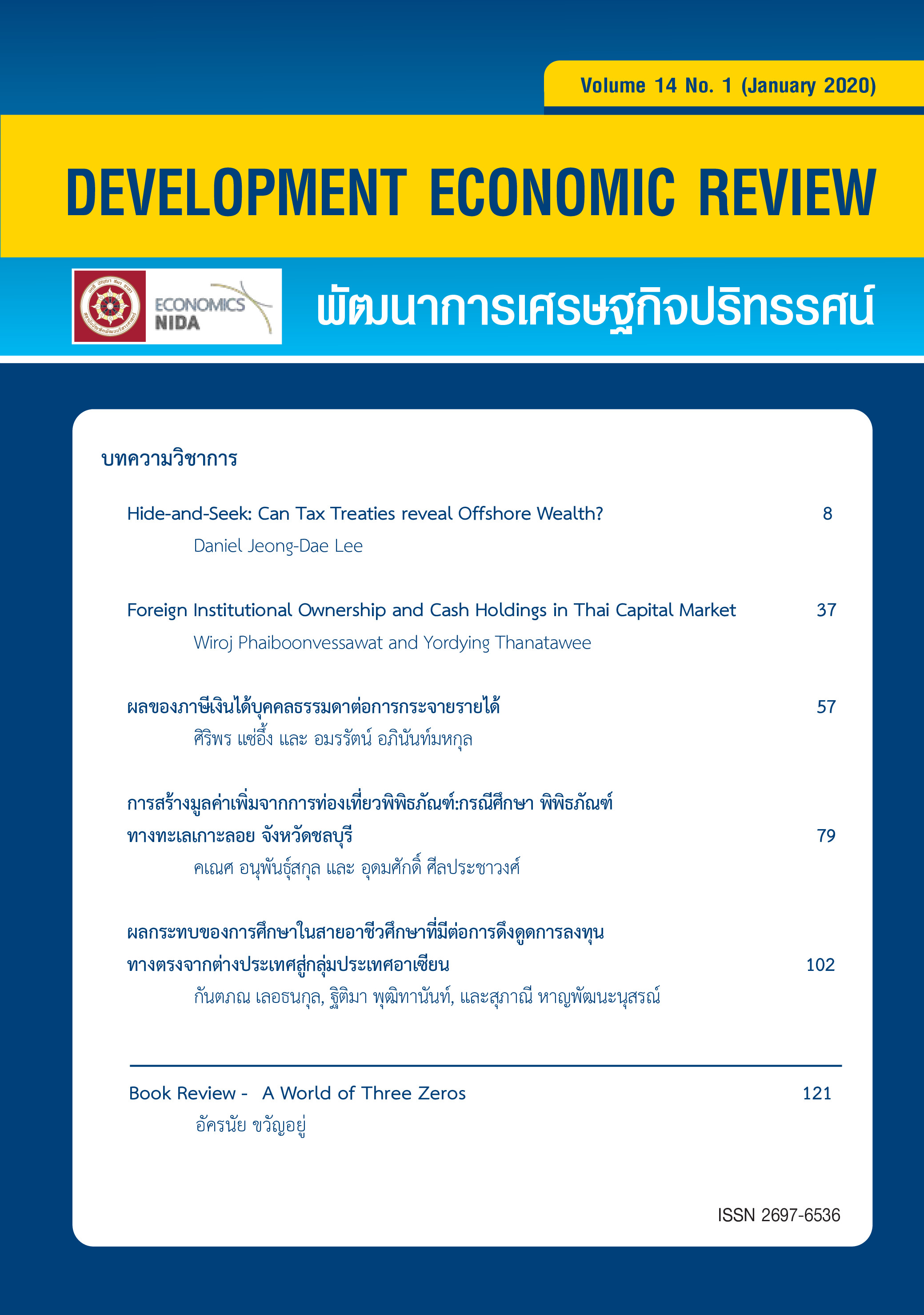
Hide-and-Seek: Can Tax Treaties reveal Offshore Wealth?
Keywords:
Tax Treaties, Offshore Wealth, Offshore Evasion, Tax HavenAbstract
In response to offshore tax evasion, governments in many tax-heaven countries have introduced new tax treaties to facilitate the exchange of financial account information between jurisdictions, including traditional tax havens. This research article aims examining whether these treaties have had a material impact on offshore evasion. Based on panel regression analysis, cross-border deposits in traditional haven jurisdictions, taken as a proxy for offshore evasion in the literature, have declined substantially. However, these offshore assets are being relocated to few non-compliant tax havens and moreover, “non-haven” offshore financial centres, most notably the United States, which has yet to commit to reciprocal and automatic exchange of information and establish a public register of ultimate beneficial ownership.
References
Bank for International Settlements. (2016). “Recent enhancements to the BIS statistics.” BIS Quarterly Review, Retrieved from https://www.bis.org/publ/qtrpdf/r_qt1609c.htm.
Bilicka, K. and C. Fuest. (2014). “With which countries do tax havens share information?” International Tax and Public Finance, 21(2), 175-197.
Casi, E., C. Spengel and B. Stage. (2018). “Cross-border tax evasion after the Common Reporting Standard: Game over?”, ZEW Centre for European Economic Research Discussion Paper, No. 18-036. Retrieved from https://papers.ssrn.com/sol3/papers.cfm?abstract_id=3245144.
Cobham, A., P. Jansky and M. Meinzer. (2015). “The Financial Secrecy Index: Shedding new light on the geography of secrecy.” Center for Global Development, 91(3), 281-303.
Crivelli, E., R. de Mooij and M. Keen. (2015). “Base erosion, profit shifting and developing countries.” FinanzArchiv, 72(2), 268-301.
De Simone, L., R. Lester and K. Markle. (2018). “Transparency and tax evasion: Evidence from the foreign account tax compliance act (FATCA).” Journal of Accounting Research, Retrieved from https://onlinelibrary.wiley.com/doi/abs/10.1111/1475-679X.12293.
Dharmapala, D. (2008). “What problems and opportunities are created by tax havens?” Oxford Review of Economic Policy, 24(4), 661-679.
Elsayyad, M. and K. Konrad. (2012). “Fighting multiple tax havens.” Journal of International Economics, 86(2), 295-305.
Gravelle, J. (2009). “Tax havens: International tax avoidance and evasion.” National tax journal, 62(4), 727-753.
Hanlon, M., E.L. Maydew and J.R. Thornock. (2016). “Taking the long way home: U.S. tax evasion and offshore investments in U.S. equity and debt markets.” The Journal of Finance, 70(2015), 257-287.
Hines, J. and E. Rice. (1994). “Fiscal paradise: Foreign tax havens and American business.” Quarterly Journal of Economics, 109(1), 149-182.
Huizinga, H. and G. Nicodeme. (2004). “Are international deposits tax-driven?” Journal of Public Economics, 88(6), 1093-1118.
Johannesen, N. et al. (2018). “Taxing hidden wealth: The consequences of U.S. enforcement initiatives on evasive foreign accounts.” NBER Working Paper Series, Retrieved from
https://www.nber.org/papers/w24366.pdf.
Johannesen, N. and G. Zucman. (2014). “The end of bank secrecy? An evaluation of the G20 tax haven crackdown.” American Economic Journal: Economic Policy, 6(1), 65-91.
Menkhoff, L. and J. Miethe. (2017). “Dirty money coming home: Capital flows into and out of tax havens.” Retrieved from https://www.semanticscholar.org/paper/Dirty-Money-Coming-Home%3A-Capital-Flows-into-and-out-Miethe-Menkhoff/cb8989d4322787ed5dbc70bd98e1e76da87af0b8
OECD. (2000). “Towards global tax cooperation: Progress in identifying and eliminating harmful tax practices.” Committee on Fiscal Affairs. Paris: OECD Publishing. Retrieved from https://www.oecd.org/tax/transparency/about-the-global-forum/publications/towards-global-tax-cooperation-progress.pdf.
OECD. (2018). “Major enlargement of the global network for the automatic exchange of offshore account information as over 100 jurisdictions get ready for exchanges.” 5 July. Retrieved from https://www.oecd.org/tax/major-enlargement-of-the-global-network-for-the-automatic-exchange-of-offshore-account-information-as-over-100-jurisdictions-get-ready-for-exchanges.htm.
OECD. (2018). Taxation of Household Savings. OECD Tax Policy Studies, No.25.
OECD. (2019). “Using bank deposit data to assess the impact of exchange of information.” Retrieved from https://www.oecd.org/tax/exchange-of-tax-information/using-bank-deposit-data-to-assess-the-impact-of-exchange-of-information.pdf
Zucman, G. (2013). “The missing wealth of nations: Are Europe and the U.S. net debtors or net creditors?” Quarterly Journal of Economics, 128(3), 1321-1364
Published
Issue
Section
License
Copyright to published manuscripts becomes the property of the Graduate School of Development Economics, National Institute of Development Administration. Reproduction of all or part of a Development Economic Review (DER) article by anyone, excluding author(s), is prohibited, unless receiving our permission.
Disclaimer: Opinions expressed in articles published in this journal are those of the author (s) and do nto necessarily represent opinions of the Graduate School of Development Economics, National Institute of Development Administration. Trade and proprietary names are only for identification and not constitute our endorsement.


