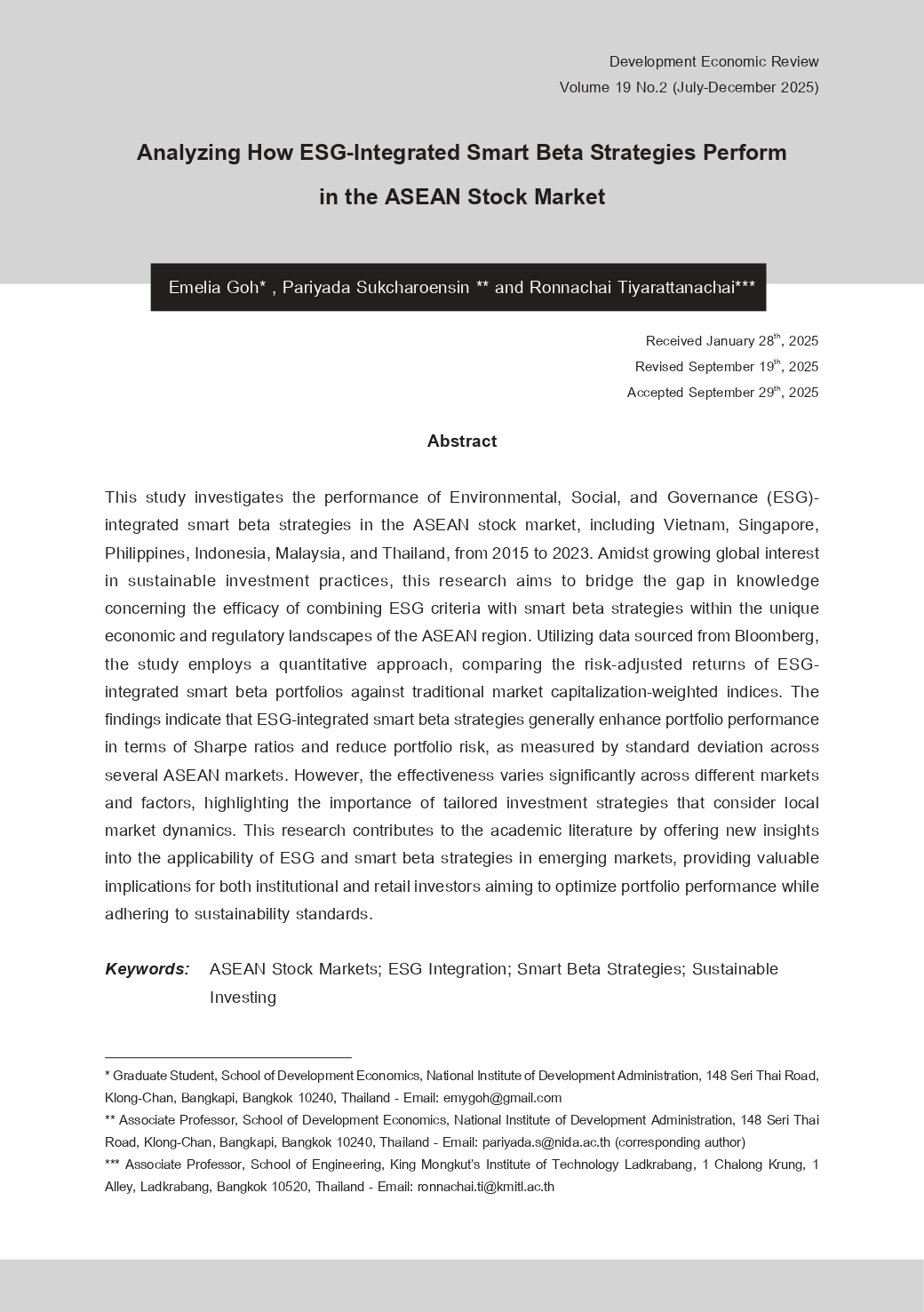
Analyzing How ESG-Integrated Smart Beta Strategies Perform in the ASEAN Stock Market
Keywords:
ASEAN Stock Markets, ESG Integration, Smart Beta Strategies, Sustainable InvestingAbstract
This study investigates the performance of Environmental, Social, and Governance (ESG)-integrated smart beta strategies in the ASEAN stock market from 2015 to 2023. Amidst growing global interest in sustainable investment practices, this research aims to bridge the gap in knowledge concerning the efficacy of combining ESG criteria with smart beta strategies within the unique economic and regulatory landscapes of the ASEAN region. Utilizing data sourced from Bloomberg, the study employs a quantitative approach, comparing the risk-adjusted returns of ESG-integrated smart beta portfolios against traditional market capitalization-weighted indices. The findings indicate that ESG-integrated smart beta strategies generally enhance portfolio performance in terms of Sharpe ratios and reduce portfolio risk, as measured by standard deviation across several ASEAN markets. However, the effectiveness varies significantly across different markets and factors, highlighting the importance of tailored investment strategies that consider local market dynamics. This research contributes to the academic literature by offering new insights into the applicability of ESG and smart beta strategies in emerging markets, providing valuable implications for both institutional and retail investors aiming to optimize portfolio performance while adhering to sustainability standards.
References
Amenc, N., & Goltz, F. (2013). Smart Beta 2.0. Journal of Index Investing, 4(3), 15–23.
Amenc, N., Goltz, F., Sivasubramanian, S., & Lodh, A. (2015). Robustness of smart beta strategies. The Journal of Index Investing, 6(1), 17–38.
Alessandrini, F., & Jondeau, E. (2019). ESG Investing: From Sin Stocks to Smart Beta. Journal of Portfolio Management, 46(3), 75–94.
Bender, J., Sun, X., & Wang, T. (2017). Thematic Indexing, Meet Smart Beta! Merging ESG into Factor Portfolios. Journal of Index Investing, 8(3), 89–101.
Cai, L., Jin, Y., Qi, Q., & Xu, X. (2018). A comprehensive study on smart beta strategies in the A-share market. Applied Economics, 50(55), 6024–6033.
Capelle-Blancard, G., & Monjon, S. (2010). The performance of socially responsible funds: Does the screening process matter? European Financial Management, 20(3), 494-520.
Chow, T., Hsu, J., Kalesnik, V., & Little, B. (2011). A Survey of Alternative Equity Index Strategies. Financial Analysts Journal, 67(5), 37–51.
Cubas-Díaz, M., & Sedano, M. Á. M. (2018). Do Credit Ratings Take into Account the Sustainability Performance of Companies? Sustainability, 10(11), 4272.
Fama, E. F., & French, K. R. (1992). The Cross-Section of Expected Stock Returns. The Journal of Finance, 47(2), 427–465.
Fama, E. F., & French, K. R. (2004). The Capital Asset Pricing Model: Theory and Evidence. Journal of Economic Perspectives, 18(3), 25–46.
Fama, E. F., & French, K. R. (2012). Size, Value, and Momentum in International Stock Returns. Journal of Financial Economics, 105(3), 457-472.
Fama, E. F., & French, K. R. (2015). Dissecting Anomalies with a Five-Factor Model. The Review of Financial Studies, 29(1), 69–103.
Glushkov, D. (2015). How Smart are Smart Beta ETFs? Analysis of Relative Performance and Factor Timing. Social Science Research Network.
Gupta, H., & Chaudhary, R. (2023). An analysis of volatility and Risk-Adjusted returns of ESG indices in developed and emerging economies. Risks, 11(10), 182.
Humphrey, J. E., & Lee, D. D. (2011). Australian Socially Responsible Funds: Performance, risk and Screening Intensity on JSTOR. www.jstor.org, 102(4), 519–535.
Ielasi, F., Ceccherini, P., & Zito, P. (2020). Integrating ESG Analysis into Smart Beta Strategies. Sustainability, 12(22), 9351.
Jegadeesh, N., & Titman, S. (1993). Returns to buying winners and selling losers: Implications for stock market efficiency. The Journal of Finance, 48(1), 65.
Kurniawan, I., & Rokhim, R. (2023). Is ESG companies’ performance influenced by ownership structure? Evidence in ASEAN. Interdisciplinary Social Studies, 2(9), 2397–2413.
Lakonishok, J., Shleifer, A., & Vishny, R. W. (1994). Contrarian investment, extrapolation, and risk. The Journal of Finance, 49(5), 1541–1578.
Lintner, J. (1965). The Valuation of Risk Assets and the Selection of Risky Investments in Stock Portfolios and Capital Budgets. The Review of Economics and Statistics, 47(1), 13–37.
Louraoui, Y. (2020). Analysis of the Performance between Smart Beta Strategies with Active and Passive Managed ETFs. Social Science Research Network.
Makhdalena, M., Zulvina, D., Zulvina, Y., Amelia, R. W., & Wicaksono, A. P. (2023). ESG and Firm Performance in Developing Countries: Evidence From ASEAN. Etikonomi, 22(1), 65–78.
Markowitz, H. (1952). Portfolio selection. The Journal of Finance, 7(1), 77–91.
Modigliani, F., & Miller, M. H. (1958). The Cost of Capital, Corporation Finance and the Theory of Investment. The American Economic Review, 48(3), 261–297.
Mollet, J. C., & Ziegler, A. (2014). Socially responsible investing and stock performance: New empirical evidence for the US and European stock markets. Review of Financial Economics, 23(4), 208–216.
Monga, R., Aggrawal, D., & Singh, J. (2022). Smart Beta Investing: an alternative investment paradigm in emerging Indian equity market. Organizations and Markets in Emerging Economies, 13(1), 209–237.
Mossin, J. (1966). Equilibrium in a Capital Asset Market. Econometrica, 34(4), 768–783.
Odell, J., & Ali, U. (2016). ESG Investing in Emerging and Frontier Markets. The Bank of America Journal of Applied Corporate Finance, 28(2), 96–101.
Paul, K. (2017). The effect of business cycle, market return and momentum on financial performance of socially responsible investing mutual funds. Social Responsibility Journal, 13(3), 513–528.
Peterdy, K. (2023, October 26). ESG (Environmental, Social, & Governance). Corporate Finance Institute.
Rahma, N., & Rokhim, R. (2022). Is There any Effect of ESG Performance in the Improvement of Financial Risk in ASEAN-5? International Journal of Quantitative Research and Modeling, 3(2), 61–65.
Raza, M. W., & Ashraf, D. (2017). Does the application of smart beta strategies enhance portfolio performance? The case of Islamic equity investments. Social Science Research Network.
Rehman, R. U., Zhang, J., Uppal, J., Cullinan, C., & Naseem, M. A. (2016). Are environmental social governance equity indices a better choice for investors? An Asian perspective. Business Ethics, 25(4), 440–459.
Rompotis, G. G. (2019). A performance evaluation of smart beta exchange traded funds. International Journal of Financial Markets and Derivatives, 7(2), 124.
Sharpe, W. F. (1964). Capital Asset Prices: A Theory of Market Equilibrium under Conditions of Risk. The Journal of Finance, 19(3), 425–442.
Sherwood, M. W., & Pollard, J. L. (2017). The risk-adjusted return potential of integrating ESG strategies into emerging market equities. Journal of Sustainable Finance & Investment, 8(1), 26–44.
Stempler, B. (2021). ESG Investing: The use of ESG ratings in a smart beta strategy. ideas.repec.org.
Suttipun, M. (2023). ESG Performance and Corporate Financial risk of the alternative capital market in Thailand. Cogent Business & Management, 10(1).
Sugiarto, A., Puspani, N. N., & Fathia, F. (2023). ESG Leverage towards Stock Performance in Indonesia Stock Exchange. International Journal of Energy Economics and Policy, 13(5), 593–606.
Volodina, A., & Trachenko, M. (2023). ESG Investment Profitability in Developed and Emerging Markets with Regard to the Time Horizon. Finansovyj Žurnal, 15(2), 59–73.
Waspada, I. P., Salim, D. F., & Fariska, P. (2021). An application of the Smart Beta Portfolio Model: An empirical study in Indonesia Stock Exchange. The Journal of Asian Finance, Economics, and Business, 8(9), 45–52.
Downloads
Published
Issue
Section
License
Copyright to published manuscripts becomes the property of the Graduate School of Development Economics, National Institute of Development Administration. Reproduction of all or part of a Development Economic Review (DER) article by anyone, excluding author(s), is prohibited, unless receiving our permission.
Disclaimer: Opinions expressed in articles published in this journal are those of the author (s) and do nto necessarily represent opinions of the Graduate School of Development Economics, National Institute of Development Administration. Trade and proprietary names are only for identification and not constitute our endorsement.


