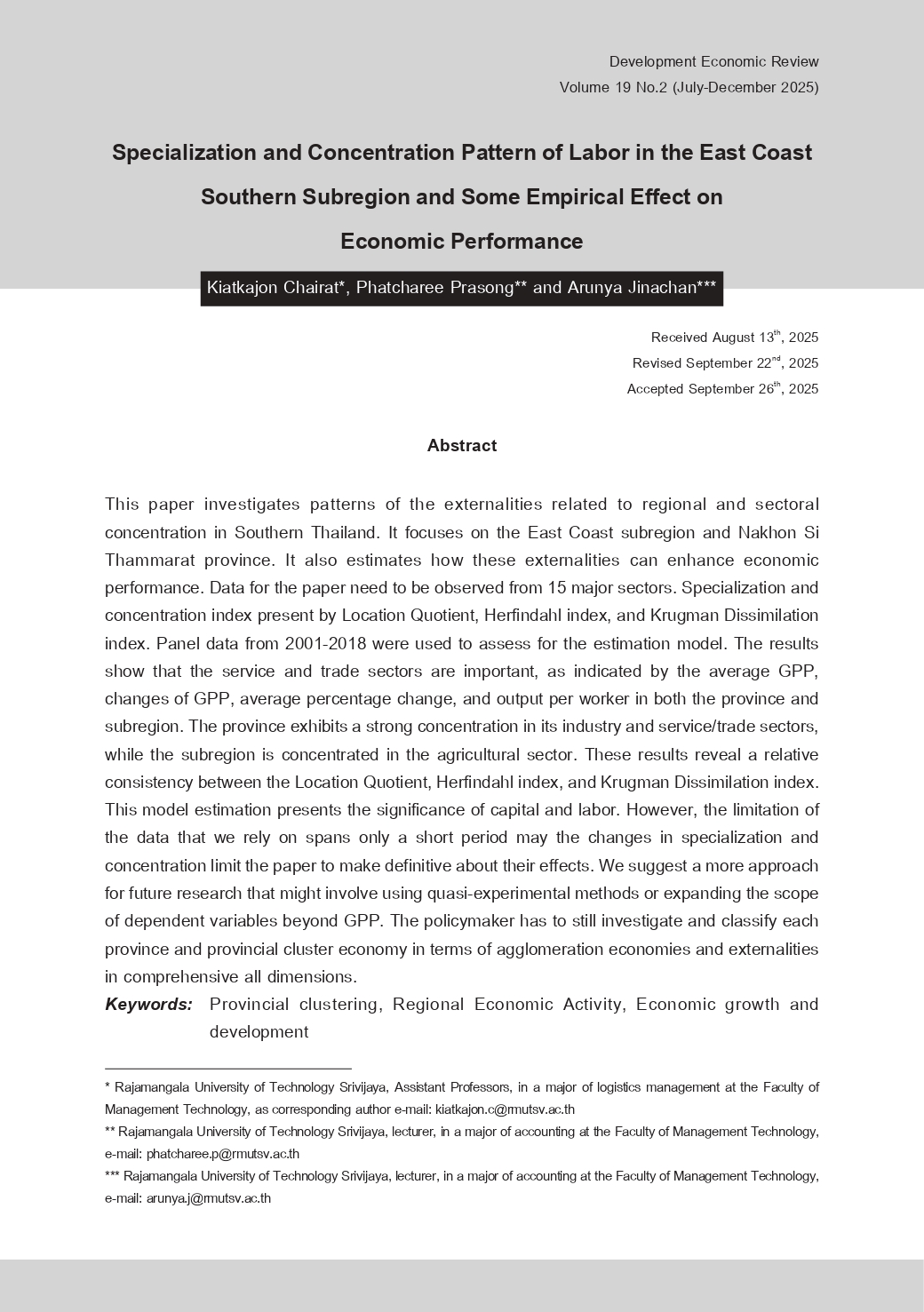
Specialization and Concentration Pattern of Labor in the East Coast Southern Subregion and Some Empirical Effect on Economic Performance
Abstract
This paper investigates patterns of the externalities related to regional and sectoral concentration in Southern Thailand. It focuses on the East Coast subregion and Nakhon Si Thammarat province. It also estimates how these externalities can enhance economic performance.
Data for the paper need to be observed from 15 major sectors. Specialization and concentration index present by Location Quotient, Herfindahl index, and Krugman Dissimilation index. Panel data from 2001-2018 were used to assess for the estimation model.
The results show that the service and trade sectors are important, as indicated by the average GPP, changes of GPP, average percentage change, and output per worker in both the province and subregion. The province exhibits a strong concentration in its industry and service/trade sectors, while the subregion is concentrated in the agricultural sector. These results reveal a relative consistency between the Location Quotient, Herfindahl index, and Krugman Dissimilation index. This model estimation presents the significance of capital and labor. However, the limitation of the data that we rely on spans only a short period may the changes in specialization and concentration limit the paper to make definitive about their effects. We suggest a more approach for future research that might involve using quasi-experimental methods or expanding the scope of dependent variables beyond GPP. The policymaker has to still investigate and classify each province and provincial cluster economy in terms of agglomeration economies and externalities in comprehensive all dimensions.
References
Aiginger, K., Rossi-Hansberg, E. (2006). Specialization and concentration: a note on theory and evidence, Empirica, 33(3), 255-266, Springer.
Carroll, M. C., N. Reid, and B. W. Smith. (2008). Location Quotients versus Spatial Autocorrelation in Identifying Potential Cluster Regions, The Annals of Regional Science 42(2): 449–463.
Chairat K., et. (2015). Provincial Clustering: Effects on Empirical Economic Development in Southern Thailand, Applied Econometrics and International Development Volume 15(1), 161-175.
Chairat K., et. (2020). Effects on Empirical Economic Performance in Provincial Cluster of the Southern Shore of the Gulf of THAILAND, Regional Science Inquiry Volume XII (2), 113-121.
Ezcurra, R., Pascual, P., Rapun. M. (2006). Regional Specialization in the European Union, Regional Studies, Vol. 40(6), 601-616.
Fujita, M., Krugman, P., Venables, A. (1999). The Spatial Economy, MIT Press, Cambridge.
Fujita M. and Thisse J.-F. (2004). Economies of Agglomeration, Cities, Industrial Location and Regional Growth, Cambridge, Cambridge University Press.
Gabe, T. (2004). Effects of Industry Agglomeration on Indicators of Growth and Development in Maine, Department of Resource Economics and Policy, University of Maine.
Glaeser, E. L. (1999). Learning in Cities. Journal of Urban Economics, 46(2), 254-277.
Heckscher, E. (1919). The Effect of Foreign Trade on Distribution of Income, Economisk Tidskrift, 21, 1-32.
Krugman, P. R. (1991). Increasing Returns and Economic Geography, Journal of Political Economic, 99: 137-150.
Krugman, P. R. (1995). Development, Geography and Economic Theory, MIT Press, Cambridge.
Lucas, R. E. (1988). On the Mechanics of Economic Development. Journal of Monetary Economics 22: 3-42.
Marshall, A. (1920). Principles of Economics, Macmillan, London.
Meade, J.E. (1952). External Economies and Diseconomies in a Competitive Situation, The Economic Journal. 62, 54-67.
Meliciani, V., and M. Savona. (2014). The Determinants of Regional Specialization in Business Services: Agglomeration Economies, Vertical Linkages and Innovation, Journal of Economic Geography: 1–30.
Mitra, A., Sato, H. (2006). Agglomeration Economies in Japan: Technical Efficiency, Growth and Unemployment, Institute of Development Economic (JETRO), Chiba, Japan.
Ohlin, B. (1933). Interregional and International Trade, Harvard University Press, Cambridge.
Ricardo, D. (1817). On the Principles of Political Economy and Taxation. John Murray.
Romer, P. M. (1986). Increasing Returns and Long-Run Growth. Journal of Political Economy 94(5), 1002-1037.
Romer, P. M. (1990). Endogenous Technological Change. Journal of Political Economy 98(5), S71-S102.
Scitovsky T. (1954), Two concepts of external economies Journal of Political Economy, 62, 143-151.
Solow, Robert M. (1956). A Contribution to the Theory of Economic Growth. Quarterly Journal of Economics 70, 65–94.
Solow, Robert M. (1957). Technical Change and the Aggregate Production Function. Review of Economics and Statistics 39, 312-320.
Stewart, F. and E. Ghani (1991), How significant are externalities for development?, World Development, 19(6), 569-94.
Downloads
Published
Issue
Section
License
Copyright to published manuscripts becomes the property of the Graduate School of Development Economics, National Institute of Development Administration. Reproduction of all or part of a Development Economic Review (DER) article by anyone, excluding author(s), is prohibited, unless receiving our permission.
Disclaimer: Opinions expressed in articles published in this journal are those of the author (s) and do nto necessarily represent opinions of the Graduate School of Development Economics, National Institute of Development Administration. Trade and proprietary names are only for identification and not constitute our endorsement.


