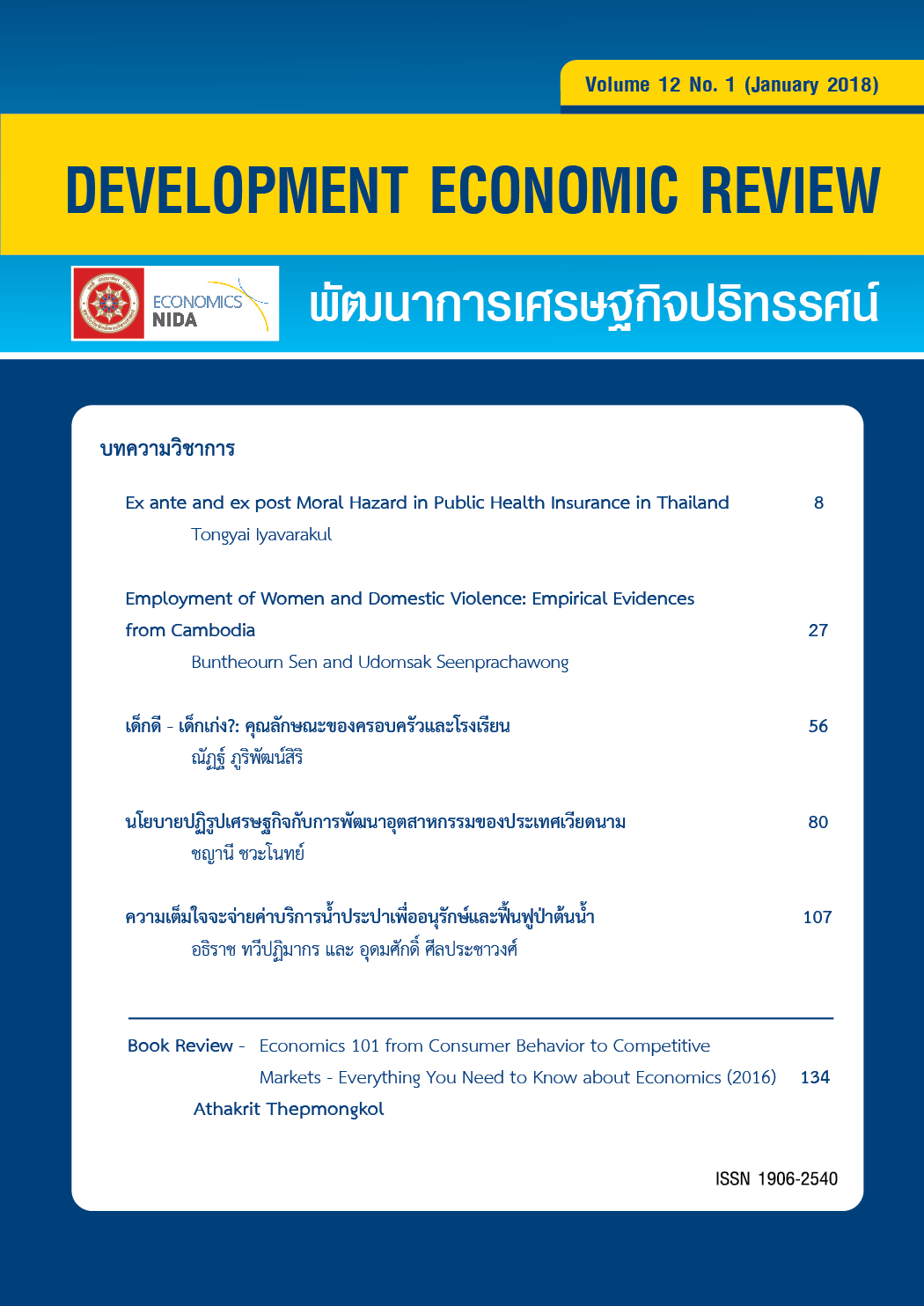
นโยบายปฏิรูปเศรษฐกิจกับการพัฒนาอุตสาหกรรม ของประเทศเวียดนาม
คำสำคัญ:
การพัฒนาอุตสาหกรรม, การปฏิรูปเศรษฐกิจ, เวียดนามบทคัดย่อ
งานศึกษาชิ้นนี้ทำขึ้นเพื่อศึกษาการปฏิรูปเศรษฐกิจของเวียดนามที่ผ่านมา โดยเฉพาะผลของนโยบาย Doi Moi ที่เน้นบทบาทของภาคเอกชนที่มากขึ้น การกระจายอำนาจสู่ภาคธุรกิจและองค์กรท่องถิ่น และ การลงทุนจากต่างประเทศที่มีผลต่อการพัฒนาด้านอุตสาหกรรม โดยใช้กรอบแนวคิดใหม่ของการ เปลี่ยนแปลงโครงสร้างเศรษฐกิจ (New Structural Economics) มาวิเคราะห์ข้อมูลจากแหล่งต่างๆ และ งานวิจัยที่ผ่านมาเพื่อพิจารณาผลของการพัฒนาอุตสาหกรรมของเวียดนาม ซึ่งพบว่า แม้ความสามารถ ในการแข่งขันของเวียดนามจะสูงขึ้นและมีการส่งออกสินค้าที่ใช้เทคโนโลยีในการผลิตขั้นกลางและสูง มากขึ้น แต่ยังขาดการถ่ายทอดเทคโนโลยี ปัญหาขาดแคลนแรงงานที่มีทักษะ มีนโยบายที่เอื้อประโยชน์ ให้แก่กลุ่มผู้ประกอบการรัฐวิสาหกิจ ภาคเอกชนในประเทศ และบริษัทต่างชาติไม่เท่าเทียมกัน และไม่สอดคล้องกับประสิทธิภาพการผลิตของกลุ่มผู้ประกอบการดังกล่าว มีความไม่พร้อมและไม่มี ประสิทธิภาพในโครงสร้างพื้นฐานทั้งทางกายภาพและเชิงสถาบันที่จะสนับสนุนการพัฒนาด้าน อุตสาหกรรมให้หลุดจากกับดักรายได้ปานกลาง
เอกสารอ้างอิง
An Inverted-U Relationship”, Quarterly Journal of Economics,120(2): 701–728.
Alvarez, R., and Claro S. (2008). “David Versus Goliath: The Impact of Chinese Competition
on Developing Countries.” World Development, 37(3): 560–571.
Bodewig, C., Badiani-Magnusson, R., Macdonald, K., Newhouse, D., & Rutkowski, J. (2013).
“Skilling up Vietnam: Preparing the workforce for a modern market economy”, Vietnam
Development Report 2014, Hanoi: World Bank Publications.
CIEM and World Bank (2013), Workforce Development, Vietnam SABER Country Report 2012,
Washington, D.C.: The World Bank
CIEM (2014). Firm-level Technology and Competitiveness in Vietnam Report on Survey 2013.
Doan, T., Nguyen, S., Vu, H., Tran, T., &Lim, S. (2015). Does rising import competition harm
local firm productivity in less advanced economies? Evidence from the Vietnam’s
manufacturing sector, Journal of International Trade and Economic Development,
25(1): 23-46.
Javorcik, B. (2004). “Does foreign direct investment increase the productivity of domestic firms?
In search of spillovers through backward linkages”, American Economics Review,
94(3), 605–627.
Kim, W., Nam, I. C., & Cuong, T. T. (2010).“On the governance of state-owned economic groups
in Vietnam, retrieved from https://ueaeprints.uea.ac.uk/51521/
Lin, Justin (2012) New Structural Economics A Framework for Rethinking Development and
Policy, Washington, D.C.: The World Bank.
Newman, C., Rand, J., Talbot, T.,& Tarp, F. (2015). “Technology transfers, foreign investment
and productivity spillovers”. European Economic Review, 76 (Issue C), 168-187.
OECD. (2016). “Economic Outlook for Southeast Asia, China and India 2016: Enhancing
Regional Ties”, Paris: OECD Publishing.
Perkins, D. H., & Vu-Thanh, T. A. (2010).“Vietnam’s Industrial Policy: Designing Policies for
Sustainable Development. United Nations Development Programme”, retrieved from
https://userpage.fu-berlin.de/~ballou/fama/vietnam/valuechain01.pdf
Thanh, N. X., & Dapice, D. (2008).“Vietnam’s Infrastructure Constraints”, UNDP – Harvard
Policy Dialogue Paper No. 3, Ash Institute for Democratic Governance and Innovation,
Boston: Harvard Kennedy School.
Tran, H. X. (2014). “The evolutions of productivity in Vietnam’s manufacturing sector.”, Doctoral
Dissertation, School of Accounting, Economics and Finance, University of Wollongong,
retrieved from https://ro.uow.edu.au/theses/4444
Tran, A. N. & Norlund, I. (2015).“Globalization, industrialization and labor markets in Vietnam”,
Journal of the Asia Pacific Economy, 20(1),143-163.
Tsuboi, Y. (2007). “Twenty Years After the Adoption of the Doi Moi Policy”. Tokyo: Waseda
University.
UNIDO. (2011). “Viet Nam Industrial Competitiveness Report 2011”, United Nations Industrial
Development Organization and Ministry of Industry and Trade, Viet Nam.
Van, H. T. H. (2012). “Industrial readjustment in Vietnam: Special focus on the new 10 year
socio-economic development strategy for 2011-2020”, Industrial Readjustment in the
Mekong River Basin Countries: Toward the AEC, BRC Research Report, 7.
VDR (2012) “Market Economy for a Middle-Income Vietnam”, Vietnam Development Report
2012, Joint donor report to the Vietnam Consultative Group Meeting.
Vu-Thanh, T. A. (2015). “The political economy of industrial development in Vietnam”.Impact of
State- Business Relationship on Industrial Performance, 1986-2012, GEG Working
Paper 2015/107.
สัมภาษณ์เพิ่มเติม
Ureerat Ratanaprukse, Consul-General, Royal Thai Consulate-General, Ho Chi Minh City.
Tharabodee Serng-Adichaiwit, Senior Vice President and General Manager – Vietnam, Ho Chi
Minh City Branch, Bangkok Bank Public Company Limited.
Asada Boonsrirat, Investment Coordinating Manager, SCG Vietnam Company Limited.
Trinh Nguyen Phuong, Assistant to Investment Coordinating Director, SCG Vietnam Company
Limited.
Suwicha Boonsupa, BJC International Business Division,Berli Jucker Public Company Limited.
Nguyen Thi Tue Anh, Vice President, Central Institute for Economic Management (CIEM),
Ministry of Planning and Investment, Hanoi.
Ngo Minh Tuan, Deputy Director, Central Institute for Economic Management (CIEM), Ministry
of Planning and Investment, Hanoi.
Nguyen Kim-Anh, Director, Center for Information and Documentation, Central Institute for
Economic Management (CIEM), Ministry of Planning and Investment, Hanoi.
Tran Quang Tuyen, Associate Dean, Faculty of Political Economics, VNU University of Economics
and Business, Hanoi.
Hoang Khac Lich, Faculty of Development Economics, VNU University of Economics and Business,
Hanoi.
Dao Vu Phuong Linh, Faculty of Economics and Accounting, Quy Nhon University
Nguyen Thi Thuy Dung, Faculty of Economics and Accounting, Quy Nhon University
ดาวน์โหลด
เผยแพร่แล้ว
ฉบับ
ประเภทบทความ
สัญญาอนุญาต
Copyright to published manuscripts becomes the property of the Graduate School of Development Economics, National Institute of Development Administration. Reproduction of all or part of a Development Economic Review (DER) article by anyone, excluding author(s), is prohibited, unless receiving our permission.


