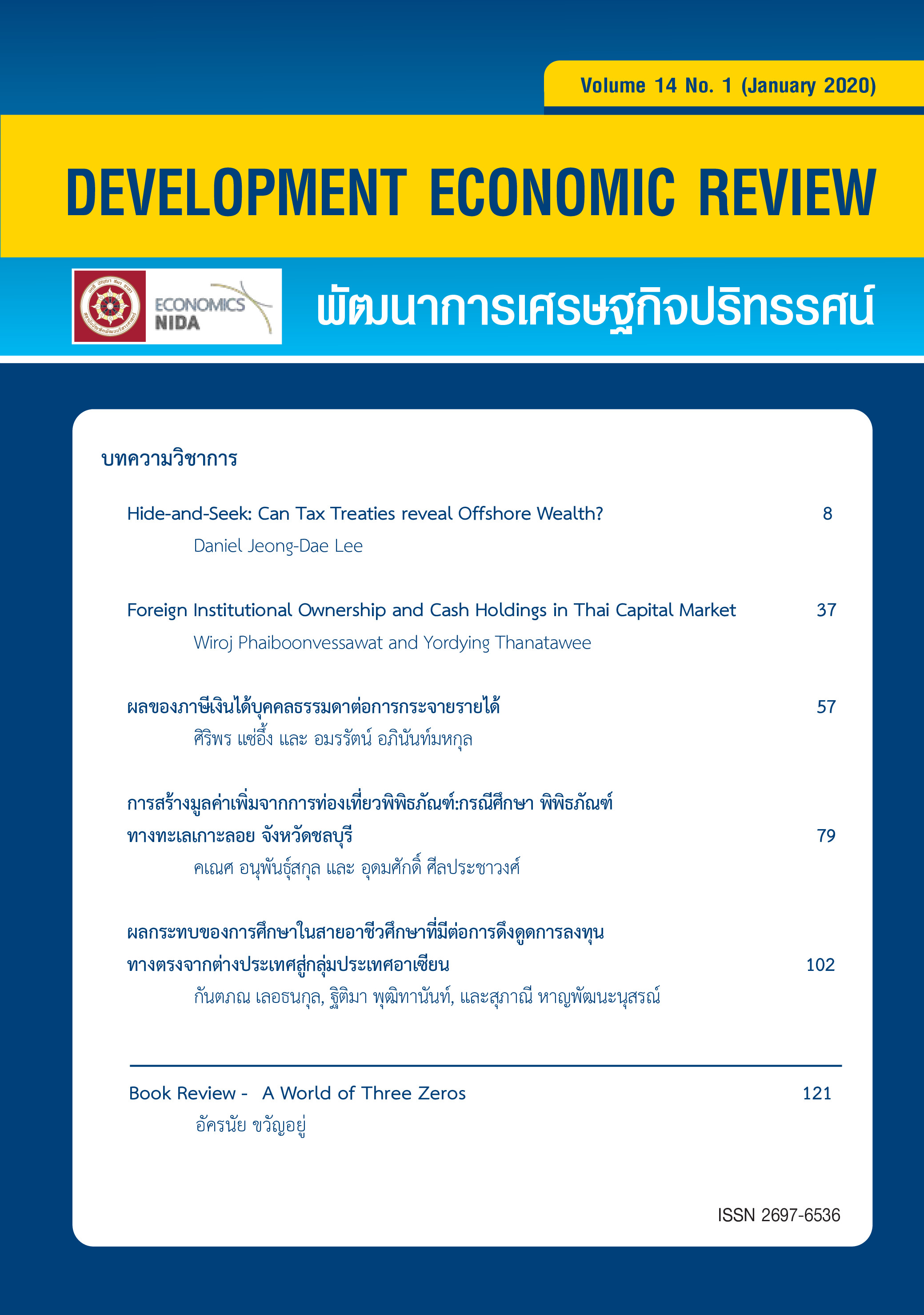
ผลกระทบของการศึกษาในสายอาชีวศึกษาที่มีต่อการดึงดูดการลงทุนทางตรงจากต่างประเทศสู่กลุ่มประเทศอาเซียน
คำสำคัญ:
อาชีวศึกษา, การลงทุนทางตรงระหว่างประเทศ, อาเซียนบทคัดย่อ
การศึกษานี้มีจุดประสงค์เพื่อศึกษาว่าระบบการศึกษาในสายอาชีวศึกษาในกลุ่มประเทศอาเซียนมีผลต่อการช่วยดึงดูดการลงทุนทางตรงจากต่างประเทศ จากการใช้ข้อมูลทุติยภูมิในประเทศกลุ่มอาเซียนตั้งแต่ปี ค.ศ. 1994 - 2015 ด้วยสมการ Random Effect ผลการศึกษาพบว่า จำนวนนักเรียนอาชีวศึกษามีผลต่อการดึงดูดการลงทุนทางตรงจากต่างประเทศเฉพาะประเทศไทย อินโดนีเซีย ฟิลิปปินส์ และมาเลเซียแต่ไม่มีผลต่อการดึงดูดการลงทุนทางตรงจากต่างประเทศของสิงคโปร์ บรูไน และประเทศสปป.ลาว และกัมพูชา เนื่องจาก โครงสร้างของอุตสาหกรรมภายในประเทศไม่ได้สอดคล้องกับแรงงานที่จบจากระบบอาชีวศึกษา ดังนั้น ประเทศกลุ่มสมาชิกอาเซียนควรพิจารณาร่วมกันเกี่ยวกับการส่งเสริมให้มีผู้เรียนในระบบอาชีวศึกษามากขึ้น พร้อมทั้งสร้างความร่วมมือในภูมิภาคเพื่อยกระดับคุณภาพอาชีวศึกษาให้ได้มาตรฐานสากล
เอกสารอ้างอิง
Aring, M. (2015). ASEAN Economic Community 2015 : Enchancing Competitiveness and Employability Through Skill Development. Bangkok: International Labour Organization. Retrieved from https://www.ilo.org/wcmsp5/groups/public/---asia/---ro-bangkok/documents/publication/wcms_344796.pdf.
Demirhan, E., & Masca, M. (2008). Determinants of foreign direct investment flows to developing countries: A cross-sectional analysis. Prague Economic, 2008(4), 356-369.
Du, J. (2011). What are the Determinants of FDI to Vietnam. Tilburg: Tilburg University. Retrieved from http://arno.uvt.nl/show.cgi?fid=114526.
Dunning, J. H., & Narula, R. (1993, September). Transpacific Foreign Direct Investment And The Investment Development Path: The Record Assessed. Maastrcht: Faculty of Economics, International Business Section, University of Limburg, 93(24). Retrieved from https://www.merit.unu.edu/publications/rmpdf/1993/rm1993-024.pdf.
Gocer, I., Akin, T., & Alatas, S. (2016). The effects of saving-investment gap on economic growth in developing countries : A clustering and panel data analysis. Theoretical and Applied Economics, 23(2), 157-172.
João Pedro Gomes de Oliveira. (2014). The Determinants Of Foreign Direct Investment In Bric Countries: A Focus On Brazil. Porto: Catholic University of Portugal. Retrieved from
https://repositorio.ucp.pt/bitstream/10400.14/16882/1/Master%20Dissertation_Jo%C3%A3o%20Pedro%20Oliveira.pdf
Lucas, R. E. (1990). Why Doesn't Capital Flow from Rich to Poor Countries? The American Economic Review, 80(2), 92-96.
Mankiw, N. (2009). Macroeconomics. New York: Worth Publishers.
Nair, D. (2016). Learning Diplomacy: Cambodia, Laos, Myanmar and Vietnam Diplomats in ASEAN. Singapore: ISEAS Publishing.
Newman, C., Rand, J., Talbot, T., & Tarp, F. (2015). Technology transfers, foreign investment and productivity spillovers. European Economic Review, 76, 168–187.
Noorbakhsh, Farhad; Paloni, Alberto. (2001). Human capital and FDI inflows to developing countries: New empirical evidence. World Development, 29, 1593-1610.
Open Data of Singapore. Retrieved from https://data.gov.sg/group/education. (December 3, 2017).
Organization International Labour. (2014). Survey of ASEAN Employers on Skills and Competitiveness / Emerging Markets Consulting (Vol. 1). Bangkok. Retrieved from
https://www.ilo.org/wcmsp5/groups/public/---asia/---ro-bangkok/---sro-bangkok/documents/publication/wcms_249982.pdf.
Park, C., & Mercado, R. (2011). What Drives Different Types of Capital Flows and Their Volatilities in Developing Asia. ADB Working Paper Series on Regional Economic Integration No.84. Retrieved from
https://www.adb.org/sites/default/files/publication/29154/wp84-mercado-park-types-volatilities-capital-flows-0.pdf.
Park, D., & Shin, K. (2009). Saving, Investment, and Current Account Surplus in Developing Asia. ADB Economics Working Paper Series No.158. Manila: Asian Development Bank. Retrieved from https://www.adb.org/sites/default/files/publication/28249/economics-wp158.pdf
Protsenko, A. (2004). Vertical and Horizontal Foreign Direct Investments in Transition Countries. München: Ludwig-Maximilians-University. Retrieved from
https://edoc.ub.uni-muenchen.de/2105/1/Protsenko_Alexander.pdf.
Salike, N. (2016). Role of human capital on regional distribution of FDI in China:New evidences. China Economic Review, 37, 66-84.
Solow, R. M. (1956). A contribution to the theory of economic growth. Quarterly Journal of Economics, 70(1), 65-94.
Technical Education and Skills Development Authority. Retrieved from
https://www.tesda.gov.ph/Uploads/File/Planning2015/TVETSTAT/Philippine-TVET-Statistics2008-2013-%20FINAL.pdf. (December 3, 2017).
The World Bank. Retrieved from https://data.worldbank.org/. (December 3, 2017).
UNICEF. UNICEF. Retrieved from https://data.unicef.org/. (December 3, 2017).
บุษกร วัฒนบุตร. (2559). การพัฒนาศักยภาพทุนมนุษย์ในศตวรรษที่ 21. ธรรมทรรศน์, 163-176.
Vatthanabut B. (2016). Human capital potential development in 21st century. Dhammathas Academic Journal, 16(2), 163 – 176. (In Thai)
ดาวน์โหลด
เผยแพร่แล้ว
ฉบับ
ประเภทบทความ
สัญญาอนุญาต
Copyright to published manuscripts becomes the property of the Graduate School of Development Economics, National Institute of Development Administration. Reproduction of all or part of a Development Economic Review (DER) article by anyone, excluding author(s), is prohibited, unless receiving our permission.


