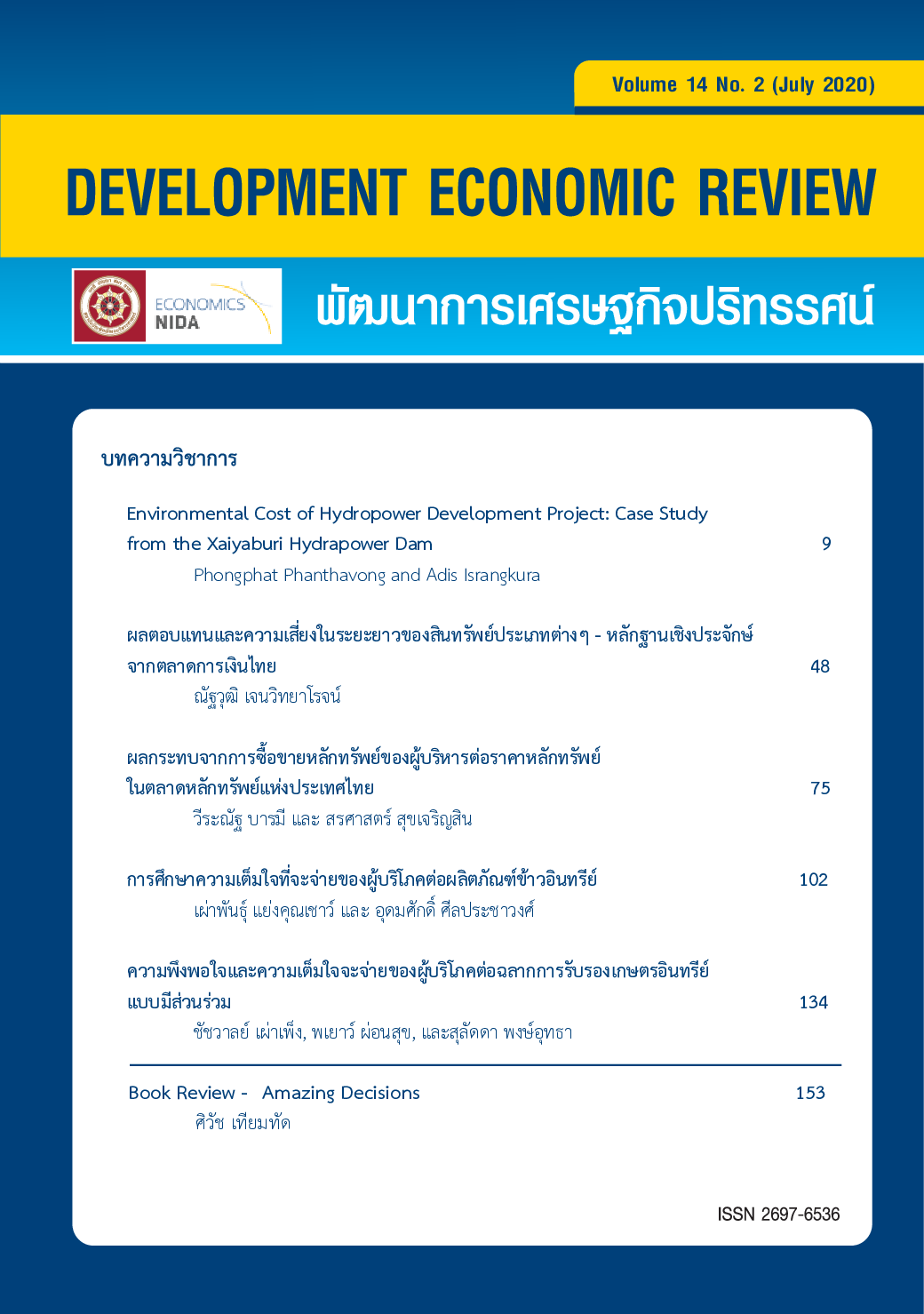
Price Effects of Insider Trading in the Stock Exchange of Thailand
Keywords:
Insider Trading, Abnormal Returns, Event Study, Stock Exchange of ThailandAbstract
The purpose of this paper is to study the stock price effects of insider trading activities in the Stock Exchange of Thailand. Using a standard event-study methodology, this paper finds that both buy and sell transactions of insider trading are followed by abnormal returns; however, most of the sell transactions have higher abnormal return relatively to buy transactions. This paper also discovers that abnormal returns from top executives’ buy and sell transactions have higher abnormal return than those of lower management level. The differences in abnormal returns depend on size of company, large market capitalization companies have higher abnormal returns than medium and small market capitalization companies. This paper also investigates the relationship between abnormal returns and other factors using regression analysis, the result indicates that size of the firms and growth opportunity, along with corporate governance score are inversely related to abnormal returns.
References
Brown, S. J. & Warner, J. B. (1985). Using Daily Stock Returns: The Case of Event Studies. Journal of Financial Economics, 14(1), 3-31.
Charasrungrojkul, S. (2009). Corporate Governance and Insider Trading: Evidence from Thailand. Master Thesis, Faculty of Commerce and Accountancy, Chulalongkorn University. Retrieved from http://cuir.car.chula.ac.th/handle/123456789/18454.
Cohen, L., Malloy, C., & Pomorski, L. (2010). Decoding Inside Information. Journal of Financial Economics, 67(3), 1009-1043.
Dierkens, N. (1991). Information Asymmetry and Equity Issues. Journal of Financial and Quantitative Analysis, 26(2), 181–199.
Fama, E. F. (1970). Efficient Capital Markets: A Review of Theory and Empirical Work. The Journal of Finance, 25(2), 383-417.
Fang, L. & Peress, J. (2009). Media Coverage and the Cross-Section of Stock Returns, Journal of Finance, 64(5), 2023–2052.
Fidrmuc, J. P., Goergen, M., & Renneboog, L. (2006). Insider Trading, News Releases, and Ownership Concentration. Journal of Finance, 61(6), 2931-2973.
Givoly, D. & Palmon D. (1985), Insider Trading and the Exploitation of Insider Information: Some Empirical Evidence, Journal of Business, 58(1), 69-87.
Ingkasit, R. (2017). Family Affair? Insider Trading and Family Firms: Evidence from Thailand. Master Thesis, Faculty of Commerce and Accountancy, Thammasat University.
Retrieved from http://ethesisarchive.library.tu.ac.th/thesis/2017/TU_2017_5702042176_7172_4679.pdf.
Jaffe, J. F. (1974). Special Information and Insider Trading. The Journal of Business, 47(3), 410-28.
Jeng, L. A., Metrick, A., & Zeckhauser, R. (2003). Estimating the Returns to Insider Trading: A Performance-Evaluation Perspective. Review of Economics and Statistics, 85(2), 453-471.
Karpoff, J. M. (1987). The Relation between Price Changes and Trading Volume: A Survey, Journal of Financial and Quantitative Analysis, 22(1), 109-126.
Ke, B., Huddart, S. J., & Petroni, K. R. (2003). What Insiders Know About Future Earnings and How They Use it. Journal of Accounting and Economics, 35(3), 315-346.
Klassen, R. D. & McLaughlin, C.P. (1996). The Impact of Environmental Management on Firm Performance. Management Science, 42(8), 1199-214.
Lakonishok, J. & Lee, I. (2001). Are Insider Trades Informative? Review of Financial Studies, 14(1), 79-111.
Laoniramai, W. (2012). Insider Trading Behavior and News Announcement: Evidence from the Stock Exchange of Thailand. Bangkok: CMRI Working Paper 3/2013. Retrieved from
https://www.set.or.th/setresearch/files/cmresearch/2013.03_CMRI_Working_Paper.pdf.
Lhaopadchan, S., Budsaratragoon, P., & Hillier, D. (2016). Earnings Management, Corporate Governance and Insider Trading: Evidence from Thailand. Chulalongkorn Business Review, 38(3), Issue 149, 107-156.
Lin, J. C., & Howe, J. S. (1990). Insider Trading in the OTC Market. Journal of Finance, 45(4), 1273-1284.
Penman, S. (1982). Insider Trading and the Dissemination of Firms’ Forecast Information. Journal of Accounting Research, 20(2), 639-653.
Piotroski, J. D., & Roulstone, D. T. (2005). Do Insider Trades Reflect Both Contrarian Beliefs and Superior Knowledge about Future Cash Flow Realizations. Journal of Accounting and Economics, 39(1), 55-81.
Seyhun, H. (1986). Insiders’ Profits, Costs of Trading, and Market Efficiency. Journal of Financial Economics, 16(2), 189-212.
Sivakumar, K. & Waymire, G. (1994), Insider Trading Following Material News Events: Evidence from Earnings. Financial Management, 23(1), 23-32.
Sukcharoensin, S. & Sathitviangthong, S. (2012). Do Corporate Insiders have Market-Timing Ablility? Evidence from the Stock Exchange of Thailand. Journal of Financial Markets Research, 4, 6-17.
Tassaneyapong, P. & Sukcharoensin, P. (2020). Stock Price Reactions of Target Companies to Mergers and Acquisitions Announcements. Journal of Business Administration and Social Sciences, 3(1). 52-68.
Wu, Y. & Zhu, Q. (2011). When is Insider Trading Informative? SSRN Electronic Journal. Retrieved from www.researchgate.net/publication/228259458_When_is_Insider_Trading_Informative
Downloads
Published
Issue
Section
License
Copyright to published manuscripts becomes the property of the Graduate School of Development Economics, National Institute of Development Administration. Reproduction of all or part of a Development Economic Review (DER) article by anyone, excluding author(s), is prohibited, unless receiving our permission.
Disclaimer: Opinions expressed in articles published in this journal are those of the author (s) and do nto necessarily represent opinions of the Graduate School of Development Economics, National Institute of Development Administration. Trade and proprietary names are only for identification and not constitute our endorsement.


