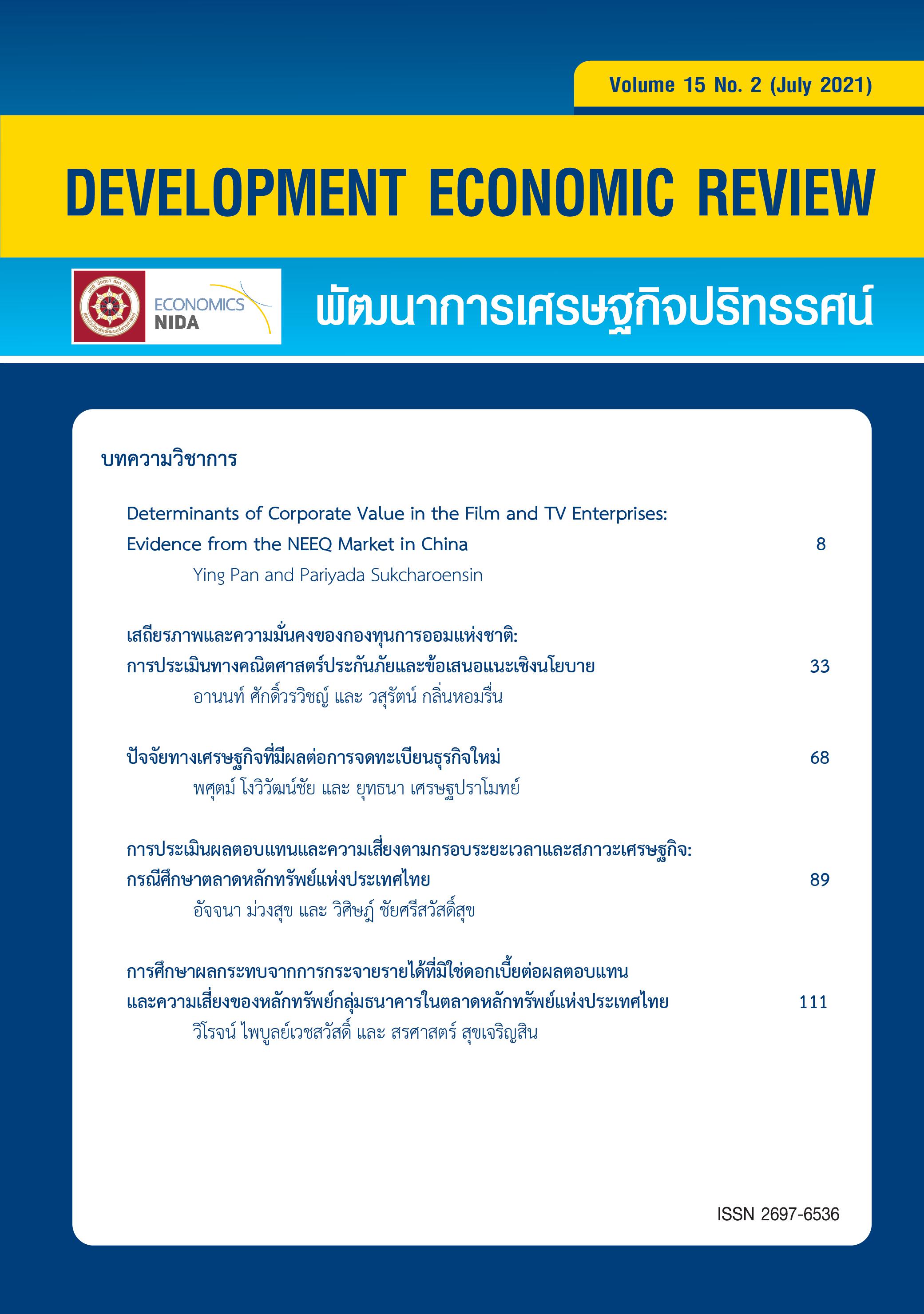
การศึกษาผลกระทบจากการกระจายรายได้ที่มิใช่ดอกเบี้ยต่อผลตอบแทนและความเสี่ยงของหลักทรัพย์กลุ่มธนาคารในตลาดหลักทรัพย์แห่งประเทศไทย
คำสำคัญ:
การกระจายรายได้ที่มิใช่ดอกเบี้ย, ผลตอบแทนและความเสี่ยงของธนาคาร, กลุ่มธนาคารพาณิชย์ในประเทศไทยบทคัดย่อ
วัตถุประสงค์ของการศึกษานี้เพื่อขยายผลการศึกษาเชิงประจักษ์ จากผลกระทบของการกระจายรายได้ต่างๆ ที่มิใช่ดอกเบี้ยต่อผลตอบแทนและความเสี่ยงของธนาคารของกลุ่มธนาคารพาณิชย์ จำนวน 10 ธนาคารที่จดทะเบียนในตลาดหลักทรัพย์แห่งประเทศไทย ในช่วงเวลา 19 ปี ตั้งแต่ปี พ.ศ. 2540 ถึง พ.ศ.2558 จากผลการศึกษาเชิงประจักษ์ พบว่า ค่าดัชนีการปรับสัดส่วนของรายได้ต่างๆ ที่ไม่ใช่ดอกเบี้ย มีแนวโน้มไปในทิศทางที่เพิ่มขึ้นและมีความสัมพันธ์เชิงบวกต่อความสามารถในการทำกำไรของธนาคาร นอกจากนี้ ยังพบว่า แนวโน้มของการเพิ่มสัดส่วนของรายได้ที่มาจากค่าธรรมเนียม ค่านายหน้า และสัดส่วนของรายได้ที่มาจากการลงทุนต่างๆ ส่งผลต่อการลดลงอัตราผลตอบแทนที่ปรับด้วยค่าความเสี่ยงของกลุ่มธนาคาร โดยเฉพาะอย่างยิ่ง หากกลุ่มธนาคารพาณิชย์ปรับเพิ่มค่าดัชนีการกระจายของรายต่างๆ ที่มิใช้ดอกเบี้ย มากจนเกินไป (over-diversification) แล้ว กลับจะส่งผลกระทบในเชิงลบต่ออัตราผลตอบแทนที่ปรับด้วยค่าความเสี่ยง
เอกสารอ้างอิง
Baele, L., De Jonghe, O., & Vander Vennet, R. (2007). Does the stock market value bank
diversification?. Journal of Banking and Finance, 31, 1999–2023.
Berger, A. N., Hasan, I., & Zhou, M. (2010). The effects of focus versus diversification on bank performance: evidence from Chinese banks. Journal of Banking and Finance, 34, 1417–1435.
Chantapong, S. (2005). Comparative study of domestic and foreign bank performance in Thailand: the regression analysis. Economic Change and Restructuring, 38, 63–83.
Chiorazzo, V., Milani, C., & Salvini, F. (2008). Income diversification and bank performance:
evidence from Italian Banks. Journal of Financial Services Research, 33, 181–203.
Demirgüç-Kunt, A., & Huizinga, H., (2004). Market discipline and deposit insurance. Journal of Monetary Economics, 51 (2), 375–399.
Demirgüç-Kunt, A., & Huizinga, H. (2010). Bank activity and funding strategies: the impact on risk and returns. Journal of Financial Economics, 98 (3), 626–650.
DeYoung, R., & Roland, K. P. (2001). Product mix and earnings volatility at commercial banks: evidence from a degree of leverage model. Journal of Financial Intermediation, 10, 54–84.
Gochoco-Bautista, S., Oh, S. N., Rhee, S. G. (2000). In the eye of the Asian financial maelstrom: banking sector reforms in the Asia-Pacific region. Asian Development Bank, 1, 50–106.
Haq, M., Faff, R., Seth, R., & Mohanty, S. (2014). Disciplinary Tools and Bank Risk Exposure. Pacific-Basin Finance Journal, 26, 37–64.
Jensen, M., & Meckling, W. (1976). Theory of the firm: managerial behavior, agency costs, and ownership structure. Journal of Financial Economics, 3, 305–360.
Klein, P. G., & Saidenberg, M. R. (1997). Diversification, organization and efficiency: Evidence from bank holding companies. mimeo.
Laowattanabhongsea, S., & Sukcharoensin S. (2018). Bank Competition and Economic Growth: A Cross-Country Investigation. Southeast Asian Journal of Economics, 6 (1), 1-21.
Lee, C. C., Hsieh, M. F., & Chang, C. H. (2014). The relationship between revenue diversification and bank performance: Do financial structures and financial reforms matter.? Japan and the World Economy, 29, 18–35.
Lee, C. C., Yang, S. J., & Chang, C. H. (2014). Non-interest income, profitability, and risk in banking industry: A cross-country analysis. The North American Journal of Economics and Finance, 27, 48–67.
Lepetit, L., Nys, E., Rous, P., & Tarazi, A. (2008). Bank income structure and risk: An empirical analysis of European banks. Journal of Banking & Finance, 32, 1452–1467.
Lin, J. R., Chung, H., Hsieh, M. H., & Wu, S. (2012). The determinants of interest margins and their effect on bank diversification: Evidence from Asian banks. Journal of Financial Stability, 8 (2), 96-106.
Meslier, C., Tacneng, R., & Tarazi, A. (2014). Is bank income diversification beneficial? Evidence from an emerging economy. Journal of International Financial Market Institutions and Money, 31(1), 97–126.
Nguyen, M., Skully, M., & Perera, S. (2012). Bank market power and revenue diversification:
evidence from selected ASEAN countries. Journal of Asian Economics, 23(6), 688-700.
Pennathur, A. K., Subrahmanyam, V., & Vishwasrao, S. (2012). Income diversification and risk: does ownership matter? An empirical examination of Indian banks. Journal of Banking and Finance, 36, 2203–2215.
Rajan, R., Servaes, H., & Zingales, L. (2000). The cost of diversity: the diversification discount and inefficient investment. Journal of Finance, 55, 35–80.
Sanya, S., & Wolfe, S. (2011). Can banks in emerging economies benefit from revenue diversification?. Journal of Financial Services Research, 40, 79–101.
Sawada, M. (2013). How does the stock market value bank diversification? Empirical evidence from Japanese banks. Pacific-Basin Finance Journal, 25, 40–61.
Stein, J. C. (1997). Internal capital markets and the competition for corporate resources. Journal of Finance, 52, 111–133.
Senesombath, V. & Sukcharoensin, S. (2020). Evaluating the Operating Efficiency of Commercial Banking Sector in Lao PDR, Journal of Global Business Review 22 (2), 23-39.
Stein, J. C. (2002). Information production and capital allocation: decentralized vs. hierarchical firms. Journal of Finance, 57, 1891–1921.
Stiroh, K. J. (2004). Diversification in banking: Is noninterest income the answer?. Journal of Money, Credit, and Banking, 36 (5), 853–882.
Stiroh, K. J., & Rumble, A. (2006). The dark side of diversification: the case of US financial holding companies. Journal Banking Finance, 30, 2131–2161.
Sufian, F., & Habibullah, M. S. (2010). Developments in the efficiency of the Thailand banking sector: A DEA approach. International Journal of Development Issues, 9(3), 226-245.
ดาวน์โหลด
เผยแพร่แล้ว
ฉบับ
ประเภทบทความ
สัญญาอนุญาต
Copyright to published manuscripts becomes the property of the Graduate School of Development Economics, National Institute of Development Administration. Reproduction of all or part of a Development Economic Review (DER) article by anyone, excluding author(s), is prohibited, unless receiving our permission.


