การเคลื่อนย้ายเงินทุนและอัตราผลตอบแทน ในช่วงวัฏจักรธุรกิจในประเทศไทย
คำสำคัญ:
fund flow, investor types, Stock market returnsบทคัดย่อ
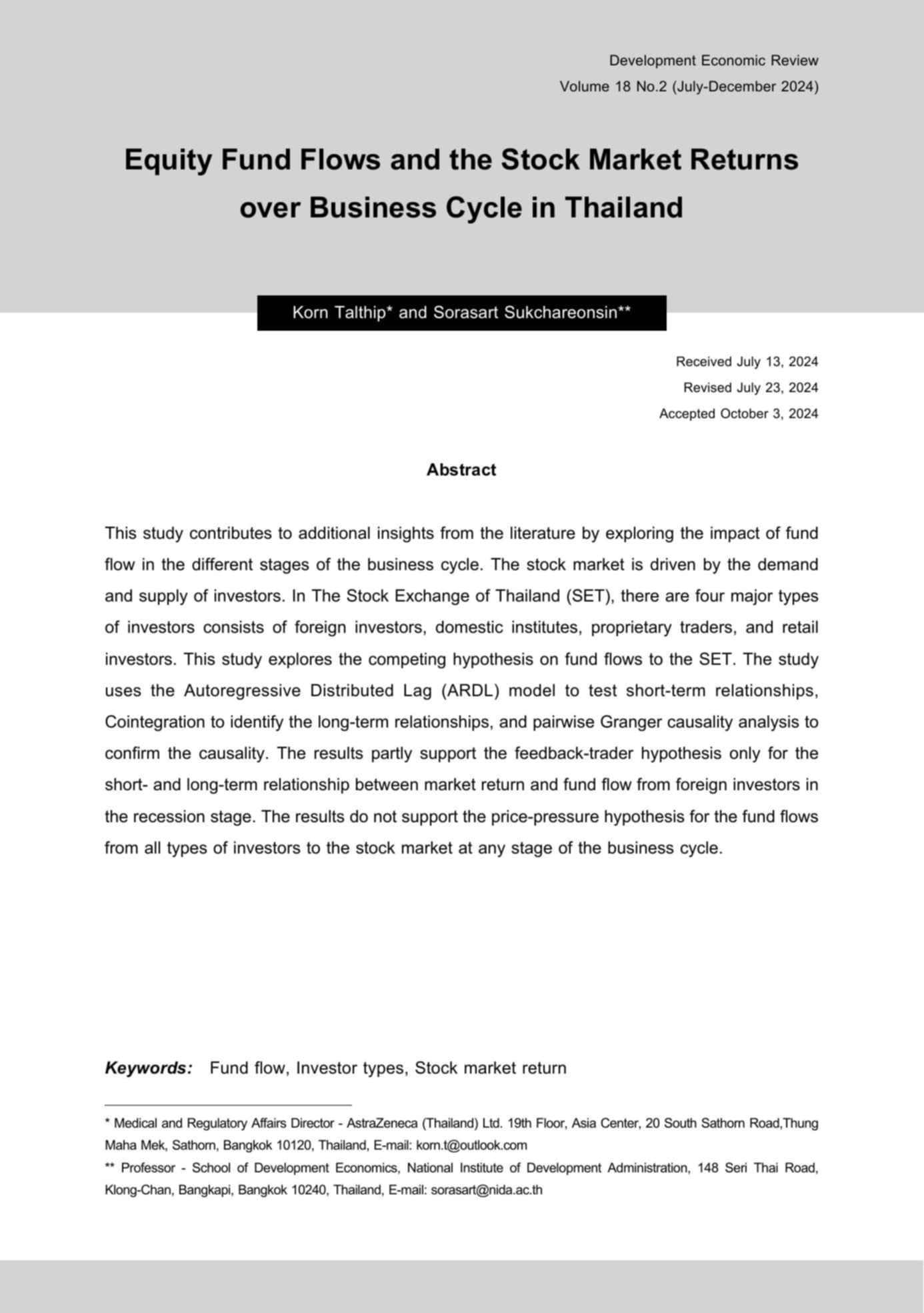
การศึกษานี้ ขยายมุมมองใหม่จากงานวิจัยในปัจจุบันโดยการสำรวจผลกระทบของการเคลื่อนย้ายเงินทุนในระยะต่าง ๆ ของวัฏจักรธุรกิจ ตลาดหุ้นถูกขับเคลื่อนโดยอุปสงค์และอุปทานของนักลงทุน ในตลาดหลักทรัพย์แห่งประเทศไทย (SET) มีนักลงทุนหลัก 4 ประเภทได้แก่นักลงทุนต่างประเทศ สถาบันในประเทศ ผู้ค้าที่เป็นโบรกเกอร์ และนักลงทุนรายย่อย การศึกษานี้สำรวจสมมติฐานที่แข่งขันกันเกี่ยวกับการไหลเข้าของกองทุนใน SET การศึกษานี้ใช้แบบจำลอง Autoregressive Distributed Lag (ARDL) เพื่อทดสอบความสัมพันธ์ระยะสั้น การวิเคราะห์ความสัมพันธ์เชิงดุลยภาพระยะยาวด้วยวิธี Cointegration และการวิเคราะห์สาเหตุของ Granger เพื่อยืนยันความเป็นเหตุเป็นผล ผลการศึกษาสนับสนุนสมมติฐาน feedback-trader hypothesis เพียงบางส่วนเท่านั้นสำหรับความสัมพันธ์ระยะสั้นและระยะยาวระหว่างผลตอบแทนของตลาดและเคลื่อนย้ายเงินทุนจากนักลงทุนต่างประเทศในช่วงสภาวะถดถอย อย่างไรก็ตาม ผลการศึกษาไม่สนับสนุนสมมติฐาน price-pressure hypothesis สำหรับการเคลื่อนย้ายเงินทุนจากนักลงทุนทุกประเภทไปยังตลาดหุ้นในทุกขั้นตอนของวัฏจักรธุรกิจ
เอกสารอ้างอิง
Babalos, V., Caporale, G.M., & Spagnolo, N. (2019). Equity fund flows and stock market returns in the USA before and after the global financial crisis: a VAR-GARCH-in-mean analysis. Empirical Economics, 1-17, https://doi.org/10.1007/s00181-019-01783-5
Baker, M., & Wurgler, J. (2007). Investor sentiment in the stock market. Journal of Economic Perspectives, 21(2), 129-152
Boyer, B., & Zheng, L. (2009). Investor flows and stock market returns. Journal of Empirical Finance, 16(1), 87-100.
Dash, S.R., & Mahakud, J. (2013). Impact of investor sentiment on stock return: Evidence from India. Journal of Management Research, 13(3), 131-144
Economou, F., Gavriilidis, K., Gebka, B. and Kallinterakis, V. (2023), Feedback trading: a review of theory and empirical evidence, Review of Behavioral Finance, Vol. 15 No. 4, pp. 429-476. https://doi.org/10.1108/RBF-12-2021-0268
Jank, S. (2012). Mutual fund flows, expected returns, and the real economy, Journal of Banking & Finance, Volume 36, Issue 11, 2012, Pages 3060-3070.
Kang, H., & Suh, H. (2015). Reverse spillover: Evidence during emerging market financial turmoil in 2013–2014. Journal of International Financial Markets, 38, 97-115.
Kopsch, F., & Song, H. S. (2015). Determinants of mutual fund flows. Managerial Finance, 41(1), 10-25.
Koutmos, G. (2014), Positive feedback trading: a review, Review of Behavioral Finance, Vol. 6 No. 2, pp. 155-162. https://doi.org/10.1108/RBF-08-2014-0043
Ndei, C. M., Muchina, S., & Waweru, K. (2019). Equity Unit Trust Funds Flow and Stock Market Returns: Evidence from Kenya. International Journal of Finance & Banking Studies, 8(1), 21-36.
Richard Apau, Paul-Francois Muzindutsi and Peter Moores-Pitt (2021). Mutual fund flow-performance dynamics under different market conditions in South Africa. Investment Management and Financial Innovations, 18(1), 236-249. doi:10.21511/imfi.18(1).2021.20
Talthip, K., & Sukcharoensin, S. (2020). A new approach to the business cycle and insights for the allocation of investment asset classes and sectoral stock returns along the business cycle (Unpublished doctoral dissertation). School of Development Economics, National Institute of Development Administration, Bangkok, Thailand
Talthip, K., & Sukcharoensin, S. (2022). Equity sector investing over business cycles: The case of Thailand. Kasetsart Journal of Social Sciences, 43(2), 379‒386. Retrieved from https://so04.tci-thaijo.org/index.php/kjss/article/view/258496
Warther, Vincent A. (1995). Aggregate Mutual Fund Flows and Security Returns. Journal of Financial Economics, 39, 209-235.
Zeckhauser, R. J. (1994). Investment flows and performance: Evidence from mutual funds, cross-border investments, and new issues. In R. Sato, L. R. M., & R. R. V. (Eds.), Japan, Europe, and International Financial Markets (pp. 51-72). Cambridge: Cambridge University Press.
Zhu, B. (2012). The effects of macroeconomic factors on stock return of energy sector in Shanghai stock market. International Journal of Scientific and Research Publications, 2(11), 1-4.
ดาวน์โหลด
เผยแพร่แล้ว
ฉบับ
ประเภทบทความ
สัญญาอนุญาต
Copyright to published manuscripts becomes the property of the Graduate School of Development Economics, National Institute of Development Administration. Reproduction of all or part of a Development Economic Review (DER) article by anyone, excluding author(s), is prohibited, unless receiving our permission.


