ความสัมพันธ์ระหว่างอัตราค่าใช้จ่ายรวมและผลตอบแทนของกองทุนความยั่งยืนในประเทศไทย
คำสำคัญ:
กองทุนยั่งยืน, อัตราส่วนค่าใช้จ่ายรวม, ระดับความยั่งยืน, มอร์นิ่งสตาร์บทคัดย่อ
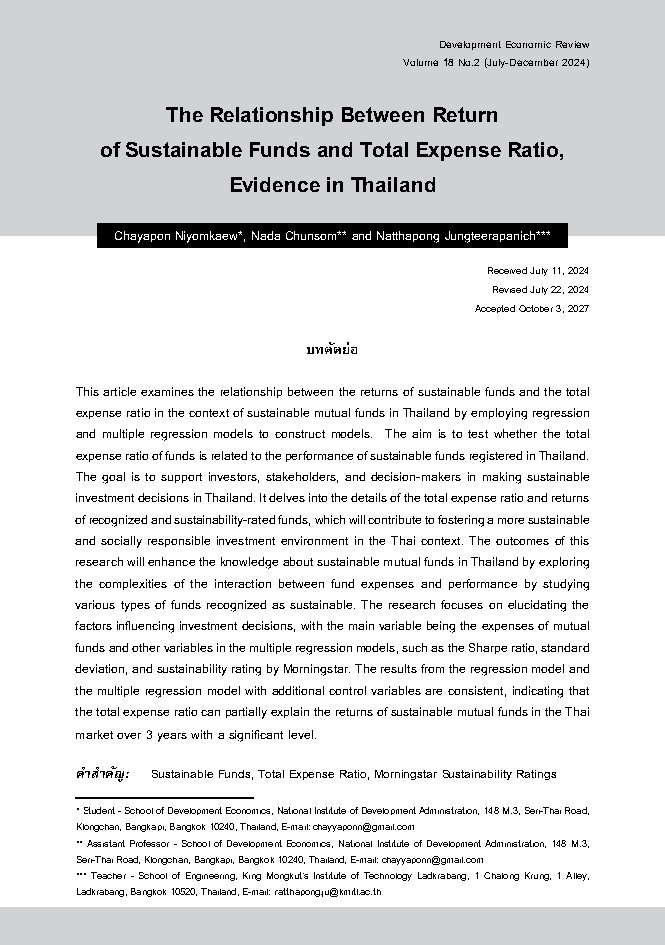
บทความนี้ศึกษาความสัมพันธ์ระหว่างผลตอบแทนของกองทุนยั่งยืนและอัตราค่าใช้จ่ายรวมในบริบทของกองทุนรวมยั่งยืนในประเทศไทย โดยใช้แบบจำลองการถดถอยและแบบจำลองการถดถอยพหุคูณในการสร้างโมเดล มีเป้าหมายเพื่อทดสอบว่าอัตราค่าใช้จ่ายรวมของกองทุนมีความสัมพันธ์กับต่อผลการดำเนินงานของกองทุนยั่งยืนที่จดทะเบียนในประเทศไทยหรือไม่ เพื่อเป็นข้อมูลสนับสนุนนักลงทุน ผู้มีส่วนได้ส่วนเสีย และผู้มีอำนาจตัดสินใจในการตัดสินใจเกี่ยวกับการลงทุนอย่างยั่งยืนในประเทศไทย โดยลงรายละเอียดไปยังอัตราส่วนค่าใช้จ่ายรวมและผลตอบแทนของกองทุนที่ได้รับการยอมรับและจัดอันดับความยั่งยืน ซึ่งจะเป็นส่วนเสริมให้เกิดสภาพแวดล้อมการลงทุนที่ยั่งยืน และมีความรับผิดชอบต่อสังคมมากขึ้นในบริบทของประเทศไทย ผลการศึกษาจะเป็นการเสริมสร้างองค์ความรู้เกี่ยวกับกองทุนรวมยั่งยืนในประเทศไทยโดยสำรวจความซับซ้อนของปฏิสัมพันธ์ระหว่างค่าใช้จ่ายของกองทุนและผลการดำเนินงาน ผ่านการศึกษาประเภทต่าง ๆ ของกองทุนรวมที่ได้รับการยอมรับในฐานะกองทุนยั่งยืน โดยงานวิจัยมุ่งเน้นไปที่การชี้แจงปัจจัยที่มีอิทธิพลต่อการตัดสินใจลงทุนโดยมีตัวแปรหลัก คือ ค่าใช้จ่ายของกองทุนรวมและตัวแปรอื่น ๆ ในโมเดลถดถอยหลายตัวแปร เช่น อัตราส่วนของชาร์ป ส่วนเบี่ยงเบนมาตรฐาน และระดับความยั่งยืนที่ได้รับการจัดอันดับโดยมอร์นิ่งสตาร์ โดยผลการศึกษาจากสมการถดถอยและสมการถดถอยหลายตัวแปรที่มีตัวแปรควบคุมเพิ่มเติมเป็นไปในทิศทางเดียวกัน แสดงให้เห็นว่าอัตราส่วนค่าใช้จ่ายรวมสามารถอธิบายส่วนหนึ่งของผลตอบแทนกองทุนรวมที่เน้นเรื่องความยั่งยืนในตลาดไทยในระยะเวลา 3 ปีอย่างมีนัยสำคัญ
เอกสารอ้างอิง
Ashraf, S. H., & Sharma, D. (2014). Performance evaluation of Indian equity mutual funds against established Benchmarks index. International Journal of Accounting Research, 2(1). https://doi.org/10.4172/2472-114x.1000113
Bahl, R. W. (1971). A Regression Approach to Tax Effort and Tax Ratio Analysis. IMF Staff Papers, 18(3), 570-599.
Bednarek, Z., Patel, P., & Ramezani, C. A. (2016). Time Aggregation of the Sharpe ratio. Journal of Asset Management, 17(7), 540–555. https://doi.org/10.1057/s41260-016-0003-x
Bekaert, G., & Harvey, C. R. (1997). Emerging equity market volatility. Journal of Financial Economics, 43(1), 29–77. https://doi.org/10.1016/s0304-405x(96)00889-6
Berg, F., Kölbel, J. F., & Rigobon, R. (2022). Aggregate confusion: The divergence of ESG Ratings. Review of Finance, 26(6), 1315–1344. https://doi.org/10.1093/rof/rfac033
Chatterjee, S., & Hadi, A. S. (2006). Regression Analysis by Example, 4th ed. John Wiley & Sons.
Cheraghi, J., & Sundqvist, A. (2022). Fees in Sustainable Mutual Funds: The relationship between the return on sustainable mutual funds and the total expense ratio in the U.S. and Sweden. DIVA. https://umu.diva-portal.org/smash/record.jsf?pid=diva2%3A1679297&dswid=-5971
Chiang, T. & Zheng, D. (2010). An empirical analysis of herd behavior in global stock markets. Journal of Banking & Finance. Vol.34, Issue. 8, pp. 1911-1921.
Çitak, L. (2009), The Relationship Between Expense Ratio and Net Asset Value (NAV) Return: The Case of Turkish Investment Companies. Marmara Üniversitesi İktisadi ve İdari Bilimler Fakultesi Dergisi, no.1, pp.357-381.
Clark, G. L., Feiner, A., & Viehs, M. (2015, March 5). From the Stockholder to the Stakeholder: How Sustainability Can Drive Financial Outperformance. Available at SSRN: https://ssrn.com/abstract=2508281 or http://dx.doi.org/10.2139/ssrn.2508281
Coakes, S. J. & Steed, L. G. (2003). SPSS: Analysis without anguish: Version 11.0 for Windows, 215-224.
Cohen, J., Cohen, P., West, S. G., & Aiken, L. S. (2003). Applied Multiple Regression/Correlation Analysis for the Behavioral Sciences, 3rd ed. Mahwah, NJ: Lawrence Erlbaum Associates. https://doi.org/10.4324/9781410606266
Collis, J. & Hussey, R. (2014). Business Research: A Practical Guide for Undergraduate and Postgraduate Students, 4th ed. Basingstoke: Hampshire.
Deloitte, 2022. Thailand ESG and Sustainability Report 2022. Retrieved from th-esg-sustainability-survey-report-2022.pdf
Eccles, R., & Klimenko, S. (2019). Shareholders are getting serious about sustainability. Harvard Business Review. May-June. pp. 106-116. Retrieved from https://hbr.org/2019/05/the-investor-revolution
El Ghoul, S. & Karoui, A. (2019). Fund Performance and Social Responsibility: New Evidence using Social Active Share and Social Tracking Error. (September 7). Journal of Banking and Finance, Available at SSRN: https://ssrn.com/abstract=3489201 or http://dx.doi.org/10.2139/ssrn.3489201
Fama, E. F. (1965). The behavior of stock-market price. The Journal of Business, Vol. 8, No. 1 (Jan), pp. 34-105.
Ferreira, M.A., Keswani, A., Miguel, A.F., & Ramos, S.B. (2013). The Determinants of Mutual Fund Performance: A Cross-Country Study. Review of Finance, 17(2), pp. 483–525. https://doi.org/10.1093/rof/rfs013
Friede, G., Busch, T., & Bassen, A. (2015). ESG and financial performance: aggregated evidence from more than 2000 empirical studies. Journal of Sustainable Finance & Investment, 5(4), 210-233. https://doi.org/10.1080/20430795.2015.1118917
Fulton, M., Kahn, B. M., & Sharples, C. (2012). Sustainable investing: Establishing long-term value and performance. SSRN Electronic Journal. https://doi.org/10.2139/ssrn.2222740
Hartzmark, S. M. & Sussman, A. B. (2017, August 9). Do investors value sustainability? A natural experiment examining ranking and fund flows. SSRN. https://papers.ssrn.com/sol3/papers.cfm?abstract_id=3016092
Haslem, J. A. (2018). Mutual fund negative general effects on shareholder performance. The Journal of Wealth Management, 21(1), 51–56. https://doi.org/10.3905/jwm.2018.21.1.051
Hensawang, S. M. (2022). Effect of mutual fund fundamentals and characteristics on their performance: An empirical study of thai equity mutual funds. Cuadernos de Economía, 45, 128 (May-August). https://cude.es/submit-a-manuscript/index.php/CUDE/article/view/255
Ketsuriyang, K. (2023, May 17). Thailand ESG and Sustainability Survey Report 2022. Deloitte Thailand. https://www2.deloitte.com/th/en/pages/about-deloitte/articles/th-esg-sustainability-survey-report-2022-th.html
Korkeamaki, T. P. & Smythe, T. I. (2004). Effects of market segmentation and bank concentration on mutual fund expenses and returns: Evidence from Finland. European Financial Management, 10(3), 413–438. https://doi.org/10.1111/j.1354-7798.2004.00257.x
Lee, J. (2013). Measuring the Mutual Fund Industry Risk Management and Performance Sustainability--Quantile Regression Model. Journal of Asian Business Strategy, 3(4), 59–68. Retrieved from https://archive.aessweb.com/index.php/5006/article/view/4066
Lidyah, R. (2017). Pengaruh Total Asset, Expense Ratio Dan Portofolio Turnover Terhadap Kinerja Reksadana Saham DI Indonesia. I-Economics: A research journal on Islamic Economics. Vol. 3., No. 1, 19-37.
Manop, P. (2016). Mutual Fund in Thailand: New Evidence (in Thai). Master Thesis. Master of Science, Thammasat University. Available at https://ethesisarchive.library.tu.ac.th/thesis/2016/TU_2016_5702112995_3701_4004.pdf
Marupanthorn, P., Termsaithong, T., Wangpratham, N., Koryanyong, J., Chanpiwat, C., & Pathomsathit, C. (2024). Development of ESG factors for enhancing factor model in the Thai Stock Market. SSRN Electronic Journal. https://doi.org/10.2139/ssrn.4706129
Morningstar (2021). Morning Sustainability Rating: Methodology. 8 November. Retrieved from https://www.morningstar.com/content/dam/marketing/shared/research/methodology/744156_Morningstar_Sustainability_Rating_for_Funds_Methodology.pdf
Nalla, B., Kalyan, N. B., & Gautami, S. (2018). A study on risk & return analysis of the selected mutual funds schemes in India. ResearchGate. https://www.researchgate.net/publication/325710161_A_Study_on_Risk_Return_Analysis_of_the_Selected_Mutual_Funds_Schemes_In_India
Otten, R. & Bams, D. (2002). European Mutual Fund Performance. European Financial Management, [online] 8(1), pp.75–101. https://doi.org/10.1111/1468 036x.00177
Pukthuanthong, K., & Roll, R. (2009). Global market integration: An alternative measure and its application. Journal of Financial Economics, 94(2), 214–232. https://doi.org/10.1016/j.jfineco.2008.12.004
Sharpe, W.F. (1966). Mutual fund performance. The Journal of Business, 39, 119-138.
Singh, A.B. & Tandon, P. (2021). Association between fund attributes and fund’s performance: a panel data approach. Benchmarking: An International Journal, 29(1), pp.285–304. https://doi.org/10.1108/bij-10-2020-0545
Steen, M. (2019). The role of sustainability ratings in the assessment of responsible investment practice. Social and Environmental Accountability Journal, 39(2), 95-111. https://doi.org/10.1111/beer.12588
Studenmund, A.H. (2015). Using Econometrics: A Practical Guide. 6th Ed. Harlow, Essex: Pearson Education Limited.
The Government Public Relations Department. (2023, June 26). Thailand ranks first in ASEAN for five consecutive years in SDG index. Foreign Office, The Government Public Relations Department. https://thailand.prd.go.th/en/content/category/detail/id/48/iid/192464
Wongsurawat, W. (2011). Management fees and total expenses of mutual funds in Thailand. Journal of the Asia Pacific Economy, 16(1), 15–28. https://doi.org/10.1080/13547860.2011.539398
Yan, X. and Su, X. (2009). Linear Regression Analysis: Theory and Computing. Hackensack, N.J.: World Scientific
ดาวน์โหลด
เผยแพร่แล้ว
ฉบับ
ประเภทบทความ
สัญญาอนุญาต
Copyright to published manuscripts becomes the property of the Graduate School of Development Economics, National Institute of Development Administration. Reproduction of all or part of a Development Economic Review (DER) article by anyone, excluding author(s), is prohibited, unless receiving our permission.


