การเปลี่ยนแปลงของความเหลื่อมล้ำทางการศึกษาก่อนและหลังการระบาดของ โควิด-19 ผ่านคะแนน PISA
ความเหลื่อมล้ำทางการศึกษาไทย
คำสำคัญ:
ความเหลื่อมล้ำทางการศึกษาไทย คะแนน PISA เศรษฐสถานะ ช่องวางทางดิจิทัลบทคัดย่อ
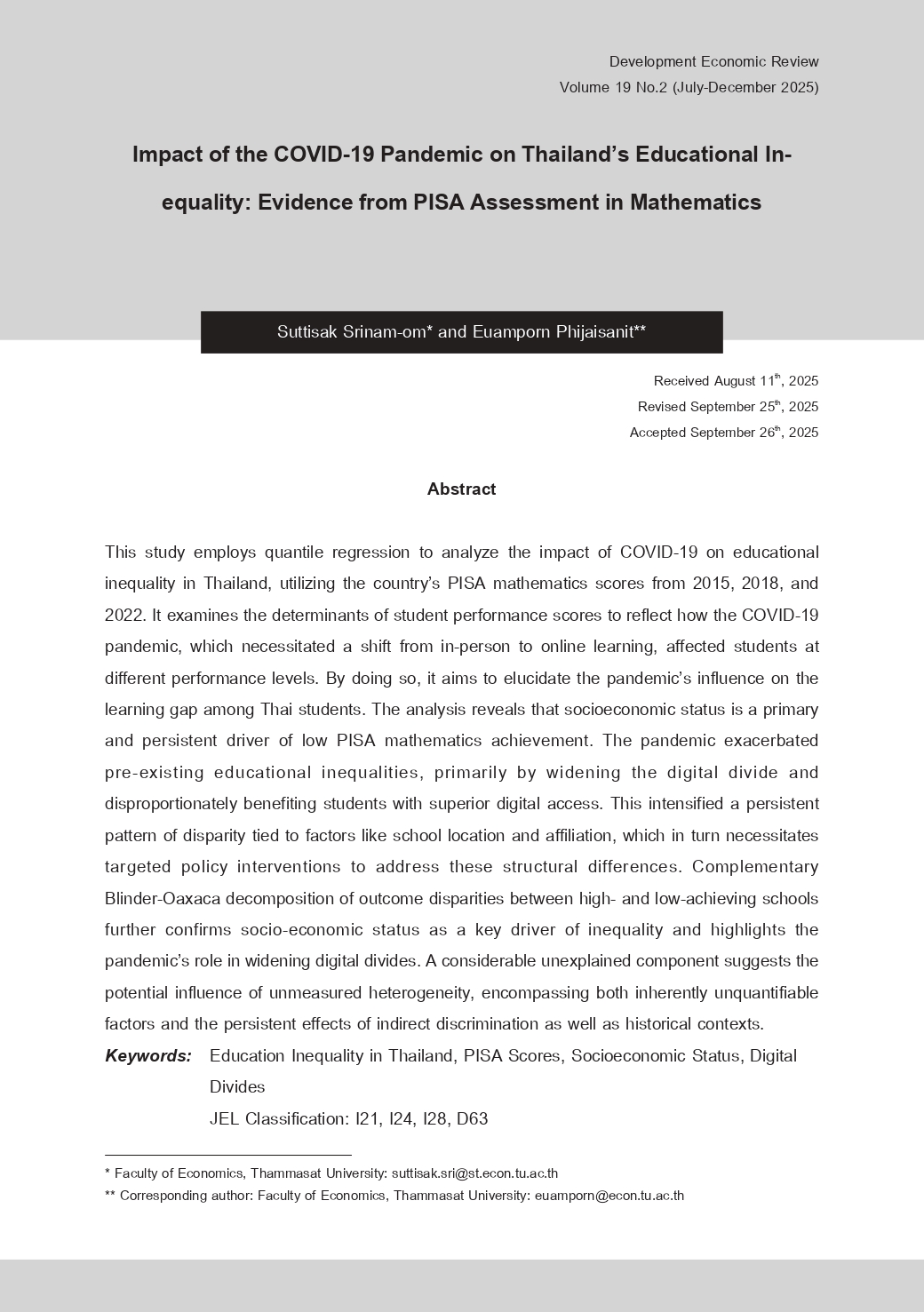
งานวิจัยนี้ใช้การวิเคราะห์การถดถอยเชิงควอนไทล์ (quantile regression) ศึกษาผลกระทบของการแพร่ระบาดโรคโควิด-19 และปัจจัยที่มีอิทธิพลต่อความเหลื่อมล้ำทางการศึกษาในประเทศไทย โดยอาศัยข้อมูลคะแนน PISA วิชาคณิตศาสตร์ในปี ค.ศ. 2015 2018 และ 2022 ผลการศึกษาพบว่าเศรษฐสถานะยังคงเป็นปัจจัยหลักที่ส่งผลให้คะแนน PISA วิชาคณิตศาสตร์อยู่ในระดับต่ำอย่างต่อเนื่อง นอกจากนี้ การแพร่ระบาดยังได้ซ้ำเติมความเหลื่อมล้ำทางการศึกษาที่มีอยู่เดิม โดยเฉพาะการขยายช่องว่างทางดิจิทัล สถานการณ์นี้ยิ่งทำให้ความเหลื่อมล้ำที่เป็นผลสืบเนื่องมาจากปัจจัยด้านสถานที่ตั้งและสังกัดของโรงเรียนมีความรุนแรงมากขึ้น ซึ่งชี้ให้เห็นถึงความจำเป็นเร่งด่วนในการดำเนินนโยบายเชิงรุกแบบเจาะจงแก้ไขปัญหาความเหลื่อมล้ำเชิงโครงสร้างเหล่านี้ การวิเคราะห์ในส่วนของ Blinder-Oaxaca Decomposition ระหว่างกลุ่มโรงเรียนที่มีผลสัมฤทธิ์สูงและต่ำ เน้นย้ำว่าเศรษฐสถานะเป็นปัจจัยสำคัญของความเหลื่อมล้ำ และโรคระบาดเป็นปัจจัยสำคัญในการขยายช่องว่างทางดิจิทัล ทั้งนี้ ส่วนที่ไม่สามารถอธิบายได้ของตัวแปรสะท้อนถึงผลกระทบอันเป็นผลพวงมาจากปัจจัยเชิงคุณภาพนอกเหนือแบบจำลอง เช่น การเลือกปฏิบัติทางอ้อมและบริบทเชิงประวัติศาสตร์
เอกสารอ้างอิง
Agenor, P. (2017). Caught in the middle? The economics of middle-income traps. Journal of Economic Surveys, 31(3), 771–79.
Barrera-Osorio, F., Garcia Moreno, V. A., Patrinos, H. A., & Porta Pallais, E. E. (2011). Using the Oaxaca-Blinder decomposition technique to analyze learning outcomes changes over time: An application to Indonesia's results in PISA mathematics (Policy Research Working Paper No. 5584). World Bank.
Blundell, R., Costa Dias, M., Cribb, J., Joyce, R., Waters, T., Wernham, T., & Xu, X. (2022). Inequality and the COVID-19 crisis in the United Kingdom. Annual Review of Economics, 14, 607–636.
Buchmann, C., & Hannum, E. (2001). Education and stratification in developing countries: A review of theories and research. Annual Review of Sociology, 27, 77–102.
Chansompoth, B. (2022). Inequality in educational learning outcome of Thai students from PISA. (Master’s Thesis, Thammasat University). http://ethesisarchive.library.tu.ac.th/thesis/2022/TU_2022_5804030111_17169_25600.pdf
Coryton, D. (2024). PISA 2022: Measuring the world’s education systems after COVID. Education Journal Review, 30(1), 83–107.
Hanushek, E. A. (1979). Conceptual and Empirical Issues in the Estimation of Educational Production Functions. The Journal of Human Resources, 14(3), 351-388.
Hoofman, J., & Secord, E. (2021). The effect of COVID-19 on education. Pediatric Clinics of North America, 68(5), 1071–1079.
Institute for the Promotion of Teaching Science and Technology (IPST). (2024). PISA Assessment Results (In Thai). https://pisathailand.ipst.ac.th/pisa-results/
Institute for the Promotion of Teaching Science and Technology (IPST). (2024). PISA 2022 Results: Executive Summary (In Thai). https://pisathailand.ipst.ac.th/pisa2022-summary-result/
Jann, B. (2008). The Blinder-Oaxaca decomposition for linear regression models. Stata Journal, 8(4), 453–479.
Koenker, R., & Bassett, G. (1978). Regression quantiles. Econometrica, 46(1), 33–50.
Lathapipat, D. (2010). Educational inequality and wage trends in Thailand. Paper presented at the 2010 Annual Academic Seminar on Reducing Inequality and Creating Economic Opportunity (In Thai), Bangkok Convention Centre, CentralWorld, Bangkok, Thailand. https://tdri.or.th/wp-content/uploads/2012/10/sec3.1_paper.pdf
Liu, D. (2024). Cross-national analysis of differences in student reading performance: Taking PISA 2022 as an example. Lecture Notes in Education Psychology and Public Media, 54, 37–43.
Lounkaew, K. (2013). Explaining urban–rural differences in educational achievement in Thailand: Evidence from PISA literacy data. Economics of Education Review, 37, 213–225.
Munir, F., & Winter-Ebmer, R. (2018). Decomposing international gender test score differences. Journal for Labour Market Research, 52(1), 1–17.
National Institute of Educational Testing Service. (2021). Average O-NET Scores for Grade 12 Students Classified by Region (In Thai). https://www.niets.or.th/th/content/view/11821
National Institute of Educational Testing Service. (2021). Basic national statistics of O-NET results for grade 12 students (In Thai). https://www.niets.or.th/th/content/view/11821
National Statistical Office. (2024). Government Expenditure Classified by Ministry for Fiscal Years 2014-2023 (In Thai). https://www.nso.go.th/nsoweb/nso/statistics_and_indicators?impt_branch=580
National Statistical Office. (2023). Average Years of Schooling of the Population Classified by Age Group and Gender for the Academic Years 2013-2022 (In Thai). https://www.nso.go.th/nsoweb/nso/statistics_and_indicators?%2Fnso%2Fstatistics_and_indicators=&impt_branch=303&page=2
Paweenawat, S. W., & Liao, L. (2022). Parenthood penalty and gender wage gap: Recent evidence from Thailand. Journal of Asian Economics, 78.
Pholphirul, P., & Teimtad, S. (2018). Living with parents and educational outcomes in developing countries: Empirical evidence from PISA Thailand. Journal of Population Research, 35(1), 87–105.
Prasartpornsirichoke, J., & Takahashi, Y. (2013). Assessing inequalities in Thai education. Institute of East Asian Studies, Thammasat University.
Psacharopoulos, G. (2006). The value of investment in education: Theory, evidence, and policy. Journal of Education Finance, 32(2), 113–136.
Ramos, R., Duque, J. C. C., & Nieto, S. (2012). Decomposing the rural-urban differential in student achievement in Colombia using PISA microdata. SSRN Electronic Journal. https://doi.org/10.2139/ssrn.2051358
Rianngern, N. (2022). Analysis of efficiency in education: Dissimilarities between schools in urban and rural areas in Thailand (In Thai) (Master’s thesis, Thammasat University). https://digital.library.tu.ac.th/tu_dc/frontend/Info/item/dc:306823
Roscigno, V. J., Tomaskovic-Devey, D., & Crowley, M. (2006). Education and the inequalities of place. Social Forces, 84, 2121–2145.
Ruangrat W. (2013). Efficiency measurement of educational management of public secondary schools. Journal of Management Science, Ubon Ratchathani University, 2(3), 38–48. (in Thai).
Srisuchart, S. (2016). A study on benefit incidence analysis of government education budget. Puey Ungphakorn Institute for Economic Research. (in Thai). https://www.pier.or.th/files/workshops/2016/pier_economics_of_fiscal_policy_2016_4_1_paper.pdf
Tadesse, S., & Muluye, W. (2020). The impact of COVID-19 pandemic on education system in developing countries: A review. Open Journal of Social Sciences, 8(10), 159–170.
Taweepreda, O. (2016). The distribution, equality of opportunity in education, and roles of public spending (In Thai) (Master’s thesis, Thammasat University). https://digital.library.tu.ac.th/tu_dc/frontend/Info/item/dc:274167
Weerapan, S., & Thinsandee, T. (2021). The new normal in education and increasing inequality. Rattanabuth Academic Journal, 3(2), 69–83.
World Bank. (n.d.). Government Expenditure on Education, total (% of Government Expenditure). World Bank Open Data. World Bank Group. https://data.worldbank.org/indicator/SE.XPD.TOTL.GB.ZS
ดาวน์โหลด
เผยแพร่แล้ว
ฉบับ
ประเภทบทความ
สัญญาอนุญาต
Copyright to published manuscripts becomes the property of the Graduate School of Development Economics, National Institute of Development Administration. Reproduction of all or part of a Development Economic Review (DER) article by anyone, excluding author(s), is prohibited, unless receiving our permission.


