Social Capital Accumulation and Macroeconomic Growth in Thailand
International and Provincial-level Comparisons
บทคัดย่อ
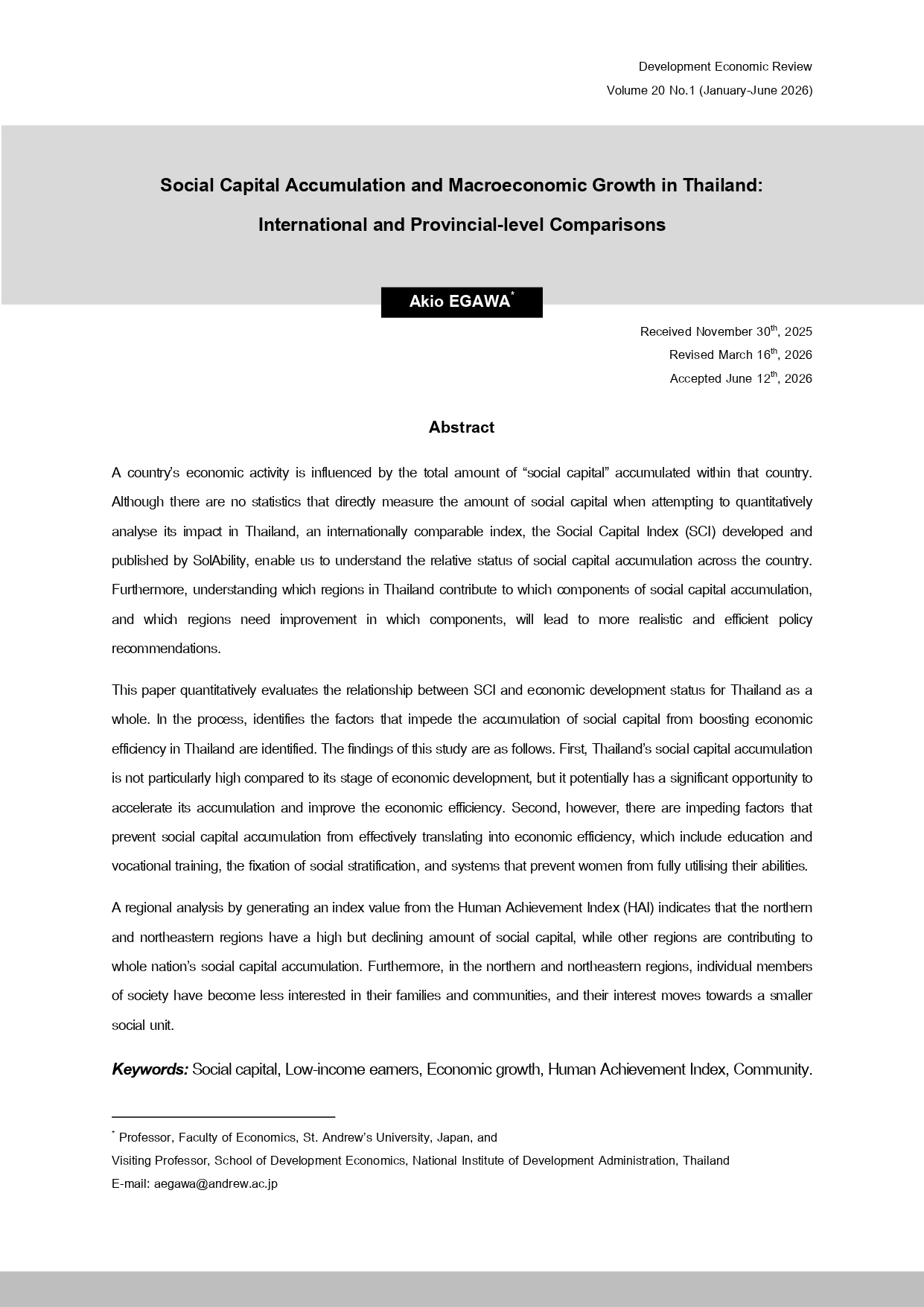
กิจกรรมทางเศรษฐกิจของประเทศได้รับอิทธิพลมาจากปริมาณ “ทุนทางสังคม” ทั้งหมดที่สะสมในประเทศนั้นๆ อย่างไรก็ตาม ถึงแม้ว่าจะไม่มีสถิติที่ใช้วัดปริมาณทุนทางสังคมในการวิเคราะห์ผลกระทบต่อประเทศไทยได้โดยตรง แต่ดัชนีทุนทางสังคม (SCI) ที่ถูกพัฒนาและเผยแพร่โดย SolAbility เป็นดัชนีที่สามารถเปรียบเทียบได้ในระดับสากลซึ่งจะช่วยให้เราเข้าใจสถานะสัมพัทธ์ของการสะสมทุนทางสังคมทั่วประเทศ นอกจากนี้ การทำความเข้าใจว่าภูมิภาคใดในประเทศไทยมีส่วนสนับสนุนองค์ประกอบใดของการสะสมทุนทางสังคม และภูมิภาคใดจำเป็นต้องปรับปรุงองค์ประกอบใด จะนำไปสู่ข้อเสนอแนะเชิงนโยบายที่สมจริงและมีประสิทธิภาพมากขึ้น
บทความนี้ประเมินความสัมพันธ์เชิงปริมาณระหว่าง SCI และสถานะการพัฒนาเศรษฐกิจของประเทศไทยโดยรวม โดยระบุปัจจัยที่เป็นอุปสรรคต่อการสะสมทุนทางสังคมจากการเพิ่มประสิทธิภาพทางเศรษฐกิจของประเทศไทย ซึ่งผลการศึกษาพบว่า ประการแรก การสะสมทุนทางสังคมของประเทศไทยไม่ได้สูงมากนักเมื่อเทียบกับระยะการพัฒนาทางเศรษฐกิจ แต่มีโอกาสสำคัญที่จะเร่งการสะสมทุนทางสังคมและพัฒนาประสิทธิภาพทางเศรษฐกิจ ประการที่สอง มีปัจจัยที่เป็นอุปสรรคในการสะสมทุนทางสังคมที่ไม่สามารถพัฒนาเศรษฐกิจได้อย่างมีประสิทธิภาพ ได้แก่ การศึกษาและการฝึกอาชีพ การกำหนดชนชั้นทางสังคม และระบบที่ขัดขวางไม่ให้ผู้หญิงใช้ศักยภาพของตนเองได้อย่างเต็มที่
การวิเคราะห์ระดับภูมิภาคโดยการสร้างค่าดัชนีจากดัชนีความก้าวหน้าของคน (HAI) ชี้ให้เห็นว่าภาคเหนือและภาคตะวันออกเฉียงเหนือมีทุนทางสังคมในระดับสูงแต่กำลังลดลง ในขณะที่ภูมิภาคอื่นๆ มีส่วนช่วยในการสะสมทุนทางสังคมของประเทศ นอกจากนี้ ในภาคเหนือและภาคตะวันออกเฉียงเหนือ สมาชิกในสังคมมีความสนใจในครอบครัวและชุมชนน้อยลง และมุ่งไปสู่หน่วยสังคมที่เล็กลง
เอกสารอ้างอิง
ADB. (2018). Asian Development Outlook 2018 – How Technology Affects Jobs. Manila.
Chongcharoentanawat, P. (2019). Beyond static inequality: public policies and economic mobility in Thailand. [Doctoral Thesis, Maastricht University]. ProefschriftMaken. https://doi.org/10.26481/dis.20191216pc
Egawa, A. (2023) “Tai no Korona-ka Deno Hinkon Taisaku: Tadashii Ninnshiki, Fujuubunna Seisaku Taiou” (in Japanese: Thailand’s Policy Measures Addressing Poverty Amid COVID-19: Right Perceptions, Inadequate Policy Responses) Japan-Thai Association, Thai-koku Joho, 57(1). January 2023, pp.14-26.
Grootaert, C., D. Narayan, V. N. Jones and M. Woolcock. (2004). “Measuring Social Capital: An Integrated Questionnaire.” World Bank working paper no. 18. World Bank, Washington, D.C. ISBN 0-8213-5661-5
Low, S. and L. Kim. (2014). The Role of Social Capital in Strengthening Disaster Resilience in Thailand. Report prepared for the Southeast Asia Regional Delegation, International Federation of Red Cross and Red Crescent Societies; and the Thailand Red Cross Society. October 2014. https://rcrc-resilience-southeastasia.org/wp-content/uploads/2016/05/
IFRC_Social-Capital_Thailand_FINAL2.pdf
NESDC. (2021). “พลิกโฉมประเทศไทยสู่ เศรษฐกิจสร้างคุณค่า สังคมเดินหน้าอย่างยั่งยืน.” (the document is already deleted from the NESDC website)
NESDC. (2023). Poverty and Inequality Report 2022. https://www.nesdc.go.th/wordpress/wp-content/uploads/2025/04/article_20241003144258.pdf
NESDC. (2024). 2023 Human Achievement Index Report. https://www.nesdc.go.th/wordpress/
wp-content/uploads/2025/04/article_20241218153002.pdf
OECD. (2023). OECD Economic Surveys: Thailand 2023. OECD Publishing. Paris.
https://doi.org/10.1787/4815cb4b-en.
Putnam, R. D. (2001). Bowling Alone: The Collapse and Revival of American Community. Simon & Schuster.
Sachs, J.D., Lafortune, G., Fuller, G., Iablonovski, G. (2025). Financing Sustainable Development to 2030 and Mid-Century. Sustainable Development Report 2025. Paris: SDSN, Dublin: Dublin University Press. DOI: https://doi.org/10.25546/111909.
SolAbility. (2024). The Sustainable Competitiveness Report, 13th edition. https://solability.com/download/the-global-sustainable-competitiveness-index-2024/?tmstv=1755678808
Solt, F. (2020). “Measuring Income Inequality Across Countries and Over Time: The Standardized World Income Inequality Database.” Social Science Quarterly 101(3):1183-99. SWIID Version 9.7. September 2024.
Suzuki, N. (2022). “Touhoku Tai no Kaihatsu to Shimin Shakai Keisei no Dainamizumu – Futatsu no Nouson no Hikaku kara (1).” (in Japanese: Dynamism of Civil Society Movement and Development in Northeast Thailand (1)) Ningenkagaku, 42, p.1-38.
Suzuki, N. (2024). “Touhoku Tai no Kaihatsu to Shimin Shakai Keisei no Dainamizumu – Futatsu no Nouson no Hikaku kara (2).” (in Japanese: Dynamism of Civil Society Movement and Development in Northeast Thailand (2)) Ningenkagaku, 44, p.89-131.
UN Women Regional Office for Asia and the Pacific. (2022). Building Pathways to Gender Equality and Sustainability through the Women’s Empowerment Principles: Thailand Policy Brief. MARCH 2022. https://asiapacific.unwomen.org/sites/default/files/2022-07/
Building-Pathway-English-Final.pdf
World Bank. (2006). Thailand Social Capital Evaluation: A Mixed Methods Assessment of the Social Investment Fund’s Impact on Village Social Capital. https://documents1.worldbank.org/curated/en/187171468308953051/pdf/377220REPLACEM1Box0311141B01PUBLIC1.pdf
World Bank. (2021). Thailand Poverty Brief. https://documents1.worldbank.org/curated/en/
/pdf/Thailand-Poverty-Brief.pdf
ดาวน์โหลด
เผยแพร่แล้ว
ฉบับ
ประเภทบทความ
สัญญาอนุญาต
Copyright to published manuscripts becomes the property of the Graduate School of Development Economics, National Institute of Development Administration. Reproduction of all or part of a Development Economic Review (DER) article by anyone, excluding author(s), is prohibited, unless receiving our permission.


