The Model of Buddhist Propagation in 26th Buddhist Century
Article Sidebar
Main Article Content
Abstract
The purposes of this research were 1) to study the propagation of Buddhism during the Buddha's time, 2) to study the propagation of Buddhism in the 26th century, 3) to analyze the pattern of Buddhism propagation in the 26th century, and 4) to Presents knowledge about the propagation pattern of Buddhism in the 26th century by studying the Tripitaka. Relevant research documents and in-depth interviews Analyze content and present it accordingly.
The results revealed that:
1. Propagation of Buddhism during the Buddha's time. The Buddha and his disciples used to travel to deliver sermons. and perform correctly It resulted in Buddhism spreading throughout the Indian subcontinent.
2. The propagation of Buddhism in the 26th century has brought in modern technology and media. Therefore, it must be combined with preserving the essence of Buddhism and adapting to the times. to fit into people's daily lives for a peaceful society.
3. The form of the propagation of Buddhism in the 26th century, despite differences in time but the principles must be adjusted to be consistent with people's living conditions. Let the basic goal be happiness. And the highest is freedom from suffering.
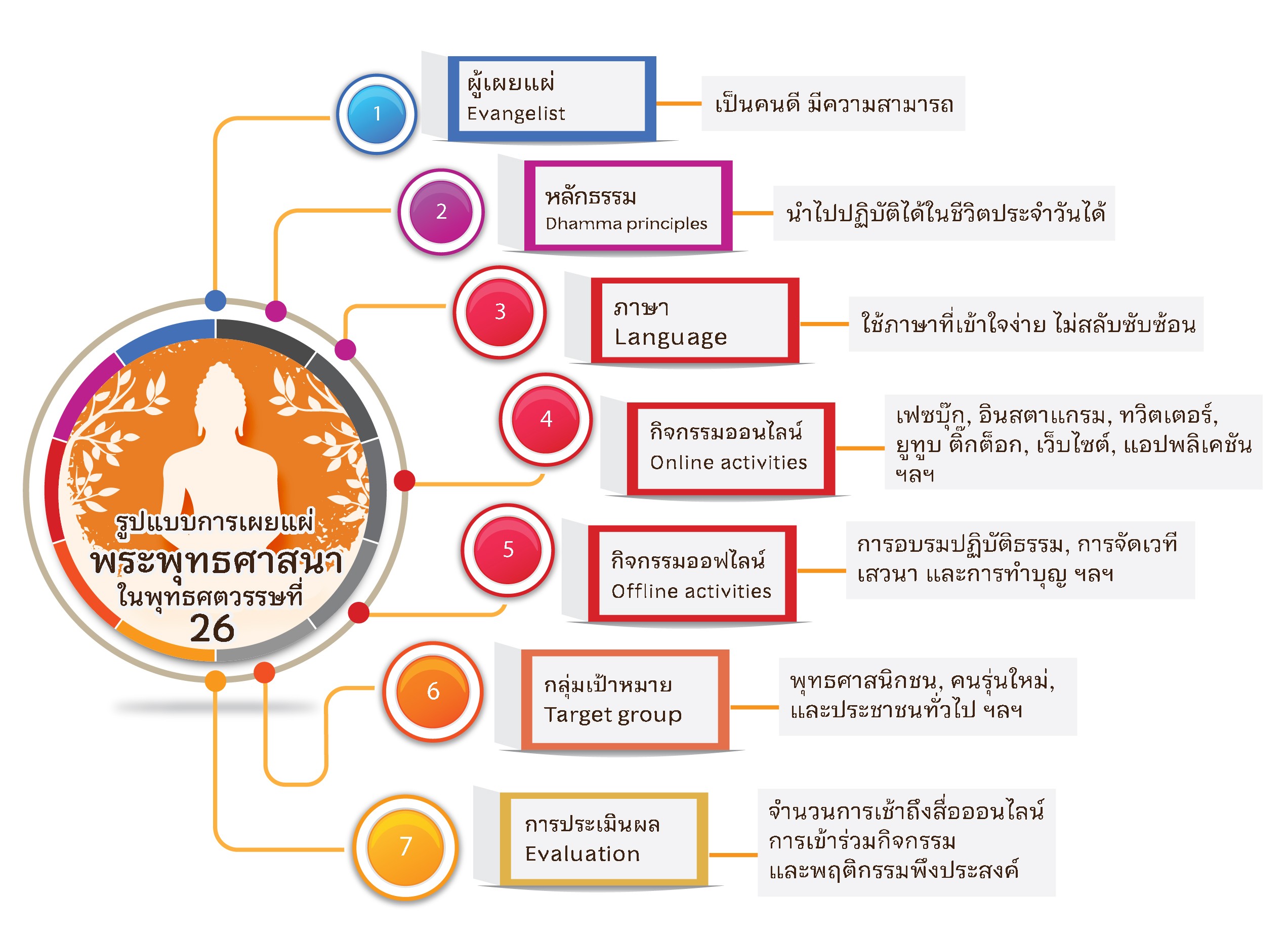
4. The model of the propagation of Buddhism in the 26th century resulted in new knowledge called Model EDLO & OTE, including 1) Evangelist 2) Dhamma principles 3) Language 4) Online activities 5) Offline activities 6) Target group 7) valuation.
Article Details

This work is licensed under a Creative Commons Attribution-NonCommercial-NoDerivatives 4.0 International License.
เพื่อให้เป็นไปตามกฎหมายลิขสิทธิ์ ผู้นิพนธ์ทุกท่านต้องลงลายมือชื่อในแบบฟอร์มใบมอบลิขสิทธิ์บทความ ให้แก่วารสารฯ พร้อมกับบทความต้นฉบับที่ได้แก้ไขครั้งสุดท้าย นอกจากนี้ ผู้นิพนธ์ทุกท่านต้องยืนยันว่าบทความ ต้นฉบับที่ส่งมาตีพิมพ์นั้น ได้ส่งมาตีพิมพ์เฉพาะในวารสาร วิชาการธรรม ทรรศน์ เพียงแห่งเดียวเท่านั้น หากมีการใช้ ภาพหรือตารางของผู้นิพนธ์อื่นที่ปรากฏในสิ่งตีพิมพ์อื่นมาแล้ว ผู้นิพนธ์ต้องขออนุญาตเจ้าของลิขสิทธิ์ก่อน พร้อมทั้ง แสดงหนังสือที่ได้รับการยินยอมต่อบรรณาธิการ ก่อนที่บทความจะได้รับการตีพิมพ์References
คมคาย คุมพันธ์. (2547). บทบาทในการเผยแผ่พระพุทธศาสตร์นาของพระธรรมทูตสายต่างประเทศ ศึกษาเฉพาะกรณี พระสุเมธาจารย์ (โรเบิร์ต สุเมโธภิกขุ). (วิทยานิพนธ์พุทธศาสตรมหาบัณฑิต). พระนครศรีอยุธยา: มหาวิทยาลัยมหาจุฬาลงกรณราชวิทยาลัย.
ธยายุส ขอเจริญ และพระมหาขุนทอง แก้วสมุทร์ (เขมสิริ). (2564). พลวัตทางสังคมและวัฒนธรรมภายใต้ความสัมพันธ์ชายแดนไทยกัมพูชา. วารสาร มจร อุบลปริทรรศน์, 6(3), 379-390. https://so06.tci-thaijo.org/index.php/mcjou/article/view/249647/170375
พระครูปลัดเฉลิมพร อภิวโร (แป้นกลม). (2565). รูปแบบการเผยแผ่พระพุทธศาสนาในยุควิถีใหม่ของพระสังฆาธิการกรุงเทพมหานคร. (ดุษฎีนิพนธ์พุทธศาสตรดุษฎีบัณฑิต). พระนครศรีอยุธยา: มหาวิทยาลัยมหาจุฬาลงกรณราชวิทยาลัย.
พระเมธาวินัยรส (สุเทพ ปสิวิโก), พระมหาวิโรจน์ คุตฺตวีโร, พระมหาวีรศักดิ์ สุรเมธี และสาลินี รักกตัญญู. (2562). รูปแบบการเผยแผ่พุทธธรรมสำหรับคนในพุทธศตวรรษที่ 26 เพื่อส่งเสริมความมั่นคงของพระพุทธศาสนา. วารสาร มจร สังคมศาสตร์ปริทรรศน์, 8(4), 17-33. https://so03.tci-thaijo.org/index.php/jssr/article/view/233797/160699
พระราชวรมุนี (ประยุต ปยุตฺโต). (2527). สถาบันสงฆ์กับสังคมไทย. กรุงเทพฯ: มูลนิธิโกมลคีมทอง.
พระศุภชาติ (ธมฺมิสฺสโร) สําลีวงษ์, ปัญณพงศ์ วงศ์ณาศรี, ปรรณพัชญ์ จิตร์จํานง และจิราภรณ์ ชูชํานาญ. (2567). พระสาวกกับบทบาทในการเผยแผ่พระพุทธศาสนา. วารสารรัฐศาสตร์ มหาวิทยาลัยมหามกุฏราชวิทยาลัย, 4(2), 152-164. https://so02.tci-thaijo.org/index.php/jpsmbu/article/view/268860/180115
มหาจุฬาลงกรณราชวิทยาลัย. (2539). พระไตรปิฎกภาษาไทย ฉบับมหาจุฬาลงกรณราชวิทยาลัย. กรุงเทพฯ: มหาจุฬาลงกรณราชวิทยาลัย.
วศิน อินทสระ. (2536). การเผยแผ่ศาสนา. กรุงเทพฯ: กิตติวรรณ.
