The Rice Offering Ceremony: Roles and Functions in the Amphoe Si Racha Community
Article Sidebar
Main Article Content
Abstract
The purposes of this research were study the roles and functions of the Bun Kong Khao ritual in the Si Racha District, Chon Buri Province community. It employs a qualitative research methodology that emphasizes field data collection from the Bun Kong Khao ritual in Si Racha District, Chon Buri Province, conducted three times between 2022 and 2024. The study analyzes the data using William Bascom's functionalist theory.
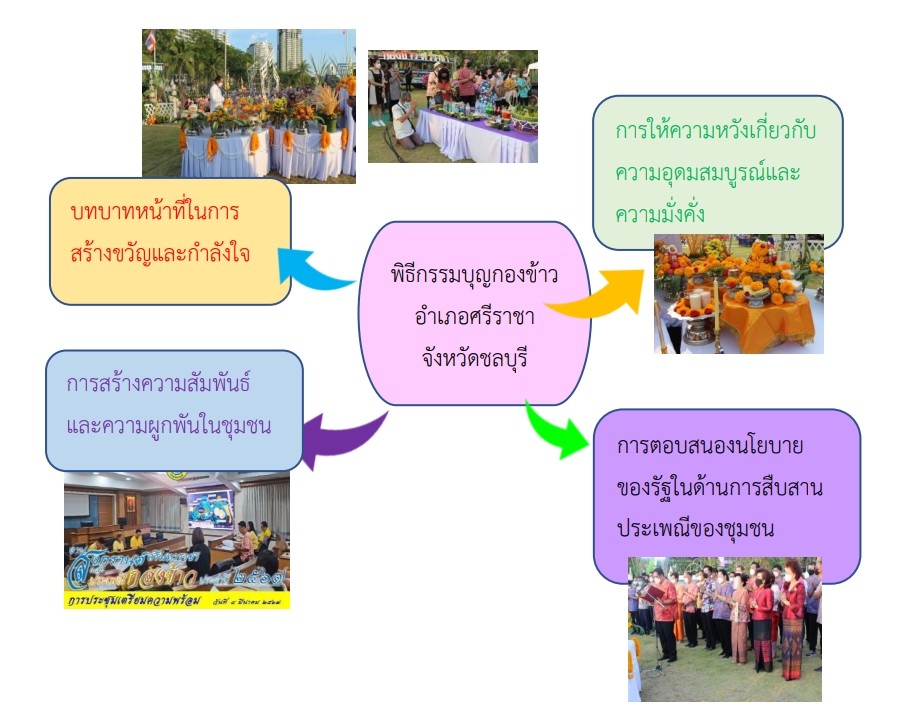
The results revealed that: The Bun Kong Khao ritual serves four important roles and functions within the community of Si Racha District, Chon Buri Province. 1. Role in instilling morale and encouragement for the community of Si Racha District. The Bun Kong Khao ceremony passed down through generations, consistently provides spiritual support. It is believed to bestow blessings and protection from deities and spirits, ensuring a smooth and harmonious life for community members. 2. Role in fostering relationships and strengthening community bonds. In the Si Racha District, various sectors-including government agencies, private organizations, and residents-collectively unite to strengthen their relationships. This collaboration is essential for upholding and preserving the community's traditions in contemporary times. 3. Role in providing hope for prosperity and abundance within the community. The Bun Kong Khao ceremony reflects a harmonious blend of cultural beliefs, integrating elements of Buddhism, Brahmanism, and ancestral worship. The symbols used in this ritual convey meanings related to good fortune, abundance, and economic prosperity, thereby offering hope for a flourishing future within the community. 4. Role in responding to governmental policies regarding the preservation of community traditions. This ceremony aligns with state policies aimed at sustaining local traditions and facilitating the transmission of cultural values from ancestors to future generations. In doing so, it ensures that the local culture is valued as a vital cultural heritage for the community.
Article Details

This work is licensed under a Creative Commons Attribution-NonCommercial-NoDerivatives 4.0 International License.
เพื่อให้เป็นไปตามกฎหมายลิขสิทธิ์ ผู้นิพนธ์ทุกท่านต้องลงลายมือชื่อในแบบฟอร์มใบมอบลิขสิทธิ์บทความ ให้แก่วารสารฯ พร้อมกับบทความต้นฉบับที่ได้แก้ไขครั้งสุดท้าย นอกจากนี้ ผู้นิพนธ์ทุกท่านต้องยืนยันว่าบทความ ต้นฉบับที่ส่งมาตีพิมพ์นั้น ได้ส่งมาตีพิมพ์เฉพาะในวารสาร วิชาการธรรม ทรรศน์ เพียงแห่งเดียวเท่านั้น หากมีการใช้ ภาพหรือตารางของผู้นิพนธ์อื่นที่ปรากฏในสิ่งตีพิมพ์อื่นมาแล้ว ผู้นิพนธ์ต้องขออนุญาตเจ้าของลิขสิทธิ์ก่อน พร้อมทั้ง แสดงหนังสือที่ได้รับการยินยอมต่อบรรณาธิการ ก่อนที่บทความจะได้รับการตีพิมพ์References
คณะกรรมการฝ่ายประมวลเอกสารและจดหมายเหตุ. (2544). วัฒนธรรม พัฒนาการทางประวัติศาสตร์เอกลักษณ์และภูมิปัญญา จังหวัดชลบุรี. กรุงเทพฯ: กรมศิลปากร.
โชติพัฒน์ ทิมกระจ่าง. (2546). ความรู้ทัศนคติและการร่วมในการอนุรักษ์และสืบทอดประเพณีกองข้าวของประชาชนในเขตอำเภอศรีราชา จังหวัดชลบุรี. (รายงานการวิจัย). ชลบุรี: คณะมนุษยศาสตร์และสังคมศาสตร์ มหาวิทยาลัยบูรพา.
ทัศนีย์ ทานตวณิช. (2535). ความเชื่อและพิธีกรรมของชาวประมงชายฝั่งทะเลตะวันออก. (รายงานการวิจัย). ชลบุรี: ภาควิชาภาษาไทย คณะมนุษยศาสตร์และสังคมศาสตร์ มหาวิทยาลัยบูรพา.
ภารดี มหาขันธ์ และนันท์ชญา มหาขันธ์. (2560). รากฐานและภูมิพลังจังหวัดชลบุรี. นนทบุรี: ปริ้นโอโซน.
Bascom, W. (1965). Four functions of folklore. In A. Dundes (Ed.), The study of folklore (pp. 279-298). New Jersey: Prentice-Hall.
