The Development and Design Measurement Tool for Higher Order Thinking Competency Based of Master Degree Students in Curriculum and Instruction Rangsit University in Measurement and Evaluation Course (ECI 607) Using The P-A-A-D
Article Sidebar
Main Article Content
Abstract
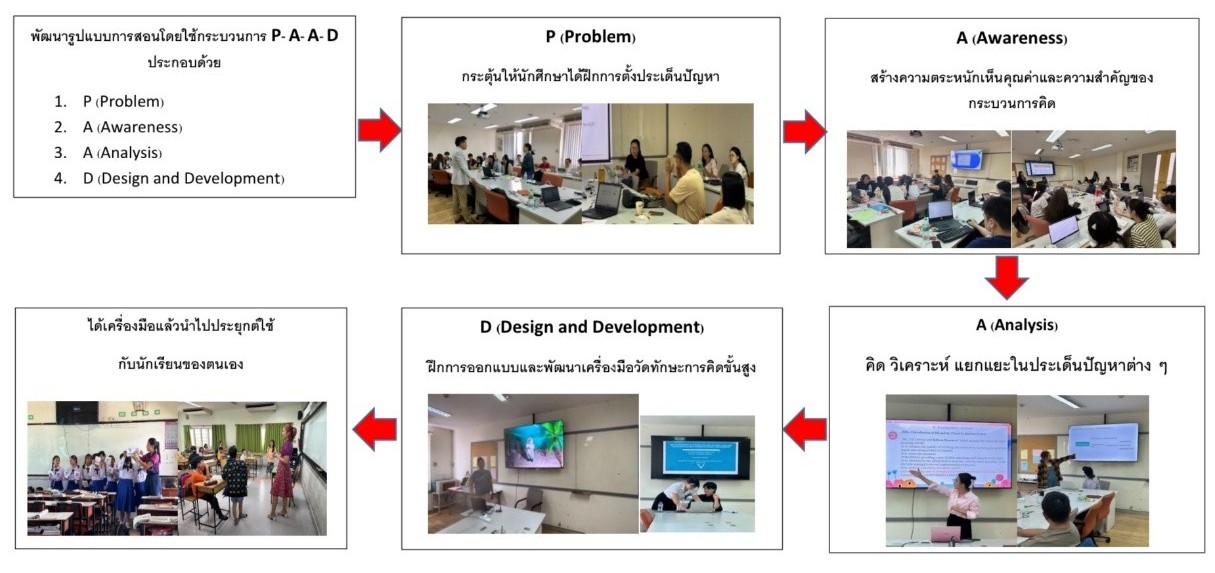
This study aimed to develop and design a competency-based measurement tool for higher-order thinking skills using the P-A-A-D model in the Measurement and Evaluation course for master’s degree students in Curriculum and Instruction at Rangsit University. The entire population, comprising 11 male and 13 female students, was used as the sample group. The research instruments included: 1) a teaching model based on the P-A-A-D process, 2) a test for measuring learning outcomes, 3) a questionnaire on students’ opinions about the designed measurement tool for higher-order thinking, and 3) a focus group discussion with experts. Data analysis of the teaching model's effectiveness was performed using paired t-tests to compare pretest and posttest scores. The questionnaire responses were analyzed using descriptive statistics, including mean and standard deviation. A focus group discussion was conducted as the final step, in which experts critically reviewed the emerging instructional model.
The results revealed the following: 1. The P-A-A-D instructional model demonstrated statistically significant efficiency at the 0.01 level (Pre-test = 12.08, S.D. = 1.31; Post-test = 17.38, S.D. = 1.34). 2. Students expressed that higher-order thinking is a complex and deep cognitive process essential for learning, understanding, and managing complex problems effectively. They rated its importance in practical life in the following order: analytical thinking, synthetic thinking, creativity, critical thinking, problem-solving thinking, strategic thinking, systems thinking, and decision-making. 3. The measurement tool was developed based on behavioral observation, utilizing a five-point Likert scale. 4. Expert evaluation of the tool confirmed that it aligned with theoretical foundations, instructional principles, and content objectives. It was found to be effective and of high quality, suitable for future applications.
Article Details

This work is licensed under a Creative Commons Attribution-NonCommercial-NoDerivatives 4.0 International License.
เพื่อให้เป็นไปตามกฎหมายลิขสิทธิ์ ผู้นิพนธ์ทุกท่านต้องลงลายมือชื่อในแบบฟอร์มใบมอบลิขสิทธิ์บทความ ให้แก่วารสารฯ พร้อมกับบทความต้นฉบับที่ได้แก้ไขครั้งสุดท้าย นอกจากนี้ ผู้นิพนธ์ทุกท่านต้องยืนยันว่าบทความ ต้นฉบับที่ส่งมาตีพิมพ์นั้น ได้ส่งมาตีพิมพ์เฉพาะในวารสาร วิชาการธรรม ทรรศน์ เพียงแห่งเดียวเท่านั้น หากมีการใช้ ภาพหรือตารางของผู้นิพนธ์อื่นที่ปรากฏในสิ่งตีพิมพ์อื่นมาแล้ว ผู้นิพนธ์ต้องขออนุญาตเจ้าของลิขสิทธิ์ก่อน พร้อมทั้ง แสดงหนังสือที่ได้รับการยินยอมต่อบรรณาธิการ ก่อนที่บทความจะได้รับการตีพิมพ์References
พัชรี นาคผง. (2562). การพัฒนาทักษะการคิดวิเคราะห์ของนักเรียนชั้นมัธยมศึกษาปีที่ 1 ที่จัดการเรียนรู้โดยใช้ปัญหาเป็นฐานร่วมกับเทคนิค STAD. (วิทยานิพนธ์ครุศาสตรมหาบัณฑิต). กรุงเทพฯ: มหาวิทยาลัยศิลปากร.
มหาวิทยาลัยรังสิต. (2562). คู่มือการฝึกประสบการณ์วิชาชีพครู ปีการศึกษา 2562-2564. กรุงเทพฯ: คณะศึกษาศาสตร์ มหาวิทยาลัยรังสิต.
สมชาย รัตนทองคำ. (2554). การวัดและประเมินผลทางการศึกษา. เอกสารประกอบการสอน 475788 การสอนทางกายภาพบำบัด ภาคต้นปีการศึกษา 2554 (หน้า137-153). ขอนแก่น: มหาวิทยาลัยขอนแก่น.
สำนักงานเลขาธิการสภาการศึกษา. (2560). แผนการศึกษาแห่งชาติ พ.ศ. 2560-2579. กรุงเทพฯ: กระทรวงศึกษาธิการ.
______. (2564). สมรรถนะการคิดขั้นสูง (Higher Order Thinking: HOT). กรุงเทพฯ: กระทรวงศึกษาธิการ.
สำนักนายกรัฐมนตรี. (2561). ยุทธศาสตร์ชาติ พ.ศ. 2561-2580 (ฉบับประกาศราชกิจจานุเบกษา). กรุงเทพฯ: สำนักงานเลขาธิการนายกรัฐมนตรี.
Adams, W. K., & Wieman, C. E. (2011). Development and validation of instruments to measure learning of expert-like thinking. International Journal of Science Education, 33(9), 1289-1312. https://doi.org/10.1080/09500693.2010.512369
Allen, I. E., & Seaman, C. A. (2007). Likert scales and data analyses. Quality Progress, 40(7), 64-65.
Anderson, L. W., & Krathwohl, D. R. (Eds.). (2001). A Taxonomy for Learning, Teaching, and Assessing: A Revision of Bloom's Taxonomy of Educational Objectives. New York: Longman.
Bezanilla, M. J. (2023). Understanding critical thinking: A comparative analysis between university students’ and teachers’ conception. Tuning Journal for Higher Education, 10(2), 223-244. https://doi.org/10.18543/tjhe.2748
Boone, H. N., Jr., & Boone, D. A. (2012). Analyzing Likert data. Journal of Extension, 50(2), 1-5. https://doi.org/10.34068/joe.50.02.48
Carifio, J., & Perla, R. J. (2007). Ten common misunderstandings, misconceptions, persistent myths and urban legends about Likert scales and Likert response formats and their antidotes. Journal of Social Sciences, 3(3), 106-116.
Creswell, J. W. (2014). Research design: Qualitative, quantitative, and mixed methods approaches. (4th ed.). Thousand Oaks, CA: Sage Publications.
Creswell, J. W., & Plano Clark, V. L. (2018). Designing and Conducting Mixed Methods Research. (3rd ed.). Thousand Oaks, CA: SAGE Publications.
Gliem, J. A., & Gliem, R. R. (2003). Calculating, interpreting, and reporting Cronbach’s alpha reliability coefficient for Likert-type scales. In Proceedings of the Midwest Research-to-Practice Conference in Adult, Continuing, and Community Education (pp. 82-88).Columbus, Ohio: Ohio State University.
Goleman, D. (1995). Emotional intelligence: Why it can matter more than IQ. New York: Bantam Books.
Jonassen, D. H., & Hung, W. (2012). Problem solving. In N. M. Seel (Ed.), Encyclopedia of the sciences of learning (pp. 2698-2703). Heidelberg: Springer.
Joshi, A., Kale, S., Chandel, S., & Pal, D. K. (2015). Likert scale: Explored and explained. British Journal of Applied Science & Technology, 7(4), 396-403. https://doi.org/10.9734/BJAST/2015/14975
King, F. J., Goodson, L., & Rohani, F. (1998). Higher Order Thinking Skills: Definition, Teaching Strategies, Assessment. Tallahassee: Center for Advancement of Learning and Assessment.
Suryadi, A. (2007). Pemanfaatan ICT dalam pembelajaran. Jurnal Pendidikan Terbuka Dan Jarak Jauh, 8(2), 83-98. https://jurnal.ut.ac.id/index.php/jptjj/article/view/537
Yukl, G. (2013). Leadership in Organizations. (8th ed.). Pearson Education India.
Zohar, A., & Dori, Y. J. (2003). Higher order thinking skills and low-achieving students: Are they mutually exclusive? The Journal of the Learning Sciences, 12(2), 145-181. https://doi.org/10.1207/S15327809JLS1202_1
