The Service Identity of Flight Attendants on Thai National Airlines: A Case Study of Thai Airways International
Article Sidebar
Main Article Content
Abstract
This study aimed to explore the Thai service identity of flight attendants working for Thai Airways, using Michel Foucault’s concept of Technologies of the Self as the theoretical framework. Foucault’s perspective posits that individuals can shape and discipline themselves through discourse and social norms. This qualitative research employed semi-structured in-depth interviews and a narrative approach to collect data from 20 purposively selected key informants, including both current and retired flight attendants. The data were analyzed using thematic analysis, and the credibility of the findings was verified through triangulation.
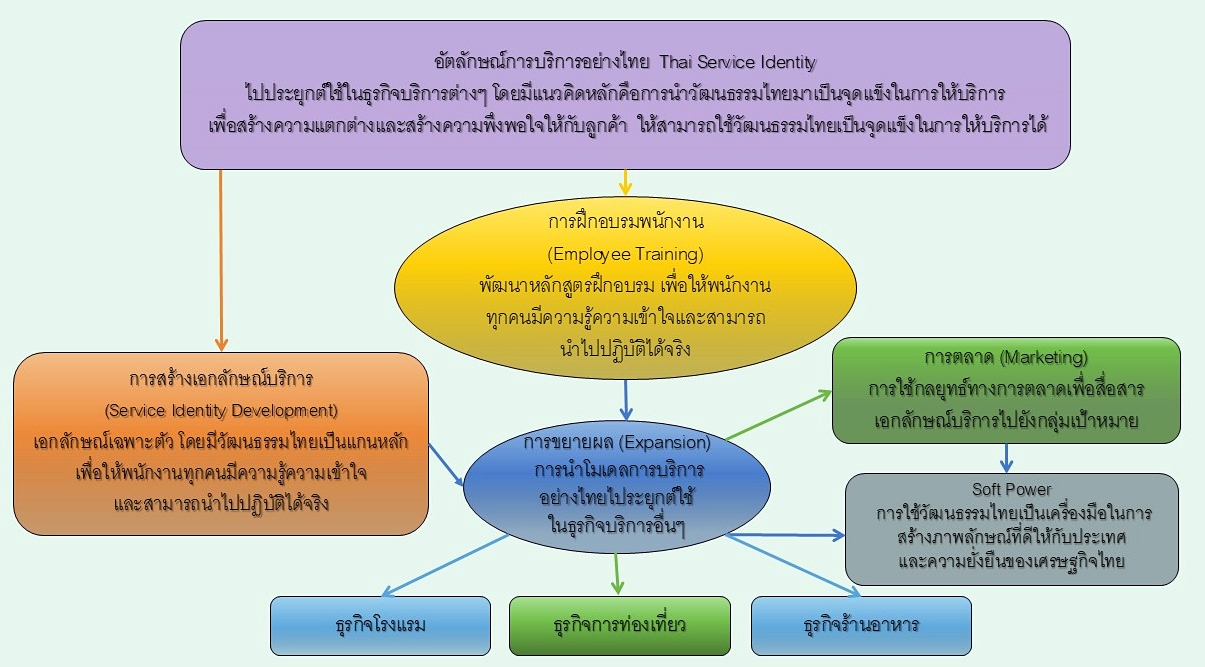
Research findings align with the objectives of the study on the Thai-style service identity of flight attendants, which is shaped through training, organizational culture, and work experience. The study identifies four key aspects of Thai-style service identity: (1) communication through Thai cultural expressions in service, (2) building positive relationships with passengers, (3) integrating Thainess to solve service-related problems, and (4) incorporating safety standards with a distinctly Thai identity. The research highlights that Thai-style service is not merely a set of technical skills, but a process of identity formation with unique characteristics. It is also a cultural strategy that creates a competitive advantage in the global in-flight service industry.
Article Details

This work is licensed under a Creative Commons Attribution-NonCommercial-NoDerivatives 4.0 International License.
เพื่อให้เป็นไปตามกฎหมายลิขสิทธิ์ ผู้นิพนธ์ทุกท่านต้องลงลายมือชื่อในแบบฟอร์มใบมอบลิขสิทธิ์บทความ ให้แก่วารสารฯ พร้อมกับบทความต้นฉบับที่ได้แก้ไขครั้งสุดท้าย นอกจากนี้ ผู้นิพนธ์ทุกท่านต้องยืนยันว่าบทความ ต้นฉบับที่ส่งมาตีพิมพ์นั้น ได้ส่งมาตีพิมพ์เฉพาะในวารสาร วิชาการธรรม ทรรศน์ เพียงแห่งเดียวเท่านั้น หากมีการใช้ ภาพหรือตารางของผู้นิพนธ์อื่นที่ปรากฏในสิ่งตีพิมพ์อื่นมาแล้ว ผู้นิพนธ์ต้องขออนุญาตเจ้าของลิขสิทธิ์ก่อน พร้อมทั้ง แสดงหนังสือที่ได้รับการยินยอมต่อบรรณาธิการ ก่อนที่บทความจะได้รับการตีพิมพ์References
กระทรวงการท่องเที่ยวและกีฬา. (2560). สรุปผลงานสำคัญของกระทรวงการท่องเที่ยวและกีฬา ปี 2560. เข้าถึงได้จาก https://www.mots.go.th/ewt_dl_link.php?nid=10464
กระทรวงวัฒนธรรม. (2566). ดัน Soft Power ไทยสู่ตลาดโลก ปัดหมุด การท่องเที่ยววัฒนธรรม. เข้าถึงได้จาก https://www.bangkokbiznews.com/health/social/1105228
เฉลิมพล แจ่มจันทร์ และสวรัย บุณยมานนท์, (2556). บทบาทของเศรษฐกิจสร้างสรรค์ในการพัฒนาสังคมและชุมชนไทย. วารสารเศรษฐศาสตร์ปริทรรศน์ สถาบันพัฒนศาสตร์, 7(1), 111-151.
ชาย โพธิสิตา. (2554). ศาสตร์และศิลป์แห่งการวิจัยเชิงคุณภาพ. (พิมพ์ครั้งที่ 5). กรุงเทพฯ: อมรินทร์พริ้นติ้ง แอนด์พับลิชชิ่ง.
นภาพร ทองคํา. (2563). วัฒนธรรมการบริการของพนักงานต้อนรับบนเครื่องบินบริษัท การบินไทย จํากัด (มหาชน). วารสารวิชาการไทยวิจัยและการจัดการ, 1(3), 40-49.
บริษัท การบินไทย จำกัด. (2566). แบบแสดงรายการข้อมูลประจำปี/รายงานประจำปี 2566. เข้าถึงได้จาก https://www.thaiairways.com/
เบญจวรรณ อุปัชฌาย์. (2561). แนวคิดเรื่องตัวตนที่รู้คิดและกระบวนการสร้างตัวตนของมิเชล ฟูโกต์. วารสารวิชาการมนุษยศาสตร์และสังคมศาสตร์ โรงเรียนนายร้อยพระจุลจอมเกล้า, 5, 1-54.
วราภรณ์ วงษ์ทอง. (2559). การสร้างความประทับใจในการให้บริการของพนักงานต้อนรับบนเครื่องบินสายการบินไทย. วารสารวิชาการมหาวิทยาลัยราชภัฏพระนคร, 7(2), 125-137.
สุภาวดี ศรีสุวรรณ. (2561). การสร้างอัตลักษณ์การบริการแบบไทยของพนักงานต้อนรับบนเครื่องบิน. กรุงเทพฯ: มหาวิทยาลัยธรรมศาสตร์.
Alavi, M., & Leidner, D. E. (2001). Review: Knowledge Management and Knowledge Management Systems: Conceptual Foundations and Research Issues. MIS Quarterly, 25(1), 107-136.
Balakrishnan, M. S. (2013). Emirates Airlines: A Case Study in the Branding of an Airline. Journal of Services Marketing, 27(2), 163-174.
Bold, C. (2012). Using Narritive in Research. Chennai: Replika press.
Bowlby, J. (1982). Attachment and Loss: Retrospect and Prospect. American Journal of Orthopsychiatry, 52(4), 664-678.
Canclini, N. (1990). Hybrid Cultures: Strategies for Entering and Leaving Modernity. Minneapolis: University of Minnesota Press.
Chenyawanichchoo, Y. (2018). The understanding of aviation terminology for Thai flight attendants. (Independent study paper). Bangkok: Thammasat University, Language Institute].
Clandinin, D. J., & Connelly, F. M. (2000). Narrative inquiry: Experience and story in qualitative research. Jossey-Bass.
Clark, B. L. (2021). Safety Talk and Service Culture: Flight Attendant Discourse in Commercial Aviation. (Doctor of Philosophy). University of London.
Cogan, M. S. (2024). Thailand’s new soft power focus and the makings of a paradox. Asian Affairs: An American Review, 51(2), 90-116. https://doi.org/10.1080/00927678.2024.2333684
Creswell, J. W. (2014). Research design: Qualitative, quantitative, and mixed methods approaches. (4th ed.). SAGE.
Dąbrowska, A., & Fandrejewska, A. (2020). The importance of cultural differences in the era of internationalisation of service enterprises. Acta Scientiarum Polonorum Oeconomia, 19(1), 13-21. https://doi.org/10.22630/ASPE.2020.19.1.2
Dech-siri, N., Pathhumcharoenwattana, W., & Ratana-Ubol, A. (2022). The understanding about cultural intelligence of cabin crew from Thailand’s international airlines. Higher Education Studies, 12(2), 84-92. https://doi.org/10.5539/hes.v12n2p84
Elliott, J. (2005). Using narrative in social research: qualitative and quantitative approaches. SAGE.
Engstrand, Å.-K., & Enberg, C. (2020). The power in positionings: A Foucauldian approach to knowledge integration processes. Management Learning, 51(3), 336-352. https://doi.org/10.1177/1350507620904307
Federal Aviation Administration. (2004). Crew Resource Management (CRM) training. AC 120-51E.
Foucault, M. (1988). Technologies of the self. In L. H. Martin, H. Gutman, & P. H. Hutton (Eds.), Technologies of the self: A seminar with Michel Foucault (pp. 16-49). University of Massachusetts Press.
Fraser, N. (1981). Foucault on Modern Power: Empirical Insights and Normative Confusions. Praxis International, 1(3), 272-287.
Helmreich, R. L., Merritt, A. C., & Wilhelm, J. A. (1999). The evolution of Crew Resource Management training in commercial aviation. The International Journal of Aviation Psychology, 9(1), 19-32.
Hofstede, G. (1980). Culture’s consequences: International differences in work-related values. Beverly Hills, CA: Sage.
Knights, D., & Morgan, G. (1991). Corporate strategy, organizations, and subjectivity: A critique. Organization Studies, 12(2), 251-273.
Kungwola, K. (2023). Airline service quality (AIRQUAL) improvement approach for Thai Airways during the rehabilitation. E3S Web of Conferences, 389, 05012. https://doi.org/10.1051/e3sconf/202338905012
Liu, X. (2024). The Influence of Cultural Background on Employment Behavior. Lecture Notes in Education Psychology and Public Media, 51(1), 1-6. https://doi.org/10.54254/2753-7048/51/20240450
Meydan, C. H., & Akkaş, H. (2024). The Role of Triangulation in Qualitative Research. Advances in Library and Information Science (ALIS) Book Series, 98-129. https://doi.org/10.4018/979-8-3693-3306-8.ch006
Qatar Airways Group. (2020). Annual report 2020. Retrieved from https://www.qatarairways.com/press-releases/documents/53724
Ryanair Holdings plc. (2020). Annual report 2020. Retrieved from https://investor.ryanair.com/wp-content/uploads/2020/07/Ryanair-Holdings-plc-Annual-Report-FY20.pdf
Sengur, K. F., Kilic, D., & Erdogan, B. (2022). Global Air Transport Management and Reshaping Business Models for the New Era. Hersey: IGI Global.
Smith, C. M. (2008). Foucauldian technologies of the self, participatory cultural production and new media. NMEDIAC: The Journal of New Media & Culture, Summer 2008, 1-15.
Suksudthi, T., Kankaew, K., & Kuosuwan, B. (2023). Thainess in airlines services strategy: A case from Thailand. E3S Web of Conferences, 389, 05009. https://doi.org/10.1051/e3sconf/202338905009
Tan, X. C. (2014). Asian paradigm in hospitality management and its expansion to non-Asian countries. In K. S. Chon (Ed.), Advances in Culture, Tourism and Hospitality Research (pp. 143-157). Emerald Group Publishing Ltd.
Tourism Authority of Thailand. (2023). ททท. ผลักดัน Soft Power ผ่านเวทีฟอรั่มการท่องเที่ยวแห่งปี. เข้าถึงได้จาก https://bcg.in.th/news/tat-pushes-soft-power-through-the-tourism-forum-of-the-year/
Villadsen, K. (2007). Managing the employee’s soul: Foucault applied to modern management technologies. Cadernos EBAPE.BR, 5(1), 1-10. http://dx.doi.org/10.1590/s1679-39512007000100002
Wongleedee, K. (2015). Thai Hospitality and Thai Culture. International Journal of Social, Behavioral, Educational, Economic, Business and Industrial Engineering, 9(2), 580-583.
Worasuwannarak, B., & Kankaew, K. (2022). The image value of Southeast Asia airlines: A study of attribute that led to image value of choosing Southeast Asia airlines by Mean-End theory approach. In Global Air Transport Management and Reshaping Business Models for the New Era (pp. 191-206). IGI Global.
Xu, Z. (2023). Impact of Soft Power on Traditional Global Dynamics. Journal of Education, Humanities and Social Sciences, 24, 595-598. https://doi.org/10.54097/1fxa9y87
