Development of a Production Model and Upgrading of Community Products Based on Cultural Capital in Tha Kasem Subdistrict, Mueang Sa Kaeo District, Sa Kaeo Province
Article Sidebar
Main Article Content
Abstract
This study aimed to: (1) examine the production potential of community producers in Tha Kasem Subdistrict; (2) analyze the needs of product users; and (3) propose guidelines for developing production models and upgrading community products based on cultural capital in Tha Kasem Subdistrict, Mueang Sa Kaeo District, Sa Kaeo Province. The research employed a mixed-methods approach, integrating quantitative and qualitative methods to obtain comprehensive and in-depth data. In the quantitative phase, the population consisted of consumers or users of community products in Tha Kasem Subdistrict and nearby areas. A sample of 300 respondents was selected using accidental sampling. A questionnaire was used as the primary research instrument and comprised three sections: (1) general information of respondents, (2) opinions on products derived from cultural capital, and (3) needs and expectations regarding the development of community products. Quantitative data were analyzed using descriptive statistics, including percentages, means, and standard deviations. In the qualitative phase, 18 key informants were purposively selected, including producers, entrepreneurs, local leaders, local sages, and representatives from relevant agencies. Data were collected through in-depth interviews and focus group discussions and analyzed using descriptive analysis through categorization and synthesis of key themes.
The findings revealed that:
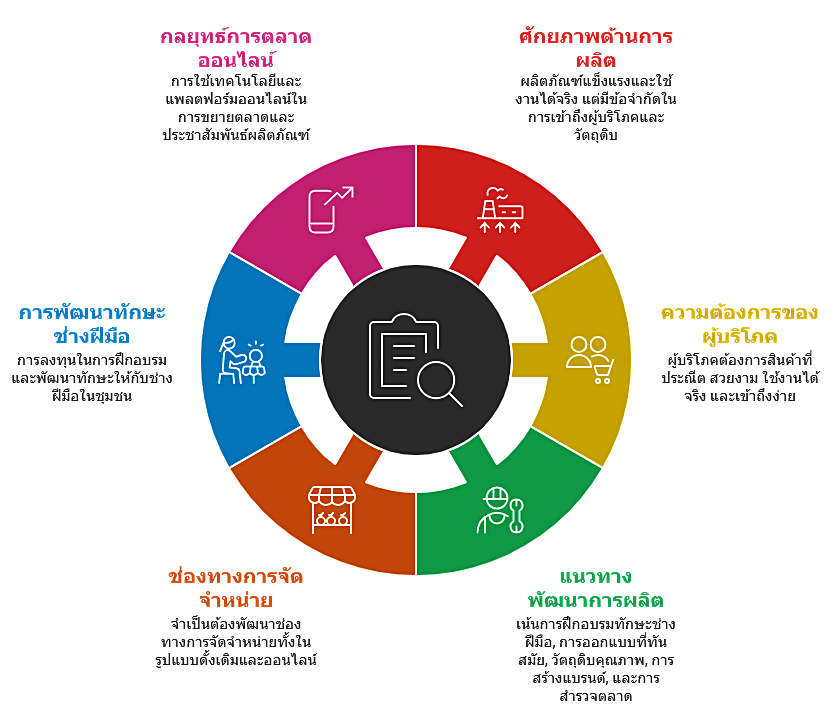
1. In terms of production potential, most products were durable and functional; however, they lacked standardized pricing. Distribution was primarily limited to the local community or periodic markets, while customer communication relied mainly on face-to-face interactions or telephone calls. Most raw materials were sourced externally. Consumers expressed a preference for products that are refined, aesthetically pleasing, and easily accessible.
2. Regarding consumer needs, respondents preferred products that are of high quality, clean, and safe, with distinctive local identity, modern packaging, reasonable pricing, diverse distribution channels, and certified quality standards.
3. The proposed development guidelines include: (1) promoting knowledge and production skills alongside the conservation of local wisdom; (2) designing products and packaging that integrate cultural capital to enhance value; (3) developing marketing networks and building local product branding; and (4) promoting participatory management and collaboration with network partners to upgrade community products toward sustainability.
Article Details

This work is licensed under a Creative Commons Attribution-NonCommercial-NoDerivatives 4.0 International License.
เพื่อให้เป็นไปตามกฎหมายลิขสิทธิ์ ผู้นิพนธ์ทุกท่านต้องลงลายมือชื่อในแบบฟอร์มใบมอบลิขสิทธิ์บทความ ให้แก่วารสารฯ พร้อมกับบทความต้นฉบับที่ได้แก้ไขครั้งสุดท้าย นอกจากนี้ ผู้นิพนธ์ทุกท่านต้องยืนยันว่าบทความ ต้นฉบับที่ส่งมาตีพิมพ์นั้น ได้ส่งมาตีพิมพ์เฉพาะในวารสาร วิชาการธรรม ทรรศน์ เพียงแห่งเดียวเท่านั้น หากมีการใช้ ภาพหรือตารางของผู้นิพนธ์อื่นที่ปรากฏในสิ่งตีพิมพ์อื่นมาแล้ว ผู้นิพนธ์ต้องขออนุญาตเจ้าของลิขสิทธิ์ก่อน พร้อมทั้ง แสดงหนังสือที่ได้รับการยินยอมต่อบรรณาธิการ ก่อนที่บทความจะได้รับการตีพิมพ์References
กรมการพัฒนาชุมชน. (2563). แนวทางการพัฒนาผลิตภัณฑ์ชุมชนและการส่งเสริมเศรษฐกิจฐานราก. กรุงเทพฯ: กระทรวงมหาดไทย.
กรมทรัพย์สินทางปัญญา. (2564). การพัฒนาผลิตภัณฑ์ชุมชนให้มีมาตรฐานและการอนุรักษ์ภูมิปัญญาท้องถิ่น. กรุงเทพฯ: กรมทรัพย์สินทางปัญญา.
กระทรวงมหาดไทย. (2564). แนวทางการพัฒนาเศรษฐกิจฐานรากเพื่อเสริมสร้างความเข้มแข็งของชุมชน. กรุงเทพฯ: สำนักนโยบายและแผน.
ธนาคารแห่งประเทศไทย. (2562). การกระจายรายได้และการลดความเหลื่อมล้ำผ่านเศรษฐกิจชุมชน. เข้าถึงได้จาก www.bot.or.th
สำนักงานส่งเสริมวิสาหกิจขนาดกลางและขนาดย่อม. (2561). การพัฒนา SMEs และเศรษฐกิจฐานรากเพื่อความยั่งยืน. กรุงเทพฯ: กระทรวงอุตสาหกรรม.
สำนักงานสภาพัฒนาการเศรษฐกิจและสังคมแห่งชาติ. (2565). แผนพัฒนาเศรษฐกิจและสังคมแห่งชาติ ฉบับที่ 13. กรุงเทพฯ: สำนักนายกรัฐมนตรี.
Babbie, E. R. (2013). The practice of social research. (13th ed.). Belmont, CA: Wadsworth Cengage Learning.
Kotler, P., & Keller, K. L. (2016). Marketing management. (15th ed.). Boston, MA: Pearson.
Krejcie, R. V., & Morgan, D. W. (1970). Determining sample size for research activities. Educational and Psychological Measurement, 30(3), 607-610. https://doi.org/10.1177/001316447003000308
UNESCO. (2015). Title of the report. Paris, France: UNESCO.
