Buddhist Integrated Multilateral Learning Management of Thai Teachers in a New Way to Solve the Problem of Language Degradation of the Generation New in the Northeast of Thailand
Article Sidebar
Main Article Content
Abstract
This research aimed to: (1) study and analyze problems related to Buddhist-integrated multi-sectoral learning management employed by Thai language teachers in the new educational paradigm to address language deterioration among the younger generation; (2) develop a Buddhist-integrated multi-sectoral learning management model for Thai language teachers in the new paradigm to resolve such language deterioration; and (3) disseminate approaches and models of Buddhist-integrated multi-sectoral learning management for Thai language teachers in the new paradigm to address language deterioration among the younger generation. This study employed a mixed-methods research design. The sample group consisted of 400 participants, including administrators, pupils, undergraduate and graduate students, and personnel from educational institutions in the central northeastern region of Thailand. In addition, five key informants were selected. The research instruments included a questionnaire with an overall reliability coefficient of 0.95 and semi-structured interviews. The statistical methods used for data analysis included frequency, percentage, mean, standard deviation, and content analysis.
The research findings were as follows:
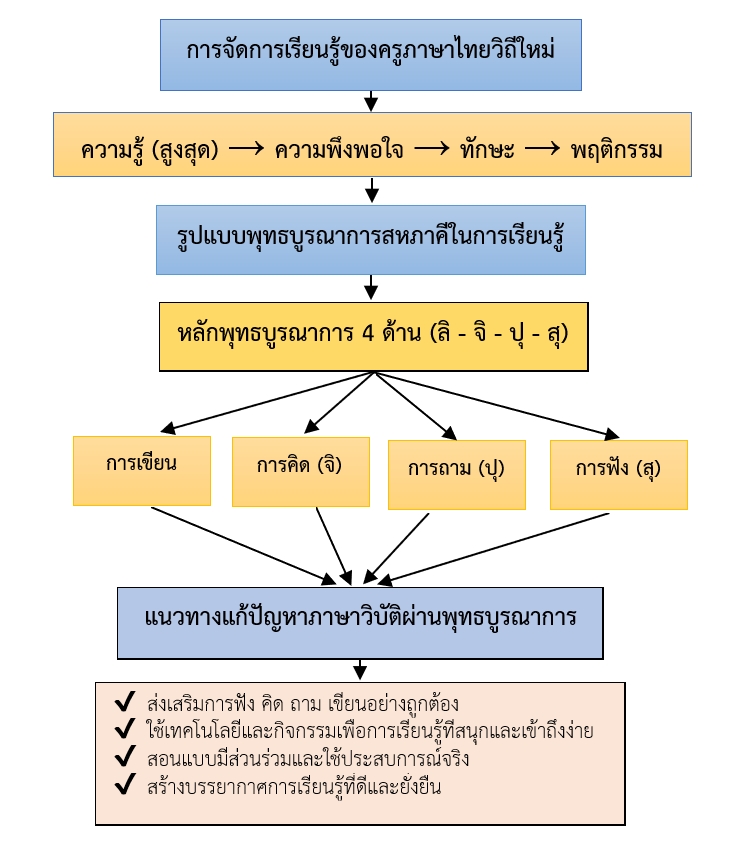
1. Regarding the current state of language deterioration among adolescents, the findings revealed that such problems primarily stemmed from online media exposure, peer imitation, and a lack of positive language role models. These factors contributed to increasing inaccuracies in communication and writing. Interviewees indicated that the Buddhist principles of Su-Ji-Pu-Li and Right Speech (Sammā Vācā) could enhance mindfulness, responsibility, and appropriate language use by emphasizing attentive listening, thoughtful thinking, proper speaking, and accurate communication.
2. The Buddhist-integrated multi-sectoral learning management model for Thai language teachers in the new paradigm comprised listening, writing, language usage, and reading components. The model was grounded in the principles of mindfulness and clear comprehension (Sati-Sampajañña), wise reflection (Yoniso Manasikāra), Right Speech (Sammā Vācā), and the Four Foundations of Mindfulness (Satipaṭṭhāna). These principles were integrated with Su-Ji-Pu-Li to promote correct listening, thinking, questioning, and writing skills. As a result, learners developed comprehensive Thai language skills, reduced language deterioration, and achieved sustainable learning outcomes.
3. Regarding the dissemination of knowledge related to the Buddhist-integrated multi-sectoral learning management model, the findings showed that training sessions and instructional manuals effectively enhanced teachers’ understanding of the model. Evaluation results indicated that the model was appropriate, feasible, and effective, with strong potential for broader implementation as a best-practice model.
Article Details

This work is licensed under a Creative Commons Attribution-NonCommercial-NoDerivatives 4.0 International License.
เพื่อให้เป็นไปตามกฎหมายลิขสิทธิ์ ผู้นิพนธ์ทุกท่านต้องลงลายมือชื่อในแบบฟอร์มใบมอบลิขสิทธิ์บทความ ให้แก่วารสารฯ พร้อมกับบทความต้นฉบับที่ได้แก้ไขครั้งสุดท้าย นอกจากนี้ ผู้นิพนธ์ทุกท่านต้องยืนยันว่าบทความ ต้นฉบับที่ส่งมาตีพิมพ์นั้น ได้ส่งมาตีพิมพ์เฉพาะในวารสาร วิชาการธรรม ทรรศน์ เพียงแห่งเดียวเท่านั้น หากมีการใช้ ภาพหรือตารางของผู้นิพนธ์อื่นที่ปรากฏในสิ่งตีพิมพ์อื่นมาแล้ว ผู้นิพนธ์ต้องขออนุญาตเจ้าของลิขสิทธิ์ก่อน พร้อมทั้ง แสดงหนังสือที่ได้รับการยินยอมต่อบรรณาธิการ ก่อนที่บทความจะได้รับการตีพิมพ์References
กานต์รวี ชมเชย. (2558) ภาษาไทยเน็ต: ภาษาสนทนาในโปรแกรมสนทนาในสมาร์ทโฟน. นครปฐม: มหาวิทยาลัยศรีนครินทรวิโรฒ.
ชญตา วงษาวดี, สังเวียน ปินะกาลัง และนฤมล อินทร์ประสิทธิ์. (2565). แนวทางการจัดการเรียนรู้วิชาภาษาไทยของครูที่มีผลต่อกระบวนการเรียนรู้ของนักเรียนประถมศึกษา. วารสารวิวิธวรรณสาร, 4(1), 117-136. https://so06.tci-thaijo.org/index.php/wiwitwannasan/article/view/239892/164394
มนัส บุญประกอบ. (2543). การวิจัยและพัฒนาเทคนิคการสอนวิทยาศาสตร์ตามแนวทางยกระดับคุณภาพวิทยาศาสตร์ศึกษา. (รายงานการวิจัย). กรุงเทพฯ: มหาวิทยาลัยศรีนครินทรวิโรฒ.
มหาวิทยาลัยสุโขทัยธรรมธิราช. (2561). ทักษะพื้นฐานที่จำเป็นสำหรับนักศึกษาในปัจจุบัน. เข้าถึงได้จาก http://www.stou.ac.th/offices/Oes/Oespage/Guide/article/n10.html
ศิราณี สนั่นเอื้อ. (2562). การพัฒนารูปแบบชุดกิจกรรมการเรียนรู้ด้านทักษะพิสัย เกี่ยวกับการฟัง พูดอ่าน เขียน วิชาภาษาไทย ของนักเรียนชั้นประถมศึกษาปีที่ 4 โรงเรียนเทศบาลวัดเหนือ จังหวัดร้อยเอ็ด. วารสารเทคโนโลยีและสื่อสารการศึกษา คณะศึกษาศาสตร์ มหาวิทยาลัยมหาสารคาม, 2(6), 45-57. https://so02.tci-thaijo.org/index.php/etcedumsujournal/article/view/242325/164487
สำนักงานพัฒนาเศรษฐกิจและสังคมแห่งชาติ. (2560). แผนพัฒนาเศรษฐกิจและสังคมแห่งชาติ ฉบับที่ 12 พ.ศ. 2560-2564. กรุงเทพฯ: สำนักงานพัฒนาเศรษฐกิจและสังคมแห่งชาติ.
สำนักงานเลขานุการของคณะกรรมการยุทธศาสตร์ชาติ. (2561). ยุทธศาสตร์ชาติ 20 ปี พ.ศ. 2561-2580. กรุงเทพฯ: สำนักงานเลขานุการของคณะกรรมการยุทธศาสตร์ชาติ.
Chinn, C. A. (2020). Digital communication and language use in the 21st century. New York, NY: Routledge.
Krejcie, R. V., & Morgan, D. W. (1970). Determining Sample Size for Research Activities. Educational and Psychological Measurement, 30(3), 607-610. https://www.scirp.org/reference/referencespapers?referenceid=1809246
