The Study and Development of a Community-Based Tourism Management Model Based on the Principles of the King’s Philosophy for Sustainability: A Case Study of Ban Muang Kham, Chiang Mai Province
Article Sidebar
Main Article Content
Abstract
This study aimed to: 1) examine the potential and readiness of the internal (strengths/ weaknesses) and external (opportunities/ threats) environments of Ban Muang Khum community in relation to community-based tourism management; 2) investigate problems and obstacles affecting the development of Ban Muang Khum as a community-based tourism destination; and 3) propose sustainable models for community-based tourism development and management based on the Principles of the King’s Philosophy. A community-based participatory research approach was employed. The population consisted of two groups: Group 1 included 221 households in Ban Muang Khum, with data collected through unstructured interviews, both non-participant and participant observations, and in-depth interviews with 10 community leaders. Group 2 comprised 16 government and private sector personnel, from whom data were collected through focus group discussions. Additional methods included document review, interviews, observations, and focus groups. Data were analyzed using SWOT analysis and content analysis. The proposed models for sustainable community-based tourism development grounded in the Principles of the King’s Philosophy. were assessed for appropriateness and feasibility by experts, stakeholders, and community members, yielding mean scores of 4.50, 5.00, and 4.69 respectively.
The findings indicate that:
1. Ban Muang Khum community demonstrates strong capacity for community-based tourism development in terms of physical resources, tourism components, leadership, and human resource readiness for self-management. The community leverages its agricultural way of life to create agrotourism routes and advance community-based tourism development under the Principles of the King’s Philosophy, thereby strengthening participation and resilience, and receiving national recognition.
2. Internal challenges include limited cultural capital, partial lack of participation in tourism management, insufficient quality of local tourism information, discontinuity in online promotion, nascent service standardization, and a weak community-based tourism fund. External challenges involve competition from emerging tourist destinations in Mae Rim and Samoeng districts, along with cultural misunderstandings caused by the influx of outsiders.
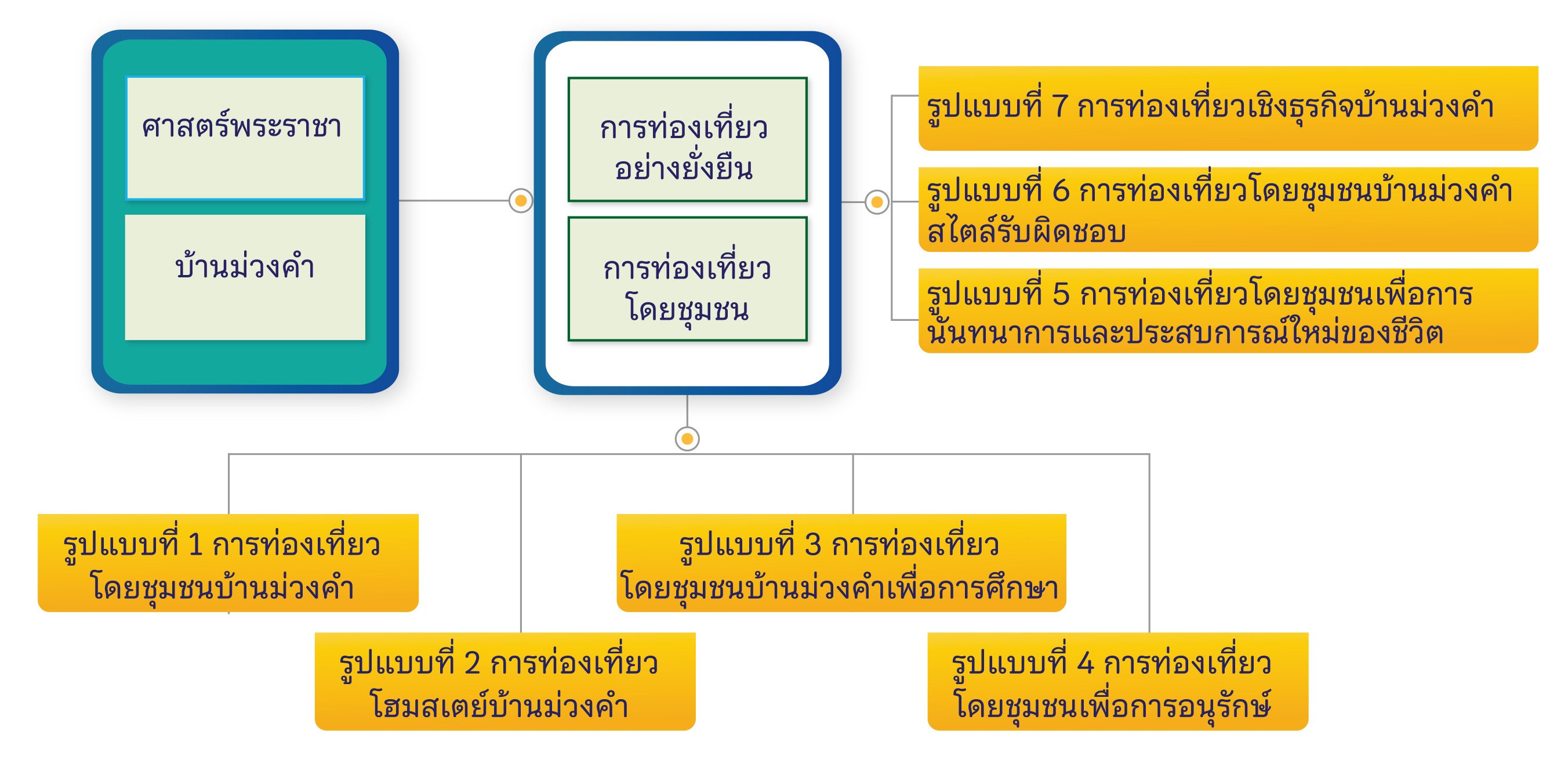
3. The sustainable development and management of community-based tourism in Ban Muang Khum, grounded in the Principles of the King’s Philosophy, can be conceptualized into seven models: (a) community-based tourism, (b) homestay tourism, (c) educational tourism, (d) conservation tourism, (e) recreational and experiential tourism, (f) responsible tourism, and (g) business-oriented tourism.
Article Details

This work is licensed under a Creative Commons Attribution-NonCommercial-NoDerivatives 4.0 International License.
เพื่อให้เป็นไปตามกฎหมายลิขสิทธิ์ ผู้นิพนธ์ทุกท่านต้องลงลายมือชื่อในแบบฟอร์มใบมอบลิขสิทธิ์บทความ ให้แก่วารสารฯ พร้อมกับบทความต้นฉบับที่ได้แก้ไขครั้งสุดท้าย นอกจากนี้ ผู้นิพนธ์ทุกท่านต้องยืนยันว่าบทความ ต้นฉบับที่ส่งมาตีพิมพ์นั้น ได้ส่งมาตีพิมพ์เฉพาะในวารสาร วิชาการธรรม ทรรศน์ เพียงแห่งเดียวเท่านั้น หากมีการใช้ ภาพหรือตารางของผู้นิพนธ์อื่นที่ปรากฏในสิ่งตีพิมพ์อื่นมาแล้ว ผู้นิพนธ์ต้องขออนุญาตเจ้าของลิขสิทธิ์ก่อน พร้อมทั้ง แสดงหนังสือที่ได้รับการยินยอมต่อบรรณาธิการ ก่อนที่บทความจะได้รับการตีพิมพ์References
กรมการพัฒนาชุมชน. (2566). รายงานประจำปี 2566 กรมการพัฒนาชุมชน. กรุงทพฯ: กรมการพัฒนาชุมชน.
คณะกรรมการนโยบายการท่องเที่ยวแห่งชาติ. (2559). เกณฑ์การพัฒนาการท่องเที่ยวโดยชุมชนของประเทศไทย. กรุงทพฯ: องค์การบริหารการพัฒนาพื้นที่พิเศษเพื่อการท่องเที่ยวอย่างยั่งยืน (องค์การมหาชน).
ชูสิทธิ์ ชูชาติ. (2562). คู่มือการท่องเที่ยวในมิติเศรษฐกิจพอเพียง. (พิมพ์ครั้งที่ 2). เชียงใหม่: ศูนย์ศึกษาศาสตร์พระราชาเพื่อการพัฒนาท้องถิ่น มหาวิทยาลัยราชภัฏเชียงใหม่.
ไทยรัฐออนไลน์. (2563). ท่องเที่ยวแบบ RT สร้างสุขทางเศรษฐกิจ รับผิดชอบต่อสังคมและสิ่งแวดล้อม ก่อน..บอกให้รู้ว่าสวยแค่ไหน. เข้าถึงได้จาก https://www.thairath.co.th/ news/society/1929608
โปรดปราน เสริญวงศ์สัตย์. (2566). ศาสตร์พระราชากับการพัฒนาท้องถิ่นในศตวรรษที่ 21. วารสารวิชาการรัฐศาสตร์และรัฐประศาสนศาสตร์, 5(1), 1-12. https://so08.tci-thaijo.org/index.php/AJPP/article/view/766
ผการัตน์ พินิจวัฒน์. (2565). ศาสตร์พระราชาสู่การพัฒนาท้องถิ่นอย่างยั่งยืน. วารสารศิลปะศาสตร์ราชมงคลสุวรรณภูมิ, 4(1), 202-212. https://so03.tci-thaijo.org/index.php/art/article/view/258274
พัลลภา ปีติสันต์. (2561). การสร้างคุณค่าให้กับชุมชน (ท้องถิ่น) ด้วยเศรษฐกิจพอเพียง. กรุงเทพฯ: สถาบันพระปกเกล้า.
มนัส สุวรรณ, สมาน ฟูแสง, ณรงพันธ์ ฉุนรัมย์, วรพล วัฒนเหลืองอรุณ และชนม์ธนัช สุวรรณ. (2562). กลยุทธ์ในการแก้ไขปัญหาความยากจนของประชาชนบนพื้นฐานของศาสตร์พระราชา. เชียงใหม่: มหาวิทยาลัยราชภัฏเชียงใหม่.
วรพล วัฒนเหลืองอรุณ, บังอร ฉัตรรุ่งเรือง และกริช สอิ้งทอง. (2566). ต้นแบบชุมชนท่องเที่ยว OTOP นวัตวิถีในยุค New Normal & Next Normal. เชียงใหม่: สำนักงานคณะกรรมการส่งเสริม วิทยาศาสตร์ วิจัยและนวัตกรรม (สกสว.).
วรากรณ์ พูลสวัสดิ์, นงนุช ยังรอด และปิยนาถ อิ่มดี. (2565). การสร้างและพัฒนาเครือข่ายการท่องเที่ยวโดยชุมชนของกลุ่มชาติพันธุ์ลาวครั่งในจังหวัดนครปฐม. วารสาร มจร บาฬีศึกษาพุทธโฆสปริทรรศน์, 8(2), 151-168. https://so05.tci-thaijo.org/index.php/Palisueksabuddhaghosa/article/view/260657
ศิราณี ขำคม, พระครูพิศาลสารบัณฑิต และสมเดช นามเกตุ. (2566). ศาสตร์พระราชากับการมีส่วนร่วมของชุมชนในการบริหารจัดการแหล่งท่องเที่ยวเชิงวัฒนธรรมจังหวัดหนองคาย. วารสารมณีเชษฐาราม วัดจอมมณี, 6(4), 265-282. https://so07.tci-thaijo.org/index.php/JMCR/article/view/3387/2257
ศูนย์ประสานงานเครือข่ายการท่องเที่ยวโดยชุมชน. (2563). การท่องเที่ยวโดยชุมชน. เข้าถึงได้จาก https://thaicommunitybasedtourismnetwork.wordpress.com/cbt/
สำนักงานคณะกรรมการพิเศษเพื่อประสานงานโครงการอันเนื่องมาจากพระราชดำริ. (2563). หลักการทรงงานในพระบาทสมเด็จพระบรมชนกาธิเบศร มหาภูมิพลอดุลยเดชมหาราชบรมนาถบพิตร. (พิมพ์ครั้งที่ 3). กรุงเทพฯ: ธนอรุณการพิมพ์.
หทัยรัตน์ สวัสดี. (2563). แนวทางการพัฒนาการท่องเที่ยวโดยชุมชนเพื่อการจัดการการท่องเที่ยวอย่างยั่งยืนชุมชนบ้านท่าแร่ อำเภอเมือง จังหวัดขอนแก่น. วารสารเพื่อการพัฒนาการท่องเที่ยวสู่ความยั่งยืน, 2(1), 64-73. https://so04.tci-thaijo.org/index.php/JSTD/article/view/254914
อุมาพร ห่านรุ่งชโรทร. (2551). การเสริมสร้างพลังอำนาจชุมชน. วารสารพยาบาล มหาวิทยาลัยนเรศวร, 2(ฉบับพิเศษ), 1-5.
Dickman, C. R. (1996). Overview of the impacts of feral cats on Australian native fauna. Canberra: Australian Nature Conservation Agency.
Erwin, W. (1976). Electoral participation in a low stimulus election. Rural Development, 4(1), 111-124.
Kotler, P., & Armstrong, G. (2018). Principles of marketing. (17th ed.). Harlow: Pearson Education Limited.
