The Development of Learning Questioning-answering Model with Artificial Intelligence to Enhance Entrepreneurial Mindsets on The Basis of Phitsanulok Soft Power for Undergraduate Students
Article Sidebar
Main Article Content
Abstract
The objectives for this research were: 1) to analyze the components of a learning Questioning-Answering Model with Artificial Intelligence to enhance Entrepreneurial Mindsets based on Phitsanulok Soft power, 2) to develop and validate the quality of the learning model, 3) to study the effects of implementing the learning model, with the following sub-objectives: (1) to compare enhance Entrepreneurial Mindsets after the learning with the criteria of 80%, (2) to study students' satisfaction with the learning activities based on the model and 4) to certify the learning model by experts The samples were 289 students who enroll in the second semester in 2024 who registered to study in the course 001226 Digital Ways Group 1. The data were collected by employing 1) learning model, 2) evaluation forms, and 3) a Satisfaction questionnaire and analyzed by using percentage, mean, standard deviation, and One sample t-test.
The results revealed that:
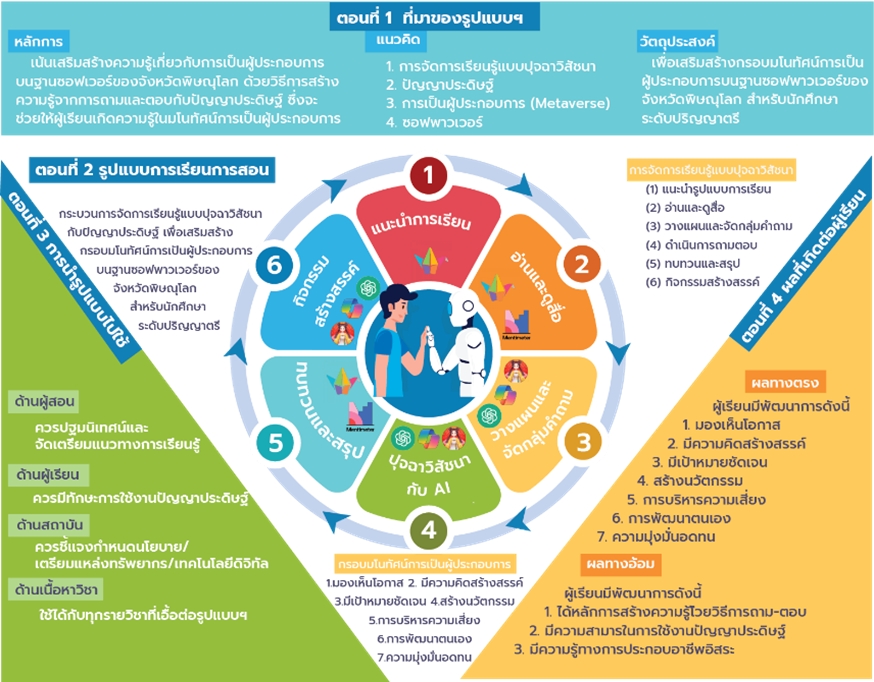
1. The developed model consisted of 4 components: 1. Principles 2. Objectives 3. The learning process consisted of six stages: (1)Lesson introduction, (2) Reading and media viewing, (3) Planning and formulating group questions, (4) Socratic dialogue with AI, (5) Reviewing and Summarizing, (6) Creative activities, and 4. Measurement and evaluation.
2. The learning model was designed based on the framework of Joyce, Weil, and Calhoun. Upon expert evaluation, the model was deemed highly appropriate.
3. Results of using the learning model: 1) Students' understanding of the entrepreneurial conceptual framework after learning through the model exceeded the 80%, with statistical significance at the .01 level. 2) Students expressed high overall satisfaction with the learning activities based on the model.
4. Expert certification confirmed that the developed learning model was suitable for use in teaching and learning management.
Article Details

This work is licensed under a Creative Commons Attribution-NonCommercial-NoDerivatives 4.0 International License.
เพื่อให้เป็นไปตามกฎหมายลิขสิทธิ์ ผู้นิพนธ์ทุกท่านต้องลงลายมือชื่อในแบบฟอร์มใบมอบลิขสิทธิ์บทความ ให้แก่วารสารฯ พร้อมกับบทความต้นฉบับที่ได้แก้ไขครั้งสุดท้าย นอกจากนี้ ผู้นิพนธ์ทุกท่านต้องยืนยันว่าบทความ ต้นฉบับที่ส่งมาตีพิมพ์นั้น ได้ส่งมาตีพิมพ์เฉพาะในวารสาร วิชาการธรรม ทรรศน์ เพียงแห่งเดียวเท่านั้น หากมีการใช้ ภาพหรือตารางของผู้นิพนธ์อื่นที่ปรากฏในสิ่งตีพิมพ์อื่นมาแล้ว ผู้นิพนธ์ต้องขออนุญาตเจ้าของลิขสิทธิ์ก่อน พร้อมทั้ง แสดงหนังสือที่ได้รับการยินยอมต่อบรรณาธิการ ก่อนที่บทความจะได้รับการตีพิมพ์References
กระทรวงศึกษาธิการ. (2567). 15 แนวโน้มการศึกษาโลกที่จะเกิดขึ้นในปี 2024. เข้าถึงได้จาก https://www.moe.go.th/moonpreneur/
กระทรวงอุตสาหกรรม. (2566). “รมว.อุตฯ” ปลื้มความสำเร็จผู้ประกอบการไทย ดันซอฟต์พาวเวอร์หนุนอาหาร-แฟชั่น-งานแฟร์ สร้างมูลค่าเศรษฐกิจเพิ่มรายได้ให้ชุมชนยั่งยืน. เข้าถึงได้จาก https://www.industry.go.th/th/secretary-of-industry/12604
กิตติมศักดิ์ ในจิต, เอกกมล บุญยะผลานันท์ และกฤษมันต์ วัฒนาณรงค์. (2565). ระบบปัญญาประดิษฐ์เพื่อนำเสนอคำตอบแบบมัลติมีเดียบนเครือข่ายสังคมออนไลน์. วารสารรัชต์ภาคย์, 16(44), 119-138. https://so05.tci-thaijo.org/index.php/RJPJ/article/view/254186/173492
ทวีสิน อำนวยพันธ์วิไล. (2567). ปลุกพลังความคิดสร้างสรรค์: การนำ Generative AI สู่การจัดการเรียนรู้. ใน ประมวลการนำเสนองานสาธิตวิชาการ ครั้งที่ 9 Essentail Soft Skills for the Future: จรณะทักษะจำเป็นสำหรับอนาคต, 8-9 สิงหาคม 2567. กรุงเทพฯ: จุฬาลงกรณ์มหาวิทยาลัย.
นรรัชต์ ฝันเชียร. (2562). AI กับการส่งเสริมการศึกษา. เข้าถึงได้จาก https://www.trueplookpanya.com/dhamma/content/75968
เปรม ถาวรประภาสวัสดิ์. (2567). Soft Power กับการท่องเที่ยวไทย. เข้าถึงได้จาก https://prt.parliament.go.th/server/api/core/bitstreams/d87c5913-7eb5-408a-b1cf-d62acb5b90ba/content
พระปลัดราชันย์ ขวัญเมือง, ไพฑูรย์ สินลารัตน์ และไสว ฟักขาว. (2563). การพัฒนารูปแบบการเรียนการสอนตามแนวคิดทางพระพุทธศาสนา เพื่อส่งเสริมความสามารถในการแก้ปัญหา สำหรับนักเรียนมัธยมศึกษาตอนปลาย. วารสารสันติศึกษาปริทรรศน์ มจร, 9(4), 1627-1640. https://so03.tci-thaijo.org/index.php/journal-peace/article/view/243833/169919
พระพรหมคุณาภรณ์ (ป.อ.ปยุตฺโต). (2564). พุทธวิธีในการสอน. (พิมพ์ครั้งที่ 26). กรุงเทพฯ: กองทุนพระองค์เจ้าวิมลฉัตร.
พระมหาบุญแล พุทฺธวโร. (2562). พุทธวิธีในการสอนที่ทรงประสิทธิผลสูงสุด. วารสารวิชาการสถาบันพัฒนาพระวิทยากร, 2(1), 31-45. https://so06.tci-thaijo.org/index.php/tmd/article/view/250195/169306
พระมหาสายัณห์ จันทร์วิบูลย์. (2557). การพัฒนาสมรรถภาพด้านการจัดการเรียนรู้ด้วยวิธีสอนแบบปุจฉาวิสัชนาโดยใช้กานิเทศน์แบบคลินิกของพระสอนศีลธรรมในโรงเรียน. Veridian E-Journal, Silpakorn University, 7(3), 582-600.
พิชญาภา ยวงสร้อย และวิวัฒน์ มีสุวรรณ. (2567). การพัฒนารูปแบบการจัดการเรียนรู้ตามหลักพุทธวิธีผ่านห้องเรียนเมตาเวิร์สร่วมกับการจัดการเรียนรู้โดยใช้ปัญหาเป็นฐานเพื่อพัฒนาทักษะการรู้เท่าทันสื่อและสารสนเทศสําหรับนิสิตระดับปริญญาตรี. วารสารพุทธจิตวิทยา, 9(3), 477-491. https://so03.tci-thaijo.org/index.php/jbp/article/view/275129/185378
มหาวิทยาลัยนเรศวร. (2567). แผนยุทธศาสตร์มหาวิทยาลัยนเรศวร. เข้าถึงได้จาก https://www.plan.office.nu.ac.th/wp-content/uploads/2024/04/NU_Strategical-Plan_2566_2570.pdf
วราพร กาญจนคลอด, สมาภรณ์ นวลสุทธิ์ และสุจินดา พรหมขํา. (2565). ลักษณะความเป็นผู้ประกอบการของนักศึกษากรณีศึกษา คณะวิทยาการจัดการ มหาวิทยาลัยราชภัฏนครศรีธรรมราช. วารสารรัชต์ภาคย์, 16(47), 363-378. https://so05.tci-thaijo.org/index.php/RJPJ/article/view/257439/175346
สำนักงานปลัดกระทรวงการอุดมศึกษา วิทยาศาสตร์ วิจัยและนวัตกรรม. (2565). AI คืออะไร ทำไมมีแต่คนพูดถึง. เข้าถึงได้จาก https://www.stkc.go.th/stiarticle/ai-คืออะไร-ทำไมมีแต่คนพูดถึง
สำนักงานเลขาธิการสภาการศึกษา. (2563). AI เพื่อพัฒนาการเรียนรู้. กรุงเทพฯ: พริกหวานกราฟฟิค
สุภาพิชญ์ ถิระวัฒน์. (2565). Soft Power (อำนาจละมุน). เข้าถึงได้จากhttps://dl.parliament.go.th/handle/20.500.13072/597578
สุรีรัตน์ จุ้นกระยาง, วิมลรัตน์ จตุรานนท์ และปริญญา ทองสอน. (2561). การพัฒนารูปแบบการเรียนการสอนเพื่อเสริมสร้างมโนทัศน์ทางวิทยาศาสตร์ และทักษะ การคิดอย่างมีวิจารณญาณของนักเรียนชั้นมัธยมศึกษาปีที่ 1. วารสารการศึกษาและการพัฒนาสังคม, 14(1), 289-298.
Castells, N., Minguela, M., Solé, I., Miras, M., Nadal, E., & Rijlaarsdam, E. (2021). Improving Questioning–Answering Strategies in Learning from Multiple Complementary Texts: An Intervention Study. Reading Research Quarterly, 57(3), 879-912. https://doi.org/10.1002/rrq.451
GURU. (2024). Guide to AI Questions: Everything you need to know. Retrieved from https://www.getguru.com/th/reference/ai-question-answer
Joyce, B., Weil, M., & Calhoun, E. (2004). Models of teaching. Boston: Allyn and Bacon.
