A Study of Stories and Legends Associated with the Origins of the Village and Town Names, Mueang District, Loei Province
Article Sidebar
Main Article Content
Abstract
This qualitative study aims to explore and compile stories, legends, and history accounts, and the origins of village and town names associated with the ecological system in Mueang District, Loei Province. Data were collected through surveys, semi-structured interviews, and observation method. The findings were analyzed descriptive used to develop innovative media for presenting local knowledge to the community. The results were presented using descriptive analysis.
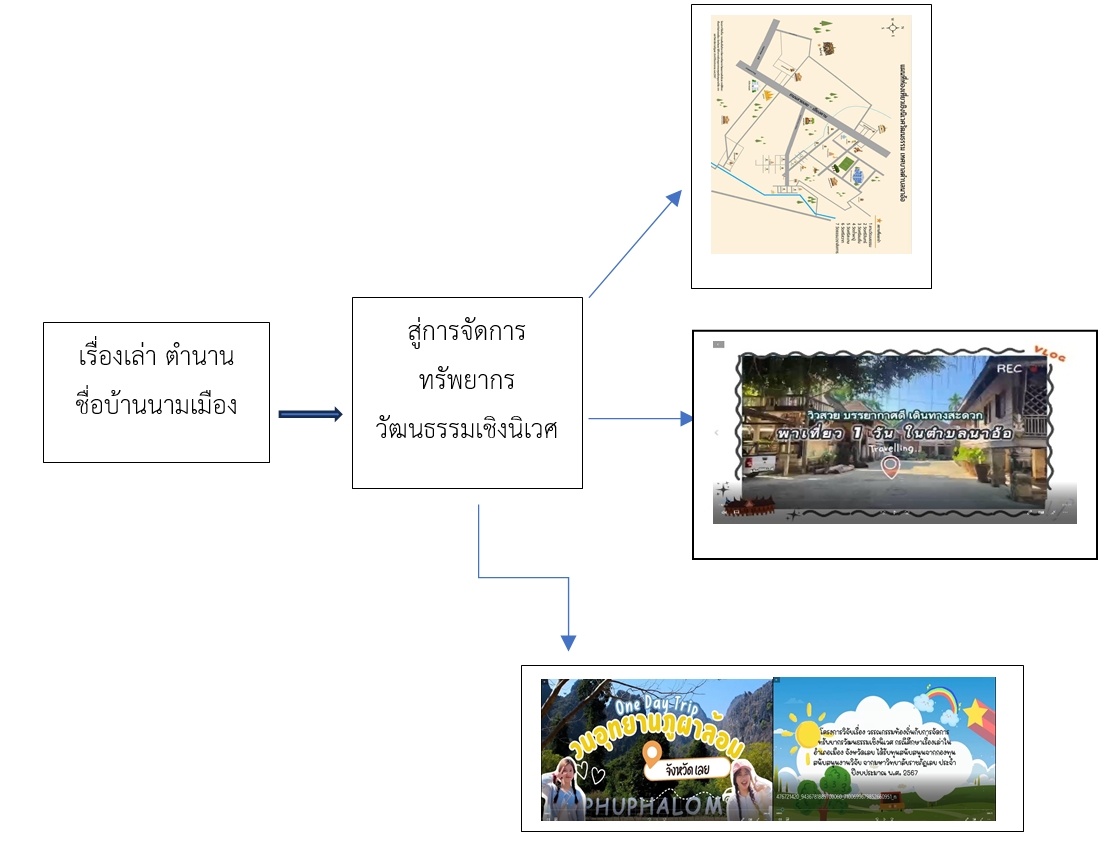
The results revealed that: 1. The study of stories and legends associated with the origins of village and town names has shown that the names of villages and towns in Mueang District, Loei Province are often derived from ecological environments. The naming origins can be categorized into six types: 1) Names based on geographical features, 2) Names derived from local animals, 3) Names inspired by plants or fruits, 4) Names reflecting specific environmental features within the community, 5) Names influenced by cultural and social characteristics or symbolic elements, and 6) Names representing the environment as a whole. 2. The analysis of the naming principles related to the ecological system has shown that stories and legends can be categorized into seven groups: 1) Stories and legends related to water, 2) Stories and legends related to soil/rice fields, 3) Stories and legends related to trees, 4) Stories and legends related to mountains/caves, 5) Stories and legends related to people /culture, 6) Stories and legend related to animals, and 7) Stories and legends related to other ecology characteristics. Cultural resource management has been done by utilizing information to develop innovative media that returns knowledge to the community in the following forms: 1) A book on the origins of village and town names in Mueang District, Loei Province; 2) A cultural tourism map; 3) A video introducing eco-tourism sites.
Article Details

This work is licensed under a Creative Commons Attribution-NonCommercial-NoDerivatives 4.0 International License.
เพื่อให้เป็นไปตามกฎหมายลิขสิทธิ์ ผู้นิพนธ์ทุกท่านต้องลงลายมือชื่อในแบบฟอร์มใบมอบลิขสิทธิ์บทความ ให้แก่วารสารฯ พร้อมกับบทความต้นฉบับที่ได้แก้ไขครั้งสุดท้าย นอกจากนี้ ผู้นิพนธ์ทุกท่านต้องยืนยันว่าบทความ ต้นฉบับที่ส่งมาตีพิมพ์นั้น ได้ส่งมาตีพิมพ์เฉพาะในวารสาร วิชาการธรรม ทรรศน์ เพียงแห่งเดียวเท่านั้น หากมีการใช้ ภาพหรือตารางของผู้นิพนธ์อื่นที่ปรากฏในสิ่งตีพิมพ์อื่นมาแล้ว ผู้นิพนธ์ต้องขออนุญาตเจ้าของลิขสิทธิ์ก่อน พร้อมทั้ง แสดงหนังสือที่ได้รับการยินยอมต่อบรรณาธิการ ก่อนที่บทความจะได้รับการตีพิมพ์References
กตัญญู ชูชื่น. (2543). ความรู้พื้นฐานเกี่ยวกับวรรณคดีไทย. กรุงเทพฯ: โอ. เอส. พริ้นติ้งเฮ้าส์.
กองโบราณคดี กรมศิลปากร. (2531). ตำนานและนิทานพื้นบ้านอีสาน. กรุงเทพฯ: การศาสนา.
ธนิก เลิศชาญฤทธิ์. (2554). การจัดการทรัพยากรวัฒนธรรม. กรุงเทพฯ: ศูนย์มานุษยวิทยาสิรินธร (องค์การมหาชน).
ธันวา ใจเที่ยง. (2550). นิเวศวิทยาชาวนา: ประวัติศาสตร์วัฒนธรรมและภูมิปัญญาทางนิเวศของกลุ่มชนชาวนาลุ่มแม่น้ำโขง. กาฬสินธุ์: มหาวิทยาลัยราชภัฏกาฬสินธุ์.
นิภาวดี ทะไกรราช. (2544). นิเวศวัฒนธรรม: ศึกษาเฉพาะกรณีบ้านโคกกลาง ตำบลแคน อำเภอวาปีปทุม จังหวัดมหาสารคาม. (วิทยานิพนธ์ศิลปศาสตรมหาบัณฑิต). กรุงเทพฯ: มหาวิทยาลัยมหิดล.
ศิราพร ณ ถลาง. (2552). ทฤษฎีคติชนวิทยา วิธีวิทยาในการวิเคราะห์ตำนาน-นิทานพื้นบ้าน. กรุงเทพฯ: จุฬาลงกรณ์มหาวิทยาลัย.
สายันต์ ไพรชาญจิตร์. (2550). การจัดการทรัพยากรทางโบราณคดีในงานพัฒนาชุมชน. (พิมพ์ครั้งที่ 3). กรุงเทพฯ: ศักดิ์โสภาการพิมพ์.
