Development of Prototype School Administration Model on Inclusive Learning of Efficient Promotion Network for Special Education in Digitized Era
Article Sidebar
Main Article Content
Abstract
The purposes of this research were 1) to study the components, conditions, problems and guidelines for School Administration Model on Inclusive Learning of Efficient Promotion Network for Special Education in Digitized Era. 2) to Develop the Prototype School Administration Model on Inclusive Learning and 3) evaluate the inclusive school administration model. The research instruments were a questionnaire, workshop, connoisseurship, and public hearing. The data were analyzed using Index of Item-Objective Congruence (IOC), reliability, discrimination (r), mean ( ), standard deviation (S.D.), Pearson’s Correlation Coefficient (r), Kaiser-Meyer-Okin Measures of sampling adequacy (KMO), confirmatory factor analysis (CFA), and content analysis. The samples consisted of 126 inclusive schools.
The results revealed that:
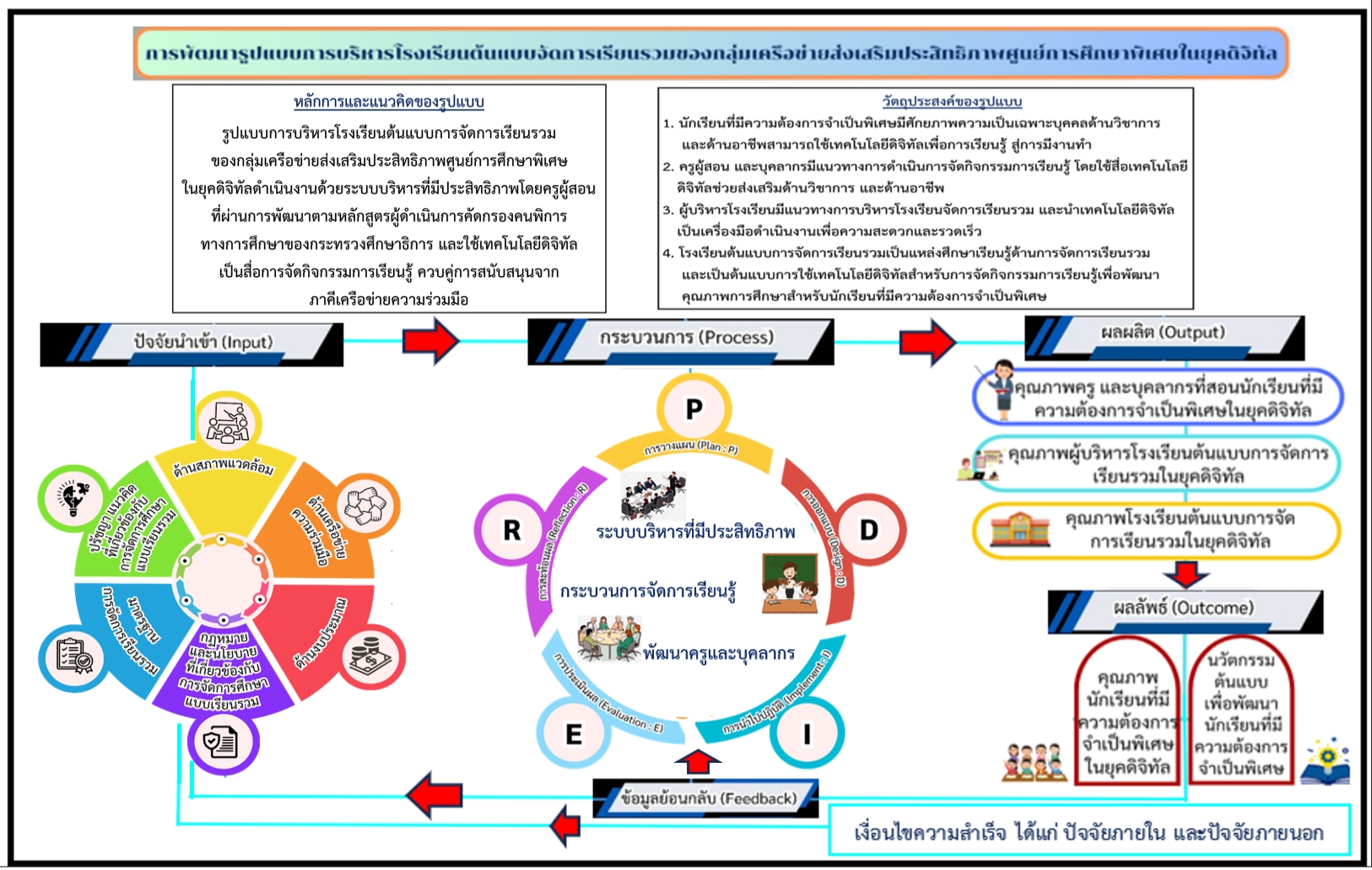
1. The components of the Prototype School Administration on Inclusive Learning of Efficient Promotion Network for Special Education in Digitized Era consists of 6 components; 1) Context 2) Cooperation Network 3) Budget 4) Effective Administration 5) Teacher and Academic personnel development and 6) Learning management process.
2. The management conditions of the Prototype School Administration on Inclusive Learning of Efficient Promotion Network for Special Education in Digitized Era The most practiced aspect was the adjusting buildings and locations to be more suitable, followed by the aspects of Effective Administration and the least practiced aspect was the aspects of Budget.
3. The components of the Prototype School Administration on Inclusive Learning of Efficient Promotion Network for Special Education in Digitized Era from the results of the examination by experts consists of 8 components; 1) Principles and concepts 2) Objectives 3) Input 4) Process 5) Product, 6) Result 7) Feedback and Success Criteria.
4. The evaluation of inclusive school administration model of efficient promotion network for Special Education Center in digital era found that the correction, the appropriateness, and the possibility were at the highest levels. The utility of the model was at the highest levels.
Article Details

This work is licensed under a Creative Commons Attribution-NonCommercial-NoDerivatives 4.0 International License.
เพื่อให้เป็นไปตามกฎหมายลิขสิทธิ์ ผู้นิพนธ์ทุกท่านต้องลงลายมือชื่อในแบบฟอร์มใบมอบลิขสิทธิ์บทความ ให้แก่วารสารฯ พร้อมกับบทความต้นฉบับที่ได้แก้ไขครั้งสุดท้าย นอกจากนี้ ผู้นิพนธ์ทุกท่านต้องยืนยันว่าบทความ ต้นฉบับที่ส่งมาตีพิมพ์นั้น ได้ส่งมาตีพิมพ์เฉพาะในวารสาร วิชาการธรรม ทรรศน์ เพียงแห่งเดียวเท่านั้น หากมีการใช้ ภาพหรือตารางของผู้นิพนธ์อื่นที่ปรากฏในสิ่งตีพิมพ์อื่นมาแล้ว ผู้นิพนธ์ต้องขออนุญาตเจ้าของลิขสิทธิ์ก่อน พร้อมทั้ง แสดงหนังสือที่ได้รับการยินยอมต่อบรรณาธิการ ก่อนที่บทความจะได้รับการตีพิมพ์References
จริยา ตรุษฏี. (2562). แนวทางการจัดการเรียนร่วมสำหรับเด็กที่มีความต้องการพิเศษในโรงเรียนประถมศึกษา สังกัดสำนักงานเขตพื้นที่การศึกษาประถมศึกษาสระบุรี เขต 2. (วิทยานิพนธ์ศึกษาศาสตรมหาบัณฑิต). ปทุมธานี: มหาวิทยาลัยเทคโนโลยีราชมงคลธัญบุรี.
ณัฐฐา แสงเชย. (2564). รูปแบบการนิเทศภายในตามสถานการณ์ชีวิตวิถีใหม่ (New Nomal) ของผู้บริหารสถานศึกษาในเขตภาคเหนือ. (วิทยานิพนธ์ปรัชญาดุษฎีบัณฑิต). กำแพงเพชร: มหาวิทยาลัยราชภัฏกำแพงเพชร.
ธัญลักษณ์ จันทร์ศรี. (2562). การพัฒนารูปแบบการบริหารการศึกษาพิเศษของโรงเรียนต้นแบบการเรียนรวม สำนักงานศึกษาธิการภาค 14. สุรินทร์: มหาวิทยาลัยราชภัฏสุรินทร์.
บุญชม ศรีสะอาด. (2560). การวิจัยเบื้องต้น. (พิมพ์ครั้งที่ 10). กรุงเทพฯ: สุวีริยาสาส์น.
เบญจา ชลธาร์นนท์. (2545). คู่มือการบริหารจัดการเรียนร่วมโดยใช้โครงสร้างชีท. กรุงเทพฯ: เพทายการพิมพ์.
วิชาญ จารุกาจน์. (2564). การบริหารจัดการศึกษาแบบเรียนรวมของโรงเรียน สังกัดสำนักงานเขตพื้นที่การศึกษามัธยมศึกษา. วารสารมหาวิทยาลัยราชภัฏร้อยเอ็ด, 17(2), 225-241.
แววตา ไชยขันธ์, วิมลมาศ ปฐมวณิชกุล และพงศ์ธร โพธิ์พูลศักดิ์. (2565). การพัฒนารูปแบบการจัดการศึกษาแบบเรียนรวมของโรงเรียนในสังกัดศึกษาธิการ ภาค 12. วารสารสหวิทยาการวิจัยและวิชาการ, 2(6), 645-670.
ศิวสันต์ สิงหะหล้า, ปิยะนุช เงินคล้าย, ปรัชญา ชุ่มนาเสียว และนิพนธ์ โซะเฮง. (2565). การศึกษาการนำนโยบายการจัดการศึกษาแบบเรียนรวมสำหรับเด็กพิการไปปฏิบัติ. วารสารรัฐศาสตร์รอบรู้และสหวิทยาการ, 5(4), 231-249. https://so01.tci-thaijo.org/index.php/WPSMS/article/view/260227/172741
สํานักงานคณะกรรมการการศึกษาขั้นพื้นฐาน. (2556). มาตรฐานการเรียนร่วม. กรุงเทพฯ: ชุมนุมสหกรณ์การเกษตรแห่งประเทศไทย.
_______. (2566). แนวทางการจัดการศึกษาให้คณะกรรมการเขตพื้นที่การศึกษาและสถานศึกษา. กรุงเทพฯ: ชุมนุมสหกรณ์การเกษตรแห่งประเทศไทย.
สำนักงานเลขาธิการสภาการศึกษา. (2556). รายงานการติดตามการศึกษาเพื่อปวงชนระดับโลก. กรุงเทพฯ: สำนักงานเลขาธิการสภาการศึกษา.
สุมาลี ศรีผง. (2561). รูปแบบการจัดการศึกษาแบบเรียนรวมของนักเรียนที่มีความบกพร่องทางการเรียนรู้ในสถานศึกษา สังกัดสำนักงานคณะกรรมการการศึกษาขั้นพื้นฐาน. วารสารมหาจุฬาวิชาการ, 5(2), 198-215. https://so04.tci-thaijo.org/index.php/JMA/article/download/162870/118416
Comrey, A. L., & Lee, H. B. (1992.) A First Course in Factor Analysis. (2nd ed). Hillsdale, New Jersey: Lawrence Erlbaum Associated.
Cronbach, L. J. (1971). Essential of psychology testing. (3rd ed.). New York: University of Chicago.
Krejcie, R. V., & Morgan, D. W. (1970). Determining Sample Size for Research Activities. Educational and Psychological Measurement, 30, 607-610. https://doi.org/10.1177/001316447003000308
Likert, R. (1961). New Patterns of Management. New York: McGraw Hill.
Pearson, K. (1920). Notes on the history of correlation. Biometrika, 13(1), 25-45. https://doi.org/10.2307/2331742
Wiersma, W., & Jurs, S. (1990). Educational measurement and testing. Needham Heights, MA: Allyn and Bacon.
