The Synthesis Results Context of Learning Assessment for Competency-based Learning
Article Sidebar
Main Article Content
Abstract
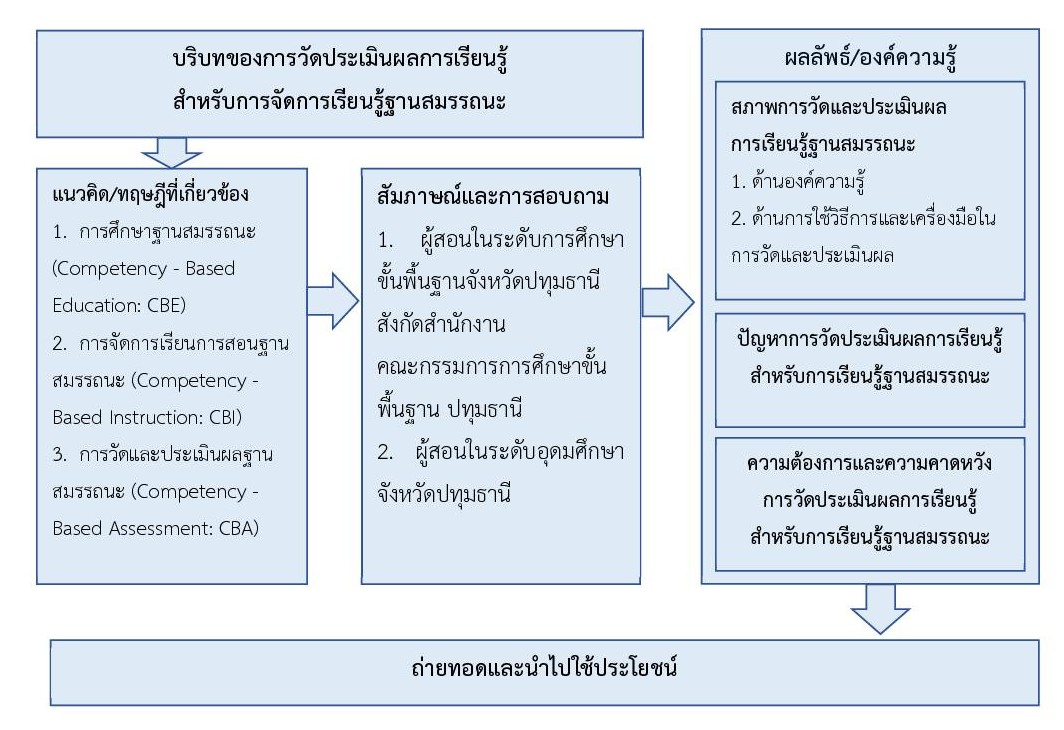
This survey research aimed to: (1) synthesize the context of learning assessment for competency-based learning; and (2) analyze the conditions, problems, and needs regarding learning assessment for competency-based learning among basic education teachers and higher education instructors in Pathum Thani Province. The sample consisted of 400 basic education teachers in Pathum Thani Province, selected via stratified random sampling, and 210 higher education instructors in Pathum Thani Province, selected via simple random sampling. The research instruments included a document synthesis form regarding the context of competency-based learning assessment and a questionnaire on the conditions, problems, and needs concerning the use of assessment tools for competency-based learning, with a reliability coefficient of 0.94. Data were analyzed using percentage, mean, standard deviation, and content analysis.
The results of the research revealed that:
1. Regarding the synthesis of the context of learning assessment for competency-based learning, the study synthesized the contexts of Competency-Based Education and Competency-Based Curriculum.
2. The conditions for learning assessment and assessment for competency-based learning among teachers in basic education in Pathum Thani Province, the overall state of practice was at a moderate level (M = 2.81, S.D. = 0.77). Problems associated with learning assessment were overall at a high level (M = 3.86, S.D. = 0.86), while expectations regarding learning assessment were at the highest level (M = 4.54, S.D. = 0.58). For higher education instructors in Pathum Thani Province, the overall state of practice regarding competency-based learning assessment was at a moderate level (M = 3.17, S.D. = 0.70). Problems related to learning assessment were overall at a high level (M = 3.75, S.D. = 0.73), and expectations for learning assessment were at the highest level (M = 4.52, S.D. = 0.58).
Article Details

This work is licensed under a Creative Commons Attribution-NonCommercial-NoDerivatives 4.0 International License.
เพื่อให้เป็นไปตามกฎหมายลิขสิทธิ์ ผู้นิพนธ์ทุกท่านต้องลงลายมือชื่อในแบบฟอร์มใบมอบลิขสิทธิ์บทความ ให้แก่วารสารฯ พร้อมกับบทความต้นฉบับที่ได้แก้ไขครั้งสุดท้าย นอกจากนี้ ผู้นิพนธ์ทุกท่านต้องยืนยันว่าบทความ ต้นฉบับที่ส่งมาตีพิมพ์นั้น ได้ส่งมาตีพิมพ์เฉพาะในวารสาร วิชาการธรรม ทรรศน์ เพียงแห่งเดียวเท่านั้น หากมีการใช้ ภาพหรือตารางของผู้นิพนธ์อื่นที่ปรากฏในสิ่งตีพิมพ์อื่นมาแล้ว ผู้นิพนธ์ต้องขออนุญาตเจ้าของลิขสิทธิ์ก่อน พร้อมทั้ง แสดงหนังสือที่ได้รับการยินยอมต่อบรรณาธิการ ก่อนที่บทความจะได้รับการตีพิมพ์References
กระทรวงศึกษาธิการ. (2551). หลักสูตรแกนกลางการศึกษาขั้นพื้นฐาน พุทธศักราช 2551. กรุงเทพฯ: คุรุสภาลาดพร้าว.
กาญจนา เงารังษี. (2559). การศึกษากับการพัฒนาที่ยั่งยืน (Education for Sustainable Development: ESD). วารสารสมาคมนักวิจัย, 21(2), 13-18.
จิราภรณ์ มีสง่า และอิศรา รุ่งทวีชัย. (2561). การศึกษาสภาพและปัญหาการวัดและประเมินผลทักษะผู้เรียนในศตวรรษที่ 21 ของครูสำนักงานเขตพื้นที่การศึกษาประถมศึกษาพระนครศรีอยุธยา เขต 1 และเขต 2. วารสารวิจัยราชภัฏกรุงเก่า, 5(2), 93-101. https://so01.tci-thaijo.org/index.php/rdi-aru/article/view/167710/120834
ชนินันท์ พฤกษ์ประมูล. (2566). การประเมินสมรรถนะของผู้เรียนในการเรียนรู้วิทยาศาสตร์. วารสารการวัดผลการศึกษา มหาวิทยาลัยมหาสารคาม, 29(1), 1-19. https://so02.tci-thaijo.org/index.php/jemmsu/article/view/254416/176399
ชูชัย สมิธิไกร. (2550). สมรรถนะในการบริหารงานทรัพยากรมนุษย์. กรุงเทพฯ: การศึกษา.
ญาณินท์ พลับจีน. (2555). การประเมินความต้องการในการพัฒนาสมรรถนะด้านการประเมินผลการเรียนรู้ตามหลักสูตรแกนกลางการศึกษาขั้นพื้นฐาน พ.ศ. 2551 ของครูในอำเภอแจ้ห่ม จังหวัดลำปาง. (วิทยานิพนธ์ครุศาสตรมหาบัณฑิต). ลำปาง: มหาวิทยาลัยราชภัฏลำปาง.
ธีระ รุญเจริญ. (2550). การบริหารสมรรถนะในการพัฒนาทรัพยากรมนุษย์. กรุงเทพฯ: การศึกษา.
ไพศาล คงภิรมย์ชื่น. (2557). แนวทางการพัฒนาระบบการวัดและประเมินผลการเรียนรู้ในศตวรรษที่ 21. กรุงเทพฯ: มหาวิทยาลัยศรีนครินทรวิโรฒ.
วรรณา ตันเทียว. (2543). การศึกษาสภาพและปัญหาการวัดและประเมินผลการเรียนของอาจารย์ผู้สอนประเภทวิชาศิลปกรรมในวิทยาลัยอาชีวศึกษา สังกัดกรมอาชีวศึกษา กระทรวงศึกษาธิการ ในเขตกรุงเทพมหานคร. (วิทยานิพนธ์ศึกษาศาสตรมหาบัณฑิต). กรุงเทพฯ: มหาวิทยาลัยรามคำแหง.
ศิริชัย กาญจนวาสี. (2554). ทฤษฎีการประเมิน. (พิมพ์ครั้งที่ 8). กรุงเทพฯ: จุฬาลงกรณ์มหาวิทยาลัย.
สำนักงานคณะกรรมการการศึกษาแห่งชาติ. (2542). พระราชบัญญัติการศึกษาแห่งชาติ พ.ศ. 2542. กรุงเทพฯ: สำนักนายกรัฐมนตรี.
สำนักงานคณะกรรมการข้าราชการพลเรือน. (2553). คู่มือการประเมินสมรรถนะของข้าราชการ. กรุงเทพฯ: สำนักงานคณะกรรมการข้าราชการพลเรือน.
สำนักงานเลขาธิการสภาการศึกษา. (2553). มาตรฐานการศึกษาขั้นพื้นฐานและการพัฒนาหลักสูตรในศตวรรษที่ 21. กรุงเทพฯ: สำนักงานเลขาธิการสภาการศึกษา.
_______. (2560). แผนการศึกษาแห่งชาติ พ.ศ. 2560-2579. กรุงเทพฯ: พริกหวานกราฟฟิค.
สุพรรณี ศรีนุช. (2557). การพัฒนาทรัพยากรมนุษย์ด้วยสมรรถนะ. กรุงเทพฯ: วิชาการ.
Black, P., & Wiliam, D. (1998). Assessment and classroom learning. Assessment in Education: Principles, Policy & Practice, 5(1), 7-74.
Boud, D., & Soler, R. (2016). Sustainable assessment revisited: Scanning the past and framing the future. Assessment & Evaluation in Higher Education, 41(3), 400-413.
Darling-Hammond, L. (2010). The flat world and education: How America’s commitment to equity will determine our future. New York, NY: Teachers College Press.
Dawson, P., Yan, Z., Lipnevich, A., Tai, J., Boud, D., & Mahoney, P. (2023). Measuring what learners do in feedback: The feedback literacy behaviour scale. Assessment & Evaluation in Higher Education, 49(3), 348-362. https://doi.org/10.1080/02602938.2023.2240983
Gervais, J. (2016). The operational definition of competency-based education. The Journal of Competency-Based Education, 1(2), 98-106.
Henri, M., Johnson, M. D., & Nepal, B. (2017). A review of competency-based learning: Basics, opportunities, and challenges. Journal of Engineering Education, 106(4), 635-650. https://onlinelibrary.wiley.com/doi/10.1002/jee.20180
Krejcie, R. V., & Morgan, D. W. (1970). Determining sample size for research activities. Educational and Psychological Measurement, 30(3), 607-610. https://doi.org/10.1177/001316447003000308
Shepard, L. A. (2000). The role of assessment in a learning culture. Educational Researcher, 29(7), 4-14.
Wiggins, G. (1998). Educative assessment: Designing assessments to inform and improve student performance. San Francisco, CA: Jossey-Bass.
