Building a Network for Preventing and Solving Drug Problems of the Sangha in the Northeast
Article Sidebar
Main Article Content
Abstract
This research aims to: 1) study the awareness, monitoring, and behaviors related to drug use; 2) develop a knowledge framework and measures for preventing and addressing drug issues; and 3) strengthen the processes and social networks for preventing and solving drug problems among Buddhist monks in the northeastern region. This research employs a mixed-method approach, including document analysis, quantitative, qualitative, and action research. The study is conducted at three levels: policy level (Supreme Sangha Council, National Office of Buddhism), provincial level, and temple level, with a sample population of 447 individuals from three provinces: Khon Kaen, Nong Khai, and Surin.
The findings are summarized as follows:
1. Most monks and public participants were unaware of monks being involved with drugs, with only a small portion recognizing such involvement. This indicates that the number of monks involved with drugs is relatively low.
2. The measures implemented at provincial, temple, and community levels adhered to the resolutions of the Supreme Sangha Council, which involved screening target groups within communities, checking the backgrounds of monastic candidates, using temples as community life quality development centers, and promoting awareness and behavioral change regarding drugs.
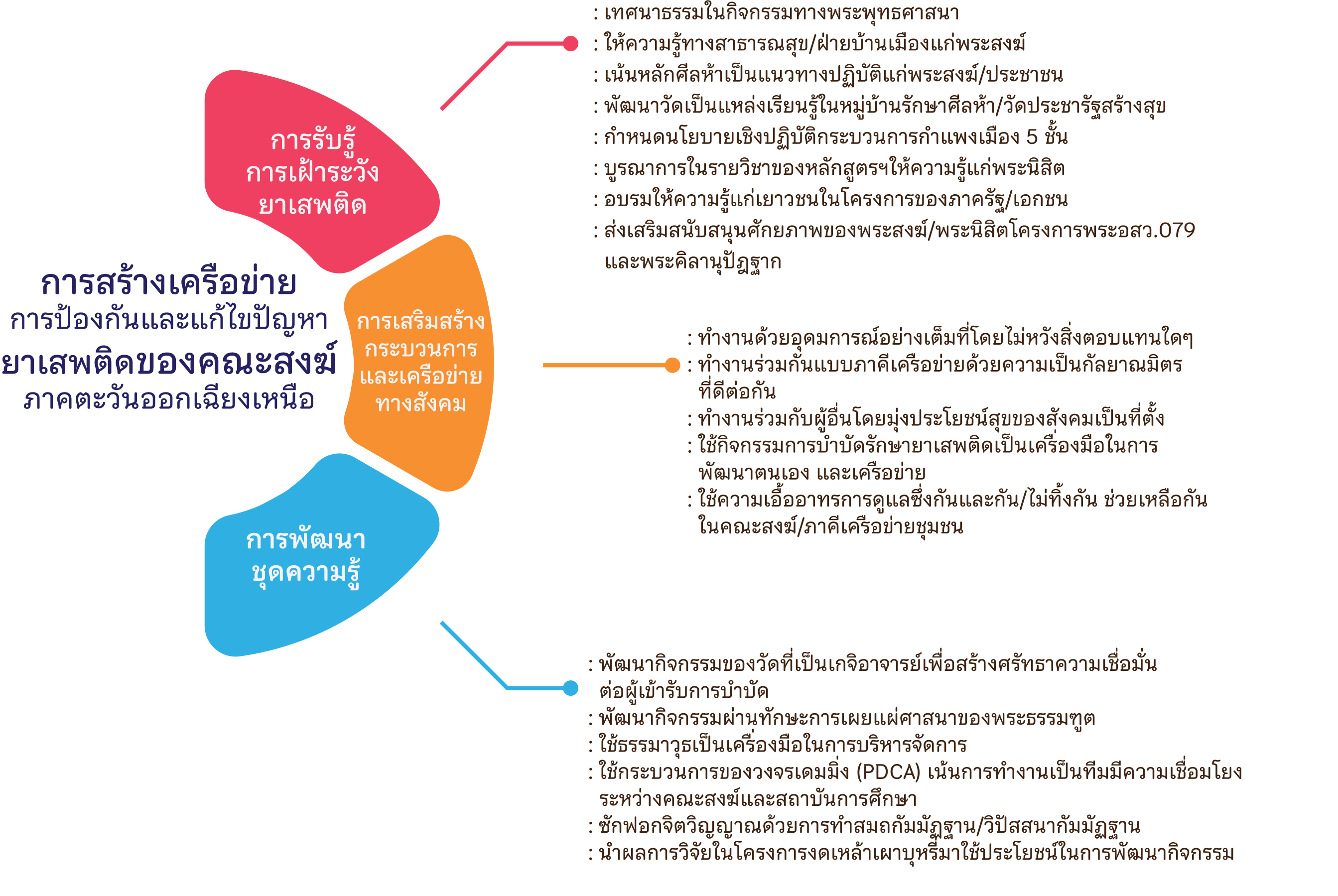
3. Community networks play a critical role in monitoring drug threats in temples and communities. In this regard, the strengthening of processes and social networks in the prevention and resolution of drug problems of the Sangha has the following working concepts and ideologies: 1) working wholeheartedly without expecting rewards; 2) collaborative partnerships based on mutual goodwill; 3) aiming for the welfare of society in joint efforts; 4) utilizing drug rehabilitation activities as a tool for self-development and networking; and 5) mutual support among monks. This includes providing knowledge about the operations of the monkhood and the dangers of drugs, adhering to the policies of the Supreme Sangha Council, promoting community programs that support the Five Precepts, developing training activities at district/community levels, and building cooperation with government/private sectors and communities in the area.
Article Details

This work is licensed under a Creative Commons Attribution-NonCommercial-NoDerivatives 4.0 International License.
เพื่อให้เป็นไปตามกฎหมายลิขสิทธิ์ ผู้นิพนธ์ทุกท่านต้องลงลายมือชื่อในแบบฟอร์มใบมอบลิขสิทธิ์บทความ ให้แก่วารสารฯ พร้อมกับบทความต้นฉบับที่ได้แก้ไขครั้งสุดท้าย นอกจากนี้ ผู้นิพนธ์ทุกท่านต้องยืนยันว่าบทความ ต้นฉบับที่ส่งมาตีพิมพ์นั้น ได้ส่งมาตีพิมพ์เฉพาะในวารสาร วิชาการธรรม ทรรศน์ เพียงแห่งเดียวเท่านั้น หากมีการใช้ ภาพหรือตารางของผู้นิพนธ์อื่นที่ปรากฏในสิ่งตีพิมพ์อื่นมาแล้ว ผู้นิพนธ์ต้องขออนุญาตเจ้าของลิขสิทธิ์ก่อน พร้อมทั้ง แสดงหนังสือที่ได้รับการยินยอมต่อบรรณาธิการ ก่อนที่บทความจะได้รับการตีพิมพ์References
คณะกรรมการบริหารเครือข่ายองค์กรวิชาการสารเสพติด. (2567). การสังเคราะห์สถานการณ์ยาเสพติดในประเทศไทย พ.ศ. 2567. (รายงานการวิจัย). นครราชสีมา: กองทุนป้องกัน ปราบปรามและแก้ไขปัญหายาเสพติด สำนักงานคณะกรรมการป้องกันและปราบปรามยา เสพติด (ป.ป.ส.) กระทรวงยุติธรรม.
พระกาญจนะ ธมฺมธโร. (2556). การประยุกต์หลักพุทธธรรมเพื่อใช้แก้ปัญหายาเสพติดในสังคมไทยยุคปัจจุบัน. (วิทยานิพนธ์พุทธศาสตรมหาบัณฑิต). พระนครศรีอยุธยา: มหาวิทยาลัยมหาจุฬาลงกรณราชวิทยาลัย.
พระสุธีรัตนบัณฑิต (สุทิตย์ อบอุ่น). (2563). การพัฒนารูปแบบและกระบวนการป้องกันแก้ไขปัญหายาเสพติดของคณะสงฆ์: กรณีศึกษาพื้นที่ต้นแบบการป้องกันและแก้ไขปัญหายาเสพติดของพระสงฆ์ 8 จังหวัด. (รายงานการวิจัย). พระนครศรีอยุธยา: สถาบันวิจัยพุทธศาสตร์ มหาวิทยาลัยมหาจุฬาลงกรณราชวิทยาลัย.
_______. (2563). การสร้างเครือข่ายการป้องกันและแก้ไขปัญหายาเสพติดของคณะสงฆ์ไทย. (รายงานการวิจัย). พระนครศรีอยุธยา: สถาบันวิจัยพุทธศาสตร์ มหาวิทยาลัยมหาจุฬาลงกรณราชวิทยาลัย.
มติมหาเถรสมาคม. (2561). มติมหาเถรสมาคม ครั้งที่ 20/2561 มติที่ 445/2561 เรื่อง รายงานการป้องกันและแก้ไขปัญหายาเสพติดในวัด. เข้าถึงได้จาก https://www.mahathera.org/index.php?url=mati&id=8428
สถาบันเอเชียศึกษา จุฬาลงกรณ์มหาวิทยาลัย. (2559). คุณธรรมในอาเซียน: จิตอาสาในอาเซียนภาคพื้นทวีป กรณีศึกษา: ประเทศไทย ลาว พม่า เวียดนาม กัมพูชา. (รายงานการวิจัย). กรุงเทพฯ: ศูนย์คุณธรรม (องค์การมหาชน).
สำนักงานคณะกรรมการป้องกันและปราบปรามยาเสพติด. (2567). นโยบายและแผนระดับชาติว่าด้วยการป้องกัน ปราบปราม และแก้ไขปัญหายาเสพติด (พ.ศ. 2566-2570). กรุงเทพฯ: สำนักงานคณะกรรมการป้องกันและปราบปรามยาเสพติด.
สุรพล พรมกุล และคณะ. (2561). การจัดการความรู้การป้องกันยาเสพติดของพระสงฆ์กลุ่มสังฆพัฒนาในภาคตะวันออกเฉียงเหนือ. (รายงานการวิจัย). พระนครศรีอยุธยา: สถาบันวิจัยพุทธศาสตร์ มหาวิทยาลัยมหาจุฬาลงกรณราชวิทยาลัย.
ASEAN-NARCO. (2023). ASEAN Drug Monitoring Report 2023. Bangkok: ASEAN Narcotics Cooperation Center.
UNODC. (2022). World Drug Report 2022: Cocaine and Its Derivatives. United Nations Publications.
UNODC. (2024). World Drug Report 2024. United Nations Publications.
