Enhancing Active Learning Management Competencies of New Faculty Members at Rangsit University, 2024 Academic Year: A Comparison of Competency and Satisfaction
Article Sidebar
Main Article Content
Abstract
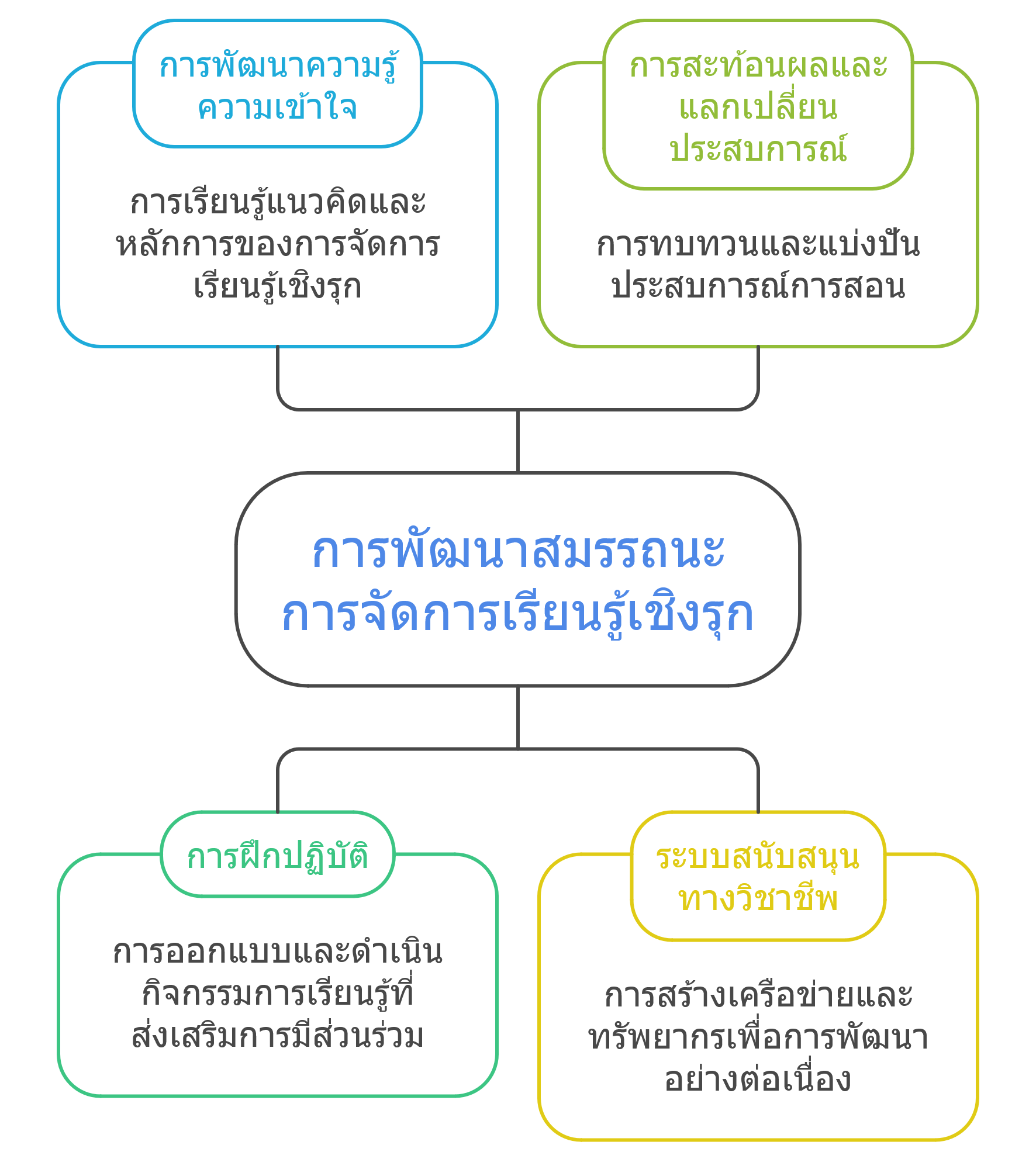
This study was conducted to investigate the active learning management competencies of new faculty members at Rangsit University. The objectives were: 1) to compare these competencies before and after participating in the "Enhancing Active Learning Management Competencies of New Faculty Members, Academic Year 2024" competency enhancement curriculum, and 2) to examine their satisfaction and identify areas for improvement regarding the professional development program. This quantitative study utilized a one-group pretest-posttest design. The target group, selected through purposive sampling, consisted of 31 new faculty members with 1-5 years of experience (student IDs 63-67) during the 2024 academic year. Research instruments included the 12-hour competency development course, a competency self-assessment, and a satisfaction questionnaire, all developed by experts. These tools achieved a Cronbach’s Alpha coefficient of 0.92, indicating high reliability. Data were analyzed using mean, standard deviation, and t-test.
The findings revealed that:
1. The participants' active learning management competencies significantly increased after the initiative at a .01 statistical level (t = 36.60).
2. The satisfaction with the aforementioned competency enhancement program was at the highest level. This curriculum effectively enhances the teaching competencies of new faculty members in alignment with professional standards and can serve as a model for academic staff development in higher education.
Article Details

This work is licensed under a Creative Commons Attribution-NonCommercial-NoDerivatives 4.0 International License.
เพื่อให้เป็นไปตามกฎหมายลิขสิทธิ์ ผู้นิพนธ์ทุกท่านต้องลงลายมือชื่อในแบบฟอร์มใบมอบลิขสิทธิ์บทความ ให้แก่วารสารฯ พร้อมกับบทความต้นฉบับที่ได้แก้ไขครั้งสุดท้าย นอกจากนี้ ผู้นิพนธ์ทุกท่านต้องยืนยันว่าบทความ ต้นฉบับที่ส่งมาตีพิมพ์นั้น ได้ส่งมาตีพิมพ์เฉพาะในวารสาร วิชาการธรรม ทรรศน์ เพียงแห่งเดียวเท่านั้น หากมีการใช้ ภาพหรือตารางของผู้นิพนธ์อื่นที่ปรากฏในสิ่งตีพิมพ์อื่นมาแล้ว ผู้นิพนธ์ต้องขออนุญาตเจ้าของลิขสิทธิ์ก่อน พร้อมทั้ง แสดงหนังสือที่ได้รับการยินยอมต่อบรรณาธิการ ก่อนที่บทความจะได้รับการตีพิมพ์References
จีราภรณ์ จันทร์เขียน และวิชชุตา อ้วนศรีเมือง. (2567). การศึกษาสมรรถนะการจัดการเรียนการสอนของครูในศตวรรษที่ 21 ตามแนวคิดชุมชนแห่งการเรียนรู้วิชาชีพ. วารสาร มจร อุบลปริทรรศน์, 9(1), 1199-1210.
มนตรี วงศ์สะพาน. (2563). พื้นฐานการวิจัยทางหลักสูตรและการสอน. มหาสารคาม: สารคามการพิมพ์.
สมาคมเครือข่ายการพัฒนาวิชาชีพอาจารย์และองค์กรระดับอุดมศึกษาแห่งประเทศไทย (ควอท). (2566). คู่มือการขอรับการประเมินสมรรถนะอาจารย์ ตามแนวทางการพัฒนาคุณภาพอาจารย์เพื่อส่งเสริมการบรรลุผลลัพธ์การเรียนรู้ตามมาตรฐานคุณวุฒิระดับอุดมศึกษา พ.ศ. 2566. เข้าถึงได้จาก https://www.thailandpod.org/doc/thailand_PSF/
Bonwell, C. C., & Eison, J. A. (1991). Active learning: Creating excitement in the classroom. Washington, DC: ERIC Clearinghouse on Higher Education.
Brookfield, S. D. (2006). The skillful teacher: On technique, trust, and responsiveness in the classroom. (2nd ed.). San Francisco, CA: Jossey-Bass.
Felder, R. M., & Brent, R. (2009). Active learning: An introduction. ASQ Higher Education Brief, 2(4), 1-5.
Freeman, S., Eddy, S. L., McDonough, M., Smith, M. K., Okoroafor, N., Jordt, H., & Wenderoth, M. P. (2014). Active learning increases student performance in science, engineering, and mathematics. Proceedings of the National Academy of Sciences, 111(23), 8410-8415.
Gravestock, P., & Gregor-Greenleaf, E. (2008). Student learning under stress: Implications for tutors and staff. Journal of Further and Higher Education, 32(4), 369-383.
Guskey, T. R. (2000). Evaluating professional development. Thousand Oaks, CA: Corwin Press.
Knowles, M. S., Holton III, E. F., & Swanson, R. A. (2015). The adult learner: The definitive classic in adult education and human resource development. (8th ed.). New York, NY: Routledge.
Prince, M. (2004). Does active learning work? A review of the research. Journal of Engineering Education, 93(3), 223-231.
