Education or Labor Migration: The Empowerment of Thai-So Women, Sakon Nakhon Province, Thailand
Article Sidebar
Main Article Content
Abstract
The objective of this research was to examine the influence of education and labor migration on the empowerment of Thai-So women across generations, this study employed the Women’s Empowerment in Agriculture Index (WEAI) to analyze decision-making roles in the areas of household, agricultural production, income control, and access to productive resources. The Kusuman district was chosen as the area of study due to the significant number of the Thai-So ethnic group, who primarily use the ‘So’ language to communicate within their communities and families. A purposive sampling technique was employed to select thirty-six key informants, and semi-structured interview guidelines were used as the research instrument.
Findings reveal that: education and labor migration are mutually reinforcing pathways to empowerment. While education offers foundational skills and social mobility, it also enables labor migration, which provides immediate financial benefits, exposure to broader social networks, and decision-making experience. Among Baby Boomers and Generation X, migration played a central role, with education having only limited influence. In contrast, Generation Y women, who had greater access to formal education, were able to secure better job opportunities outside their communities, leading to enhanced empowerment outcomes upon returning home.
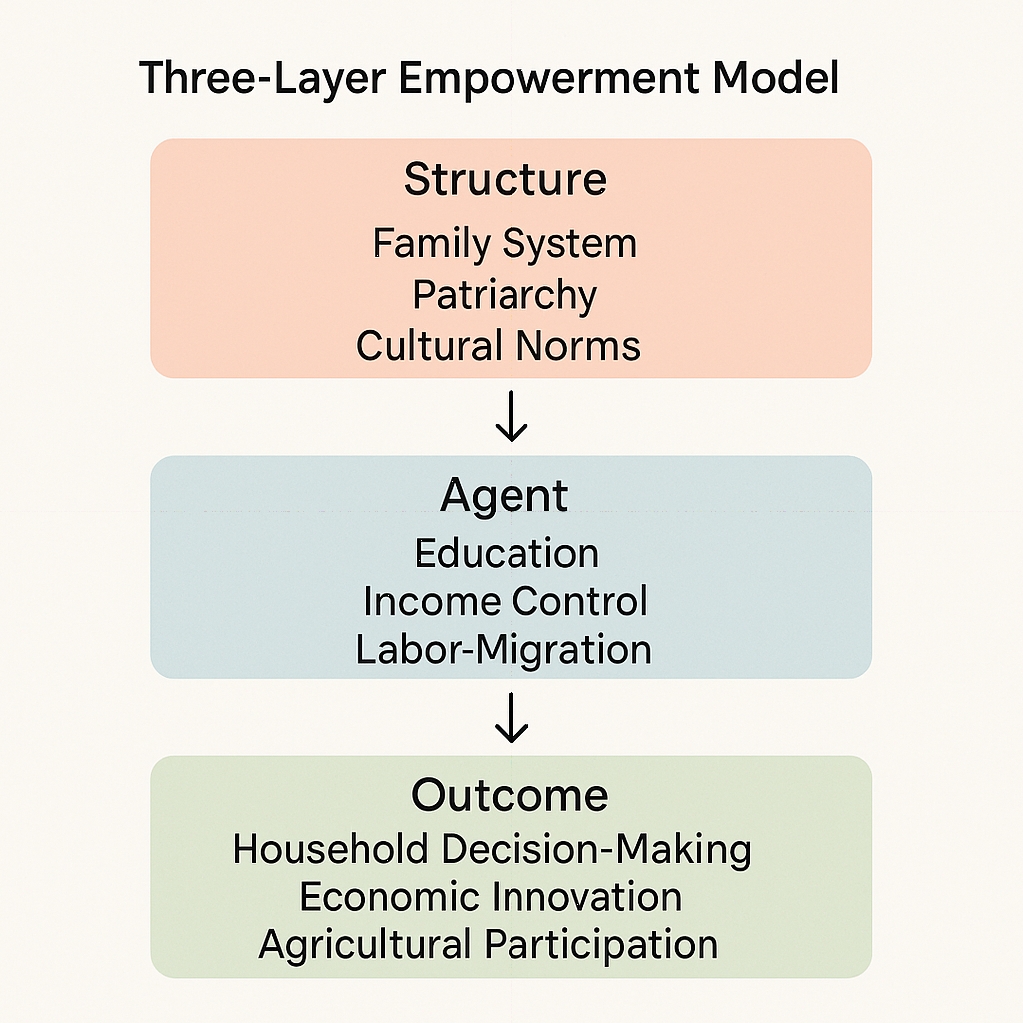
This study introduces a new “Three-Layer Empowerment Model,” which conceptualizes empowerment as an interaction between socio-cultural structures, individual agency, and observable outcomes. The model captures how gender, ethnicity, and generational change intersect to shape empowerment trajectories in a patriarchal rural society. It also highlights the importance of integrated policy support for both educational access and labor mobility in advancing empowerment among ethnic women in Southeast Asia.
Article Details

This work is licensed under a Creative Commons Attribution-NonCommercial-NoDerivatives 4.0 International License.
เพื่อให้เป็นไปตามกฎหมายลิขสิทธิ์ ผู้นิพนธ์ทุกท่านต้องลงลายมือชื่อในแบบฟอร์มใบมอบลิขสิทธิ์บทความ ให้แก่วารสารฯ พร้อมกับบทความต้นฉบับที่ได้แก้ไขครั้งสุดท้าย นอกจากนี้ ผู้นิพนธ์ทุกท่านต้องยืนยันว่าบทความ ต้นฉบับที่ส่งมาตีพิมพ์นั้น ได้ส่งมาตีพิมพ์เฉพาะในวารสาร วิชาการธรรม ทรรศน์ เพียงแห่งเดียวเท่านั้น หากมีการใช้ ภาพหรือตารางของผู้นิพนธ์อื่นที่ปรากฏในสิ่งตีพิมพ์อื่นมาแล้ว ผู้นิพนธ์ต้องขออนุญาตเจ้าของลิขสิทธิ์ก่อน พร้อมทั้ง แสดงหนังสือที่ได้รับการยินยอมต่อบรรณาธิการ ก่อนที่บทความจะได้รับการตีพิมพ์References
Aceros, J. C., Duque, T., & Paloma, V. (2021). Psychosocial Benefits and Costs of Activism among Female Migrant Domestic Workers in Southern Spain. Journal of Community Psychology, 49(7), 2905-2921. https://doi.org/10.1002/jcop.2261016
Aksornsri, A., & Saengsuwan, W. (2021). The Role of Thai Women in the Thailand 4.0 Era. The Journal of Research and Academics, 4(3), 297-310. https://so06.tci-thaijo.org/index.php/jra/article/view/239967
Alkire, S., Meinzen-Dick, R., Peterman, A., Quisumbing, A., Seymour, G., & Vaz, A. (2013). The women’s empowerment in agriculture index. World Development, 52, 71-91. https://doi.org/10.1016/j.worlddev.2013.06.007
Bera, N. (2016). Women Empowerment through Education. International Journal of Humanities & Social Science Studies (IJHSSS), 2(6), 184-190.
Buvinic, M., O’Donnell, M., Knowles, C. J., & Bourgault, S. (2020). Measuring Women’s Economic Empowerment: A Compendium of Selected Tools. Center for Global Development. Retrieved from https://www.cgdev.org/publication/measuring-womens-economic-empowerment-compendium-selected-tools
Chiengthong, J. (2020). Feminism from the Perspectives and Experiences of Ajarn Shalardchai Ramitanondh. Stance: The Thai Feminist Review, 7(1), 1-28.
de Brauw, A., Kramer, B., & Murphy, M. (2021). Migration, Labor and Women’s Empowerment: Evidence from an Agricultural Value Chain in Bangladesh. World Development, 142, 105445. https://doi.org/10.1016/j.worlddev.2021.105445
de Hoop, T., Peterman, A., & Anderson, L. (2020). Guide for Measuring Women’s Empowerment and Economic Outcomes in Impact Evaluation of Women’s Group. Washington DC.: Evidence Consortium on Women’s Groups (ECWG).
Elsayed, A., & Shirshikova, A. (2023). The Women-Empowering Effect of Higher Education. Journal of Development Economics, 163(103101). https://doi.org/10.1016/j.jdeveco.2023.103101
Eryar, D., Teckguc, H., & Toktas, S. (2018). Does migration Contribute to Women’s Empowerment? Portrait of Urban Turkey and Istanbul. Turkish Studies, 20(2), 200-221. https://doi.org/10.1080/14683849.2018.1495566
Gyae, A., & Jha, S. (2011). Measuring Women’s Empowerment through Migration. Diversities, 13(1), 49-66.
Kaithong, B. (2021). Women’s Empowerment Through Exposure to Media Messages: A Case Study of the Thai-So Ethnic Group, Kusuman District, Sakon Nakhon Province, Thailand. Journal of Mekong Societies, 17(1), 110-135. https://so03.tci-thaijo.org/index.php/mekongjournal/article/view/247967
Kaithong, B., & Phongsiri, M. (2020). Similarities or Differences: The Exposure to Media Messages among Thai-So Women, Kusuman District, Sakon Nakhon Province, Thailand. Journal of Community Development Research (Humanities and Social Sciences), 13(2), 55-69. https://doi.org/10.14456/jcdr-hs.2020.15
Li, B., & Stodolska, M. (2022). Leisure as resistance: A case study of a woman from a poor rural background in China. Journal of Leisure Research, 53(2), 248-266. https://doi.org/10.1080/00222216.2021.1926420
Menon, S., & Sharma, S. (2020). A Study on the Status of Women’s Empowerment in urban Bangalore, India. Journal of International Women’s Studies, 21(5), 54-64.
Mutyalu, T. (2019). Role of Education in Women Empowerment. Journal of Emerging Technologies and Innovative research, 6(5), 138-142.
Naowarat, N. (2018). Women’s Education: Self and Knowledge Space (3rd ed.). Chiang Mai: Wanida Printing. National Statistical Office, Ministry of Digital Economy and Society. (2017). Summary of Important Results of Women’s Work in Thailand 2016. Bangkok: Ministry of Digital Economy and Society.
Rana, Q. M., Lee, A., Saher, N., & Shabbir, Z. (2024). Barrier to empowerment: Examining the transition of Pakistani women from higher education (HE) to professional life. Social Sciences, 13(10), 514. https://doi.org/10.3390/socsci13100514
Thongyou, M., & Phongsiri, M. (2017). Gender Assessment Report for the Producer Companies Project (Final report). Khon Kaen: Center for Research on Plurality in the Mekong Region (CERP), Faculty of Humanities and Social Sciences, Khon Kaen University.
UN Women. (2011). UN Women: The United Nations Entity for Gender Equality and the Empowerment of Women [Fact Sheet]. Retrieved fromhttps://asiapacific.unwomen.org/sites/default/files/Field%20Office% 20ESEAsia/Docs/Publications/2011/06-THAILAND-factsheet.pdf
United Nations. (2024). Goal 5: Achieve gender equality and empower all women and girls. Retrieved from https://www.un.org/sustainabledevelopment/gender-equality/
