The Dynamics of Sim Nām in Northeastern Thailand: A Case Study in Ubon Ratchathani Province
Article Sidebar
Main Article Content
Abstract
This research aimed to: (1) examine the meaning of Sim Nam according to Buddhist scriptures; (2) investigate the characteristics of Sim Nam in Ubon Ratchathani Province; and (3) explore the dynamics of Sim Nam in Ubon Ratchathani Province. This study employed a qualitative research methodology. Data were collected through in-depth interviews with 30 key informants, consisting of Buddhist monks, religious scholars, local sages, community leaders, and local residents, with six participants representing each of the five groups. The data were analyzed using content analysis, and the findings were presented descriptively.
The findings revealed that:
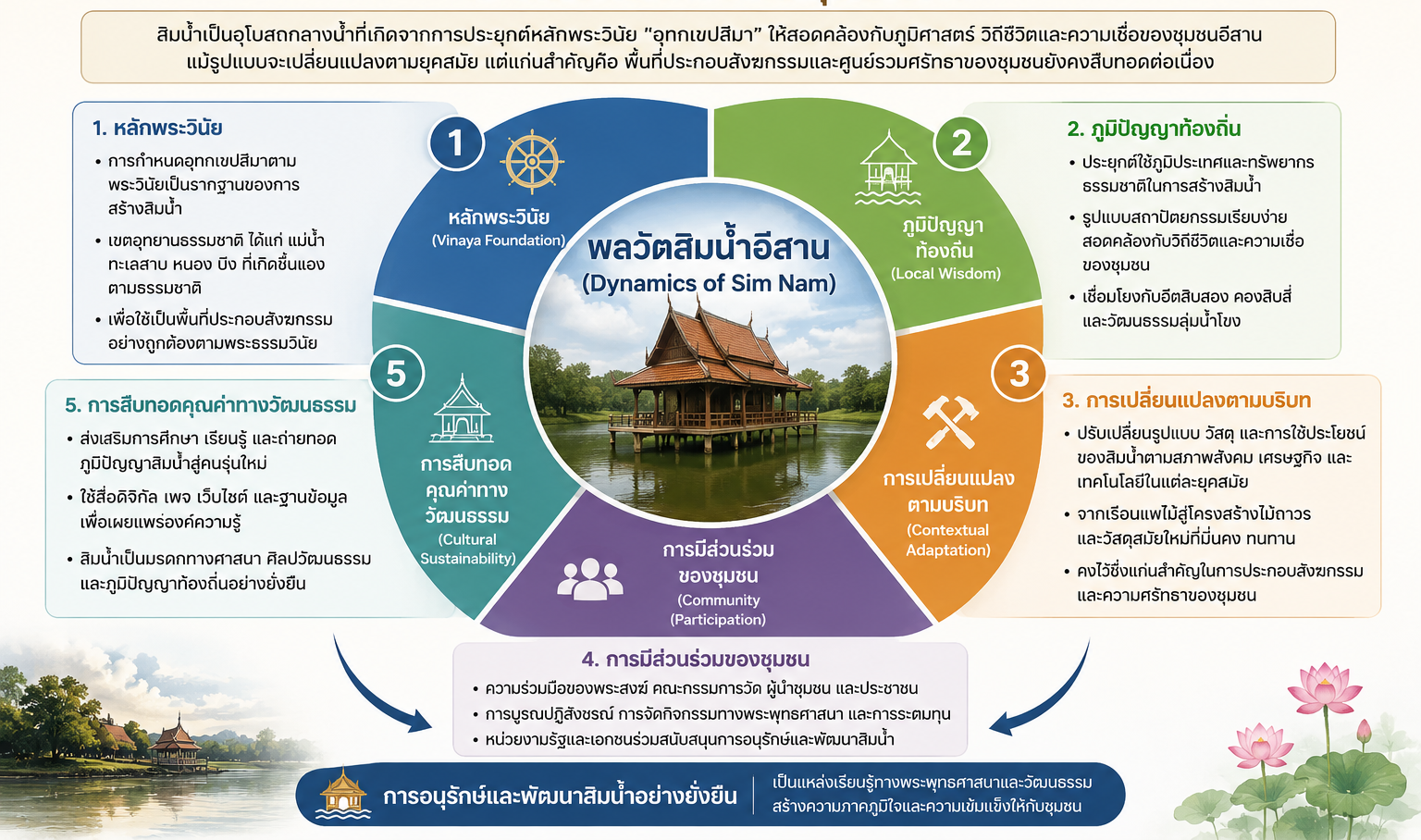
1. According to Buddhist scriptures, Sim Nam refers to a consecrated ecclesiastical boundary (Udakukkhepa Sīmā) established within a natural body of water. It is classified into three types: (1) Nadī (flowing rivers), (2) Samudda (the sea or bays), and (3) Jātasara (naturally occurring ponds, swamps, or lakes). Traditionally, Sim Nam is characterized as a simple religious structure situated in the middle of a body of water, resembling a floating pavilion.
2. The Sim Nam found in Ubon Ratchathani Province is typically constructed as a floating wooden chapel and is recognized as an important element of the province's local cultural heritage. Contemporary restoration and conservation practices integrate traditional local materials with modern construction materials, such as reinforced concrete pillars, corrugated metal roofing, and other substitute materials.
3. The dynamics of Sim Nam have evolved in response to changing social, cultural, and economic contexts. Temple committees and local communities have collaborated to conserve these structures, promote cultural activities, and disseminate information through online media to ensure that Sim Nam continues to be preserved as an ancient architectural tradition and a valuable repository of local wisdom for future generations.
Article Details

This work is licensed under a Creative Commons Attribution-NonCommercial-NoDerivatives 4.0 International License.
เพื่อให้เป็นไปตามกฎหมายลิขสิทธิ์ ผู้นิพนธ์ทุกท่านต้องลงลายมือชื่อในแบบฟอร์มใบมอบลิขสิทธิ์บทความ ให้แก่วารสารฯ พร้อมกับบทความต้นฉบับที่ได้แก้ไขครั้งสุดท้าย นอกจากนี้ ผู้นิพนธ์ทุกท่านต้องยืนยันว่าบทความ ต้นฉบับที่ส่งมาตีพิมพ์นั้น ได้ส่งมาตีพิมพ์เฉพาะในวารสาร วิชาการธรรม ทรรศน์ เพียงแห่งเดียวเท่านั้น หากมีการใช้ ภาพหรือตารางของผู้นิพนธ์อื่นที่ปรากฏในสิ่งตีพิมพ์อื่นมาแล้ว ผู้นิพนธ์ต้องขออนุญาตเจ้าของลิขสิทธิ์ก่อน พร้อมทั้ง แสดงหนังสือที่ได้รับการยินยอมต่อบรรณาธิการ ก่อนที่บทความจะได้รับการตีพิมพ์References
ฐาปกรณ์ เครือระยา. (2560). อุทกสีมา: วิวัฒนาการแพขนานสู่อุโบสถกลางนํ้าในวัฒนธรรมล้านนา. NAJUA: Architecture, Design and Built Environment, 32, A-29. retrieved from https://so04.tci-thaijo.org/index.php/NAJUA-Arch/article/view/96500
พระครูอาทรสุนทรกิจ ทม ทมจิตฺโต, พระมหาปราโมทย์ แก้วนา และวิโรจน์ คุ้มครอง. (2566). วิเคราะห์อุทกุกเขปสีมาในคัมภีร์พระพุทธศาสนาเถรวาท. วารสารนวัตกรรมการจัดการศึกษาและการวิจัย, 5(5), 1175-1184. https://so02.tci-thaijo.org/index.php/jemri/article/view/263277
พระไตรปิฎกภาษาไทย. (2539). ฉบับมหาจุฬาลงกรณราชวิทยาลัย. กรุงเทพฯ: มหาจุฬาลงกรณราชวิทยาลัย.
พระไตรปิฎกภาษาบาลี. (2535). ฉบับมหาจุฬาลงกรณราชวิทยาลัย. กรุงเทพฯ: มหาจุฬาลงกรณราชวิทยาลัย.
พระธรรมปิฎก (ป.อ.ปยุตโต). (2538). พจนานกรมพุทธธรรม ฉบับประมวลศัพท์. กรุงเทพฯ: มหาจุฬาลงกรณราชวิทยาลัย.
ไพโรจน์ สโมสร. (2530). จิตรกรรมฝาผนังอีสาน. กรุงเทพฯ: อัมรินทร์พริ้นติ้งกรุ๊ฟ.
สมคิด จิรทัศนกุล. (2547). รูปแบบพระอุโบสถและพระวิหารในสมัยพระบาทสมเด็จพระจอมเกล้าเจ้าอยู่หัว. กรุงเทพฯ: วิริยะธุรกิจ.
สมใจ นิ่มเล็ก. (2547). อุโบสถ สถาปัตยกรรมไทย. กรุงเทพฯ: เมืองโบราณ.
สุรพันธ์ สุวรรณศรี, พระมหาอํานวย มหาวีโร และเอี่ยม อามาตย์มุลตรี. (2564). สิม: ศิลปะทางวัฒนธรรมและภูมิปัญญา. วารสารพุทธปรัชญาวิวัฒน์, 5(2), 209-221. https://ojs.mbu.ac.th/index.php/jbpe/article/view/1635/1148
อนุวิทย์ เจริญศุภกุล. (2530). จุดเด่นในงานสถาปัตยกรรมอีสาน. NAJUA: Architecture, Design and Built Environment, 7, 21. https://so04.tci-thaijo.org/index.php/NAJUA-Arch/article/view/46976
