Structural Relationships Among Tourism Planning, Tourism Safety, Service Standards and Management Effectiveness: A SEM Analysis in Bueng Kan Province
Article Sidebar
Main Article Content
Abstract
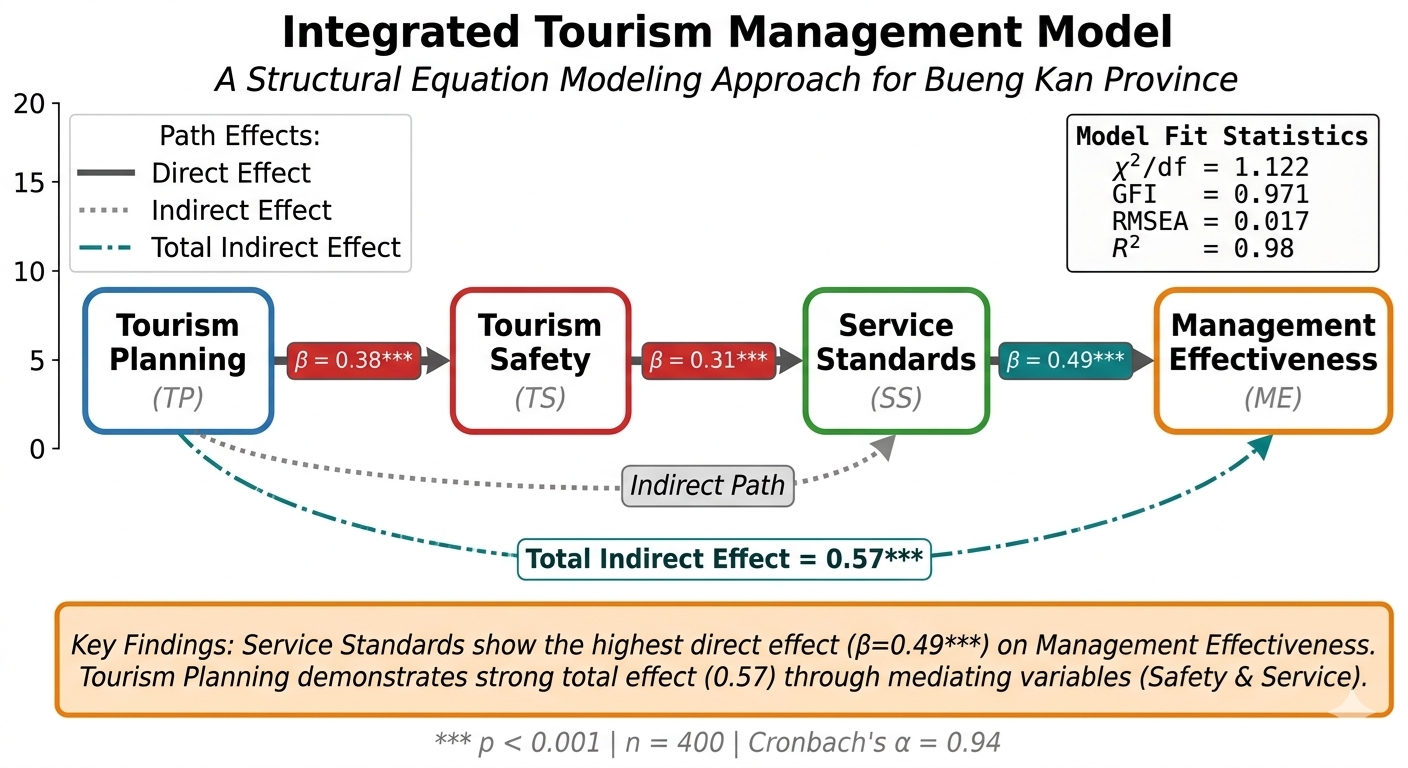
This study aims to examine the influence of tourism planning, tourism safety, and service standards on tourism management effectiveness in Bueng Kan Province, and validate the structural equation model. A quantitative survey design was employed. The sample consisted of 400 tourists selected using stratified sampling. The research instrument was a 5-point Likert-scale questionnaire with a reliability coefficient of 0.94. Data were analyzed using descriptive statistics and Structural Equation Modeling (SEM).
The research findings revealed that: service standards had the strongest direct influence on management effectiveness (β = 0.49). Meanwhile, tourism planning exerted an indirect influence on management effectiveness through safety measures and service standards, with a total effect of 0.57. The proposed model demonstrated a good fit with the empirical data (χ²/df = 1.122, GFI = 0.971, RMSEA = 0.017) and was able to explain 98% of the variance in management effectiveness. These findings indicate that sustainable tourism development requires the systematic integration of proactive tourism planning, safety management systems, and service standards in order to enhance management effectiveness and support long-term tourism sustainability.
Article Details

This work is licensed under a Creative Commons Attribution-NonCommercial-NoDerivatives 4.0 International License.
เพื่อให้เป็นไปตามกฎหมายลิขสิทธิ์ ผู้นิพนธ์ทุกท่านต้องลงลายมือชื่อในแบบฟอร์มใบมอบลิขสิทธิ์บทความ ให้แก่วารสารฯ พร้อมกับบทความต้นฉบับที่ได้แก้ไขครั้งสุดท้าย นอกจากนี้ ผู้นิพนธ์ทุกท่านต้องยืนยันว่าบทความ ต้นฉบับที่ส่งมาตีพิมพ์นั้น ได้ส่งมาตีพิมพ์เฉพาะในวารสาร วิชาการธรรม ทรรศน์ เพียงแห่งเดียวเท่านั้น หากมีการใช้ ภาพหรือตารางของผู้นิพนธ์อื่นที่ปรากฏในสิ่งตีพิมพ์อื่นมาแล้ว ผู้นิพนธ์ต้องขออนุญาตเจ้าของลิขสิทธิ์ก่อน พร้อมทั้ง แสดงหนังสือที่ได้รับการยินยอมต่อบรรณาธิการ ก่อนที่บทความจะได้รับการตีพิมพ์References
กระทรวงการท่องเที่ยวและกีฬา. (2558). ยุทธศาสตร์การท่องเที่ยวไทย พ.ศ. 2558-2560. กรุงเทพฯ: กระทรวงการท่องเที่ยวและกีฬา.
วลัยพร สกุลพอง. (2551). พฤติกรรมการจัดการขยะมูลฝอยของประชาชนในเขตเทศบาลเมืองมาบตาพุดจังหวัดระยอง. (ปัญหาพิเศษรัฐประศาสนศาสตรมหาบัณฑิต). ชลบุรี: วิทยาลัยการบริหารรัฐกิจ มหาวิทยาลัยบูรพา.
Diamantopoulos, A., & Siguaw, J. A. (2000). Introducing LISREL: A guide for the uninitiated. London: Sage Publications.
Doswell, R. (1997). Tourism: How effective management makes the difference. Oxford, England: Butterworth-Heinemann.
George, R., & Booyens, I. (2014). Township tourism demand: Tourists’ perceptions of safety and security. Urban Forum, 25(4), 449-467.
Hooper, D., Coughlan, J., & Mullen, M. (2008). Structural equation modelling: Guidelines for determining model fit. Electronic Journal of Business Research Methods, 6(1), 53-60.
MacCallum, Robert C., Browne, M. W., & Sugawara, H. M. (1996). Power analysis and determination of sample size for covariance structure modeling. Psychological Methods, 1(2), 130-149.
Schumacker, R. E., & Lomax, R. G. (2010). A beginner's guide to structural equation modeling. (3rd ed.). New York: Routledge.
World Tourism Organization. (2021). Tourism for a Sustainable Future. Madrid: UNWTO.
Yamane, T. (1967). Statistics: An introductory analysis. (2nd ed.). New York: Harper and Row.
Zhou, Y., & Ap, J. (2009). Gap between tourism planning and implementation: A case of China. Tourism Management Perspectives, 29(3), 123-135.
