Developing a Learning Model to Enhance Data Analyst Competencies Based on Professional Qualification Standards
Article Sidebar
Main Article Content
Abstract
The purposes of this study were to 1) develop of a learning model to enhance the competencies of data analyst in according with professional qualification standards, 2) develop a competency-based curriculum structure for data analysts, and 3) examine the results of implementing the develop learning model. This study employed a mixed methods research design. The population consisted of 235 undergraduate students. The sample group comprised 26 second-year students majoring in Information Technology, Faculty of Social Technology, Rajamangala University of Technology Tawan-ok, who voluntarily participated in the experimental phase and were selected through purposive sampling. The research instruments included a questionnaire, an achievement test, and competency assessment form (with a reliability coefficient of 0.89). The data were analyzed using percentage, mean, standard deviation, and the Wilcoxon Signed-Rank Test as a non-parametric statistic. The data analysis employed both descriptive and inductive methods.
The results of the research found that:
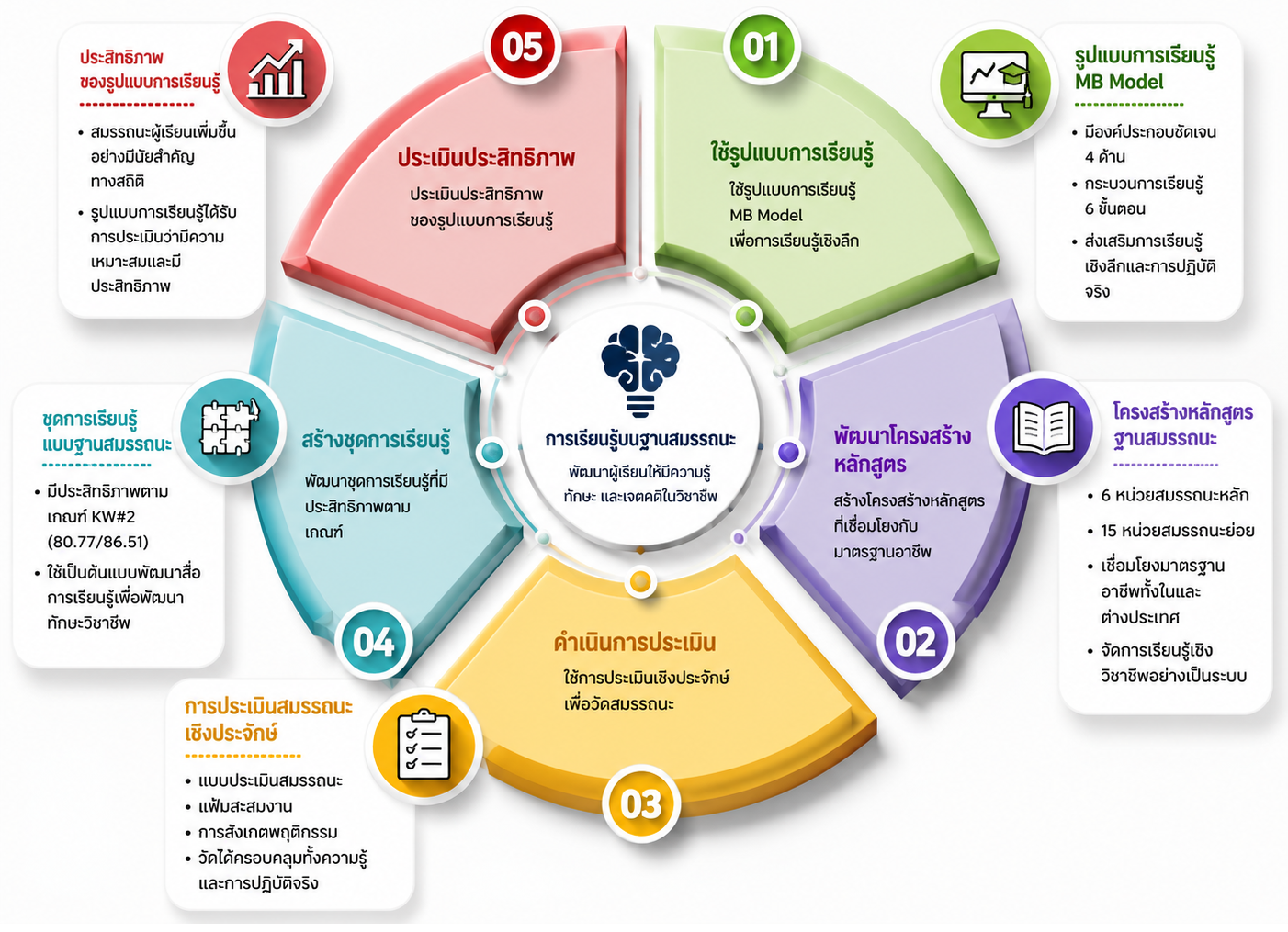
1. The MB Model learning framework, based on competency-based learning, was developed. It consisted of four components: 1) Input, 2) Process, 3) Output, and 4) Feedback. The learning process comprised six instructional steps: goals setting, stimulating interest, knowledge sharing, creative production, presentation, and evaluation. Additionally, the professional standards for data analysts were developed base on the qualifications framework from Thailand’s Professional Qualification Instituted and six international standards.
2. A competency-base curriculum structure was created, comprising six core competency units and fifteen sub-units. Each unit included defined learning outcomes, content, learning activities, and assessment evidence.
3. The implementation of the model demonstrated that the learning package achieved and effectiveness index of 80.77/86.51 according to the KW#2 criteria. Students’ post-learning competency scores were significantly higher than their pre-learning scores at the .05 level. Furthermore, the learning model was evaluated by expert as being effective and appropriate for enhancing data analyst competencies.
Article Details

This work is licensed under a Creative Commons Attribution-NonCommercial-NoDerivatives 4.0 International License.
เพื่อให้เป็นไปตามกฎหมายลิขสิทธิ์ ผู้นิพนธ์ทุกท่านต้องลงลายมือชื่อในแบบฟอร์มใบมอบลิขสิทธิ์บทความ ให้แก่วารสารฯ พร้อมกับบทความต้นฉบับที่ได้แก้ไขครั้งสุดท้าย นอกจากนี้ ผู้นิพนธ์ทุกท่านต้องยืนยันว่าบทความ ต้นฉบับที่ส่งมาตีพิมพ์นั้น ได้ส่งมาตีพิมพ์เฉพาะในวารสาร วิชาการธรรม ทรรศน์ เพียงแห่งเดียวเท่านั้น หากมีการใช้ ภาพหรือตารางของผู้นิพนธ์อื่นที่ปรากฏในสิ่งตีพิมพ์อื่นมาแล้ว ผู้นิพนธ์ต้องขออนุญาตเจ้าของลิขสิทธิ์ก่อน พร้อมทั้ง แสดงหนังสือที่ได้รับการยินยอมต่อบรรณาธิการ ก่อนที่บทความจะได้รับการตีพิมพ์References
กฤษมันต์ วัฒนาณรงค์. (2562). การพัฒนาหลักสูตรฐานสมรรถนะ. กรุงเทพฯ: มหาวิทยาลัยเทคโนโลยีพระจอมเกล้าพระนครเหนือ.
สถาบันคุณวุฒิวิชาชีพ (องค์การมหาชน). (2567). หน่วยสมรรถนะด้านการประมวลผล วิเคราะห์ และสังเคราะห์ข้อมูลด้วยสถิติที่ใช้ในการวิเคราะห์ข้อมูล. เข้าถึงได้จาก https://tpqi-net.tpqi.go.th
Borg, W. R., & Gall, M. D. (2003). Educational Research: An Introduction. (7th ed.). Boston, MA: Allyn and Bacon.
Cedefop. (2020). Vocational Education and Training in Europe 1995-2035: Scenarios for European Vocational Education and Training. Luxembourg: Publications Office of the European Union.
Dick, W., Carey, L., & Carey, J. O. (2020). The systematic design of instruction. (8th ed.). New York: Pearson Education. 5.
Hmelo-Silver, C. E. (2004). Problem-based learning: What and how do students learn? Educational Psychology Review, 16(3), 235266. https://doi.org/10.1023/B:EDPR.0000034022.16470.f3
Kirkpatrick, D. L., & Kirkpatrick, J. D. (2006). Evaluating Training Programs: The Four Levels. (3rd ed.). San Francisco, CA: Berrett-Koehler Publishers.
Mulder, M. (2014). Conceptions of professional competence. In S. Billett, C. Harteis, & H. Gruber (Eds.), International handbook of research in professional and practice-based learning (pp. 107-137). Dordrecht, The Netherlands: Springer.
Spencer, L. M., & Spencer, S. M. (1993). Competence at Work: Models for Superior Performance. New York, NY: John Wiley & Sons.
World Economic Forum. (2023). The Future of Jobs Report 2023. Geneva, Switzerland: World Economic Forum.
