The Development of English Vocabulary Learning Ability and Retention through Game-Based Learning for Matthayomsuksa 1 Students
Article Sidebar
Main Article Content
Abstract
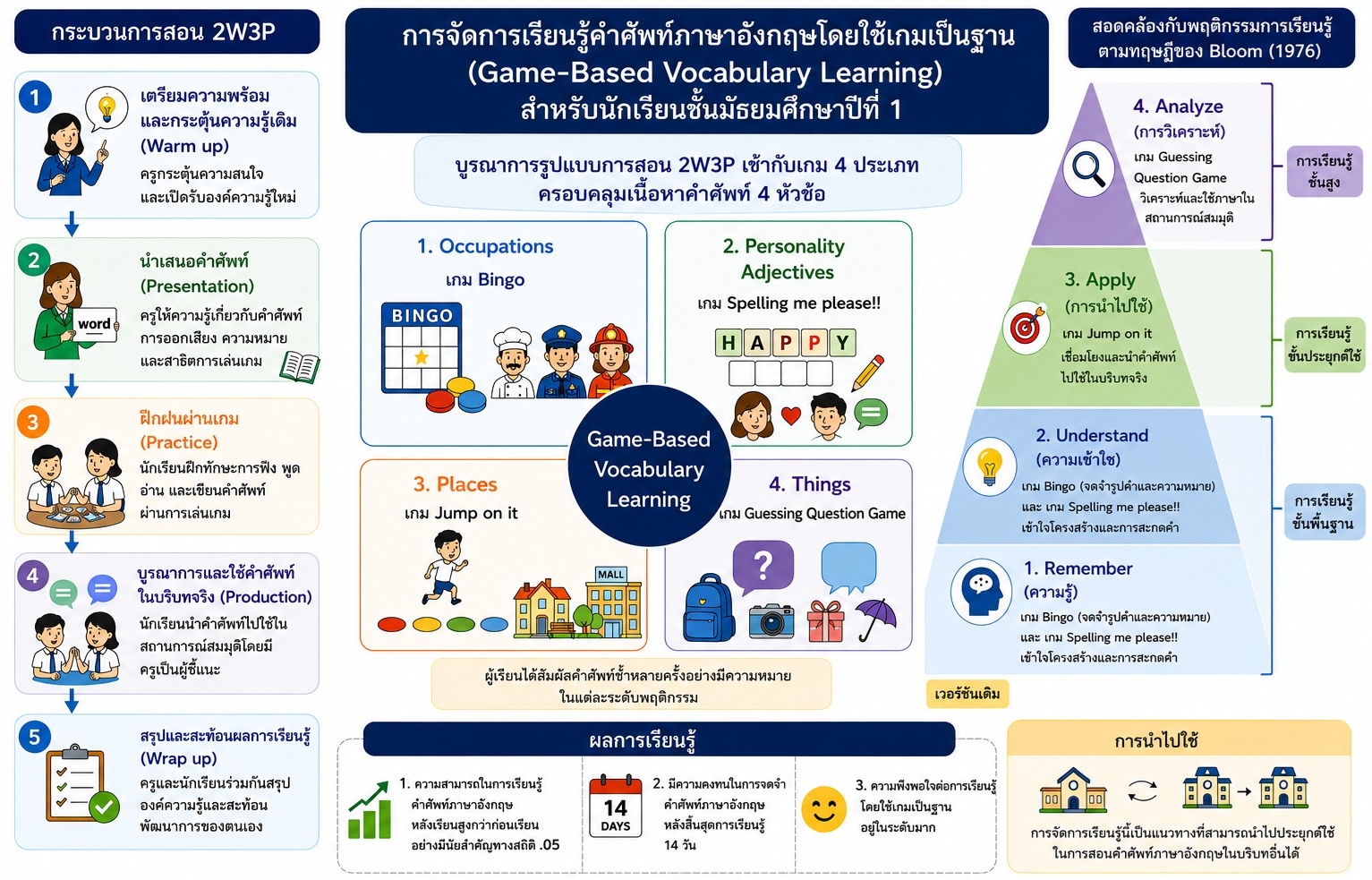
This research aimed to 1) investigate the effectiveness index of English vocabulary learning among students; 2) compare the English vocabulary learning ability of the students before and after being taught through game-based learning; 3) investigate the retention of English vocabulary among the students after instruction through games; and 4) investigate the students’ satisfaction with learning English vocabulary through game-based instruction. The sample consisted of 32 students from Matthayomsuksa 1/2 at Wat Thammanawa School, in Bang Pa-In District, Phra Nakhon Si Ayutthaya Province, during in the first semester of the 2024 academic year. The participants were selected using cluster random sampling. The experimental period lasted for twelve lessons. The research instruments included 1) game-based lesson plans, 2) a 40-question English vocabulary learning ability test with a reliability coefficient of 0.71, 3) a vocabulary retention test that has a reliability of 0.76., and 4) a satisfaction questionnaire regarding game-based vocabulary instruction. The data were analyzed using mean, standard deviation, effectiveness index (E.I.), and the dependent- sample t-test.
The results revealed that:
1. The effectiveness index (E.I.) of the game-based vocabulary instruction was 0.63, indicating a 63% improvement in students’ vocabulary knowledge.
2. The post-test scores after game-based learning were significantly higher than the pre-test scores at the .05 level.
3. There was no statistically significant difference between the immediate post-test scores and the delayed post-test scores (14 days later), indicating vocabulary retention.
4. The students reported a high level of satisfaction with learning English vocabulary through games.
Article Details

This work is licensed under a Creative Commons Attribution-NonCommercial-NoDerivatives 4.0 International License.
เพื่อให้เป็นไปตามกฎหมายลิขสิทธิ์ ผู้นิพนธ์ทุกท่านต้องลงลายมือชื่อในแบบฟอร์มใบมอบลิขสิทธิ์บทความ ให้แก่วารสารฯ พร้อมกับบทความต้นฉบับที่ได้แก้ไขครั้งสุดท้าย นอกจากนี้ ผู้นิพนธ์ทุกท่านต้องยืนยันว่าบทความ ต้นฉบับที่ส่งมาตีพิมพ์นั้น ได้ส่งมาตีพิมพ์เฉพาะในวารสาร วิชาการธรรม ทรรศน์ เพียงแห่งเดียวเท่านั้น หากมีการใช้ ภาพหรือตารางของผู้นิพนธ์อื่นที่ปรากฏในสิ่งตีพิมพ์อื่นมาแล้ว ผู้นิพนธ์ต้องขออนุญาตเจ้าของลิขสิทธิ์ก่อน พร้อมทั้ง แสดงหนังสือที่ได้รับการยินยอมต่อบรรณาธิการ ก่อนที่บทความจะได้รับการตีพิมพ์References
กนกวรรณ รอดคุ้ม, ศิตา เยี่ยมขันติถาวร และอารีรักษ์ มีแจ้ง. (2559). ผลการใช้เกมที่มีต่อการเรียนรู้และความคงทนในการเรียนรู้คำศัพท์ภาษาอังกฤษของนักเรียนชั้นประถมศึกษาปีที่ 5. วารสารบัณฑิตศึกษามหาวิทยาลัยราชภัฏวไลยอลงกรณ์, 10(2), 110-121.
กนชัย แจนโกนดี. (2565). การพัฒนาความรู้ด้านคำศัพท์ภาษาอังกฤษโดยใช้เกมบิงโกคำศัพท์ของนักเรียนชั้นประถมศึกษาปีที่ 2 ปีการศึกษา 2565 โรงเรียนวัดบ้านโป่ง สามัคคีคุณูปถัมภ์. กรุงเทพฯ: สำนักงานคณะกรรมการส่งเสริมการศึกษาเอกชน.
ปิยมน คำชมภู, อนงค์ศิริ วิชาลัย และศรีทัย สุขยศศรี. (2565). ประสิทธิผลของการใช้เพลงและเกมเพื่อพัฒนาทักษะการฟังกลุ่มสาระการเรียนรู้ภาษาอังกฤษสำหรับนักเรียนชั้นประถมศึกษาปีที่ 2 โรงเรียนสันป่าตอง เทศบาลตำบลยุหว่า 1. วารสารปัญญา, 29(2), 1-11.
ยุวดี เปรมวิชัย. (2552). การประเมินประสิทธิภาพของบทเรียน E-learning. วารสารโรงเรียนนายเรือ, 9(1), 1-11.
สถาบันทดสอบทางการศึกษาแห่งชาติ (องค์การมหาชน). (2567). ค่าสถิติพื้นฐานผลการทดสอบทางการศึกษาระดับชาติขั้นพื้นฐาน (O-NET) ชั้นมัธยมศึกษาปีที่ 3 ปีการศึกษา 2566. เข้าถึงได้จาก https://www.niets.or.th
สุมิตรา อังวัฒนกุล. (2537). วิธีสอนภาษาอังกฤษ. กรุงเทพฯ: จุฬาลงกรณ์มหาวิทยาลัย.
สุวิทย์ มูลคำ และอรทัย มูลคำ. (2550). 19 วิธีจัดการเรียนรู้เพื่อพัฒนาความรู้และทักษะ. กรุงเทพฯ: ภาพพิมพ์.
สำเนา ศรีประมงค์. (2547). การศึกษาผลการใช้เกมคำศัพท์ประกอบการสอนที่มีต่อความคงทนในการเรียนรู้คำศัพท์ภาษาอังกฤษของนักเรียนชั้นประถมศึกษาปีที่ 5 โรงเรียนอัสสัมชัญระยอง. (วิทยานิพนธ์ศิลปศาสตรมหาบัณฑิต). กรุงเทพฯ: มหาวิทยาลัยศรีนครินทรวิโรฒ.
อาภรณ์ศิริ พลรักษา. (2561). การพัฒนาความสามารถในการเรียนรู้คำศัพท์ภาษาอังกฤษโดยใช้เกมสำหรับนักเรียนชั้นประถมศึกษาปีที่ 4 โรงเรียนชุมชนเชียงใหม่พัฒนา อำเภอโพธิ์ชัย จังหวัดร้อยเอ็ด. (วิทยานิพนธ์ศิลปศาสตรมหาบัณฑิต). มหาสารคาม: มหาวิทยาลัยราชภัฏมหาสารคาม.
Arsita, D., Sain, Y., & Nasrullah, R. (2025). Students perception towards traditional game in improving students’ motivation in English language learning. Journal of English Language and Education, 10(5), 410-421. https://doi.org/10.31004/jele.v10i5.1406
Arwandi, A. W., Syarif, H., & Ardi, H. (2019). Improving students’ vocabulary through word games at grade VI of SDS Setia Padang. In H. Heldi (Ed.), Advances in Social Science, Education and Humanities Research (pp. 183-186). Proceedings of the Eighth International Conference on Languages and Arts (ICLA 2019), Padang, Indonesia. Paris, France: Atlantis Press.
Bloom, B. S. (1976). Human characteristics and school learning. New York, NY: McGraw-Hill.
Bui, T. N. (2023). A study on effectiveness of using games in learning English vocabulary. South Asian Research Journal of Arts, Language and Literature, 5(3), 53-63. https://doi.org/10.36346/sarjall.2023.v05i03.001
Chowdhury, M., Dixon, L. Q., Kuo, L. J., Donaldson, J. P., Eslami, Z., Viruru, R., & Luo, W. (2024). Digital game-based language learning for vocabulary development. Computers and Education Open, 6, 100160. https://doi.org/10.1016/j.caeo.2024.100160
Gee, J. P. (2003). What video games have to teach us about learning and literacy. New York, NY: Palgrave Macmillan.
Goodman, R. I., Fletcher, K. A., & Schneider, E. W. (1980). The effectiveness index as a comparative measure in media product evaluation. Educational Technology, 20(9), 30-40.
Huang, W. D. (2011). Evaluating game-based learning approaches in education: The effects on vocabulary retention and engagement. Educational Technology & Society, 14(2), 150-161.
Kapp, K. M. (2012). The gamification of learning and instruction: Game-based methods and strategies for training and education. San Francisco, CA: Pfeiffer.
Plass, J. L., Homer, B. D., & Kinzer, C. K. (2015). Foundations of game-based learning. Educational Psychologist, 50(4), 258-283. https://doi.org/10.1080/00461520.2015.1122533
